
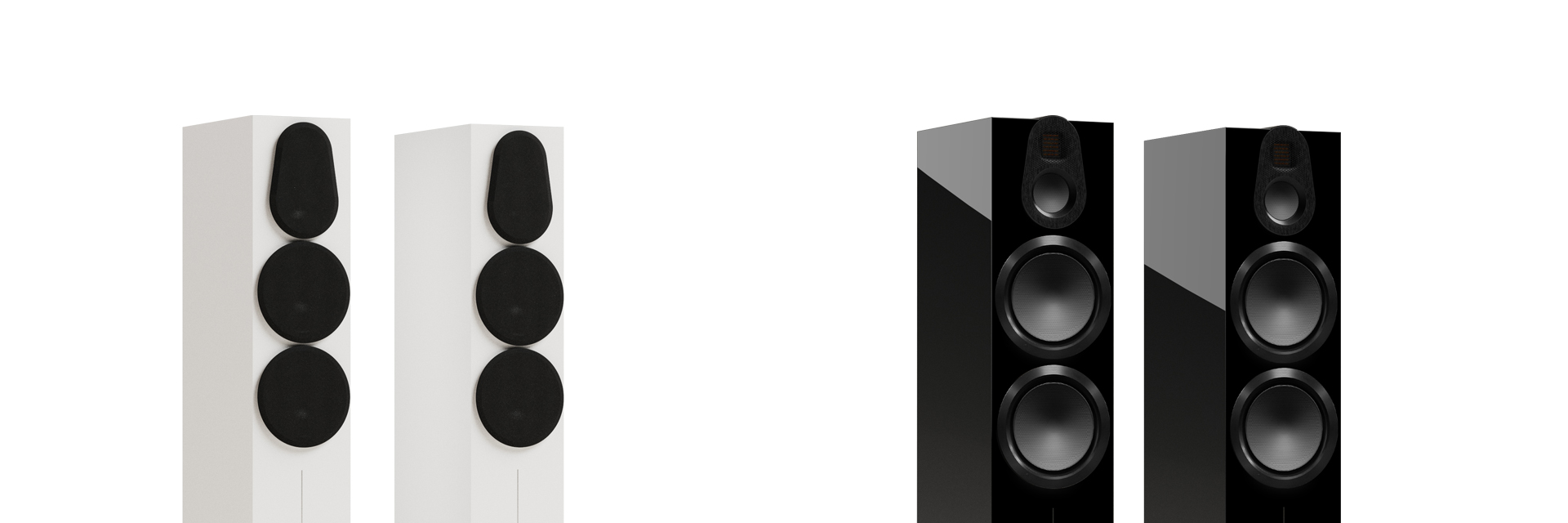
Noisy marketing may work, but it’s not Monitor Audio’s style. With the Gold 300 6G and 500 6G, the Brits have – as usual – rolled elegantly understated speaker boxes into our listening room. Also as usual, there’s far more behind the discreet façade than meets the eye.
Rock stars know how it’s done. Ever since “Eruption,” everyone understood that Eddie Van Halen could melt faces with his breakneck solos; yet in later years, the guitar legend held back on the wild tapping orgies, shifting toward more lyrical, melodic solos – like in “Not Enough” – that served the music rather than pure showmanship. “I don’t want to repeat myself,” he said – and fans understood. After all, he didn’t have anything to prove anymore.
For five decades, Monitor Audio has quietly built speakers that were both technically excellent and visually restrained – always respected, rarely show-stoppers. When Michael Hedges took over engineering in 2018, the second half of that sentence must have bothered him quite a bit. His first order of business, apparently, was to rip a page straight out of Van Halen’s playbook and slap the amazed crowd at High End 2022 – right on time for the company’s 50th anniversary – with a high-tech eruption: the Concept 50. Loud, flashy, attention-grabbing – a full-on demonstration of power that made it crystal clear that Monitor Audio does far more than bolt standard drivers into boxy cabinets. And to dispel any doubt that this technical wizardry could also make it into production, the Concept 50 entered the official catalog – largely unchanged – under its new name, Hyphn.
Once the point had been made, they returned to building speakers that are every bit as technically excellent as they are visually understated – now confident in the knowledge that the audience will understand.
Misconception No. 1: Consistency = Stagnation
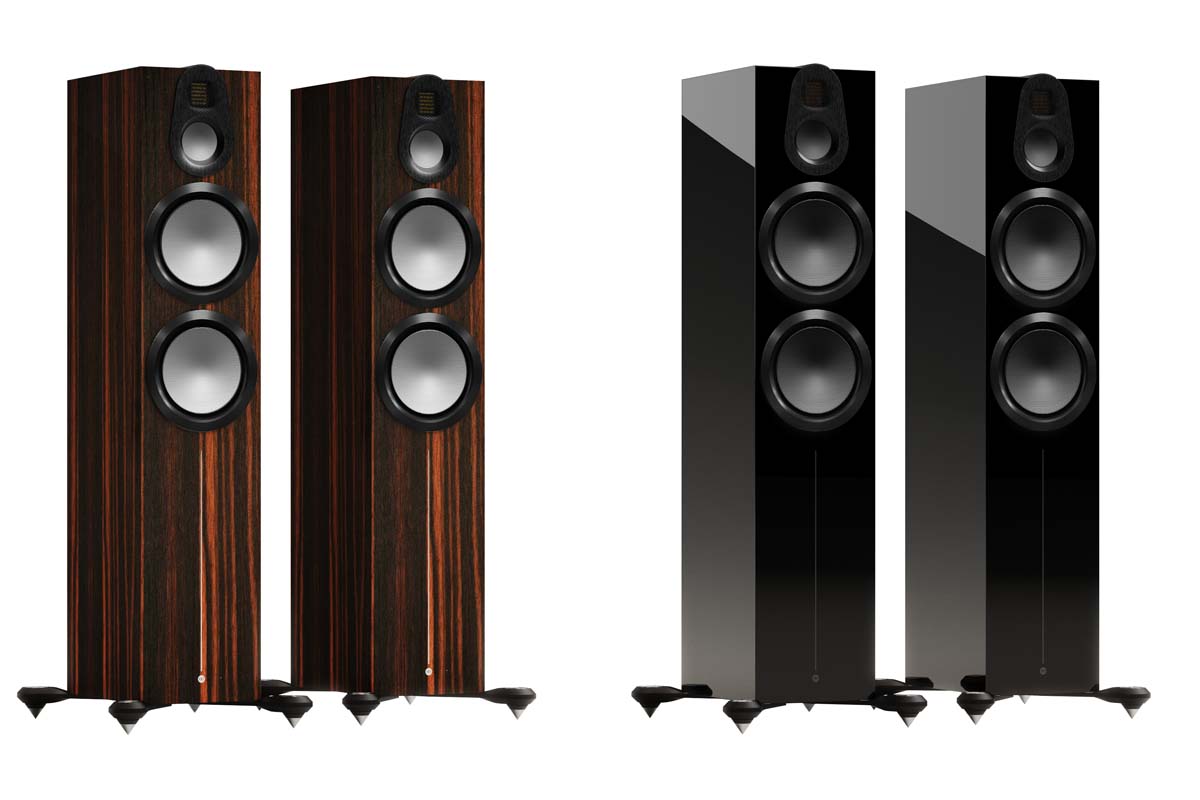
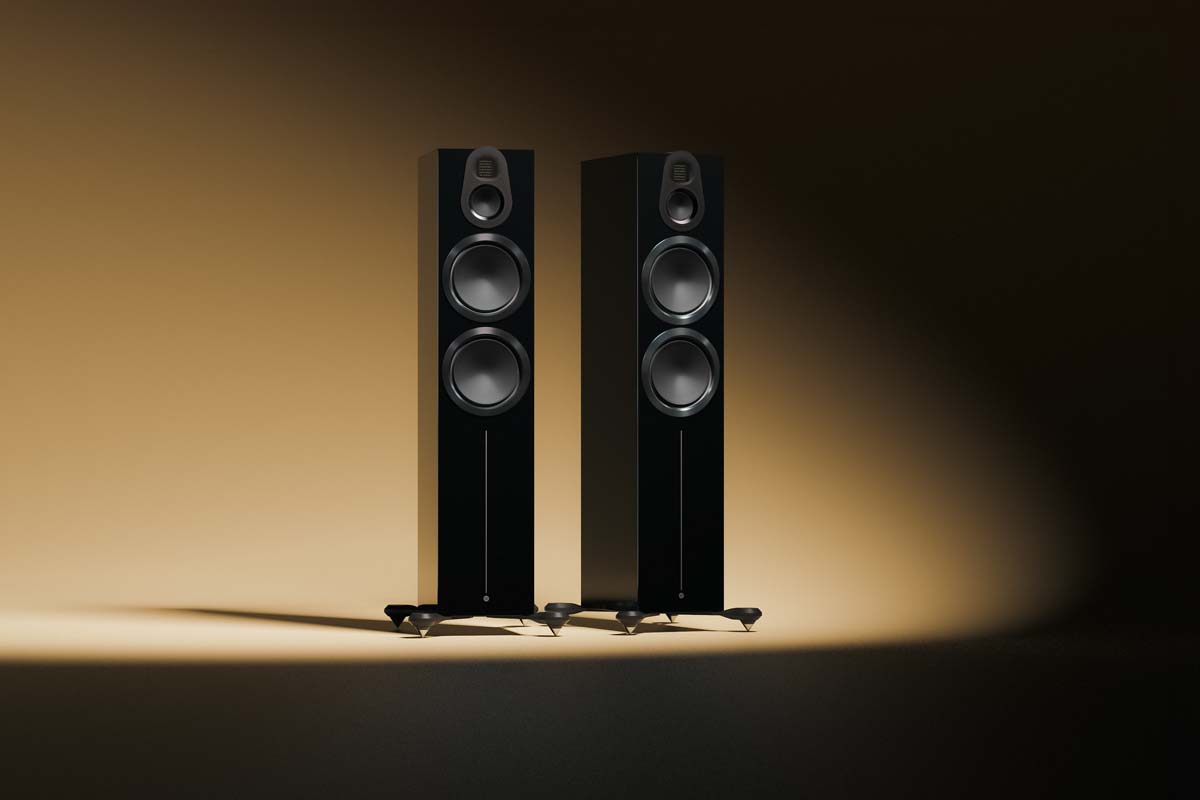
This prologue seemed necessary because unpacking the boxes reveals MDF cuboids of absolutely standard industry dimensions with fairly conventional-looking drivers – something that could easily mislead the uninitiated. But we now know better: these medium-sized floorstanders must be wolves in sheep’s clothing. At Monitor Audio, “straightforward” never means “plain,” and “conventional” never means “simple.” The veneers look refined, and the machined aluminum rings around the drivers add a premium, elegant touch.
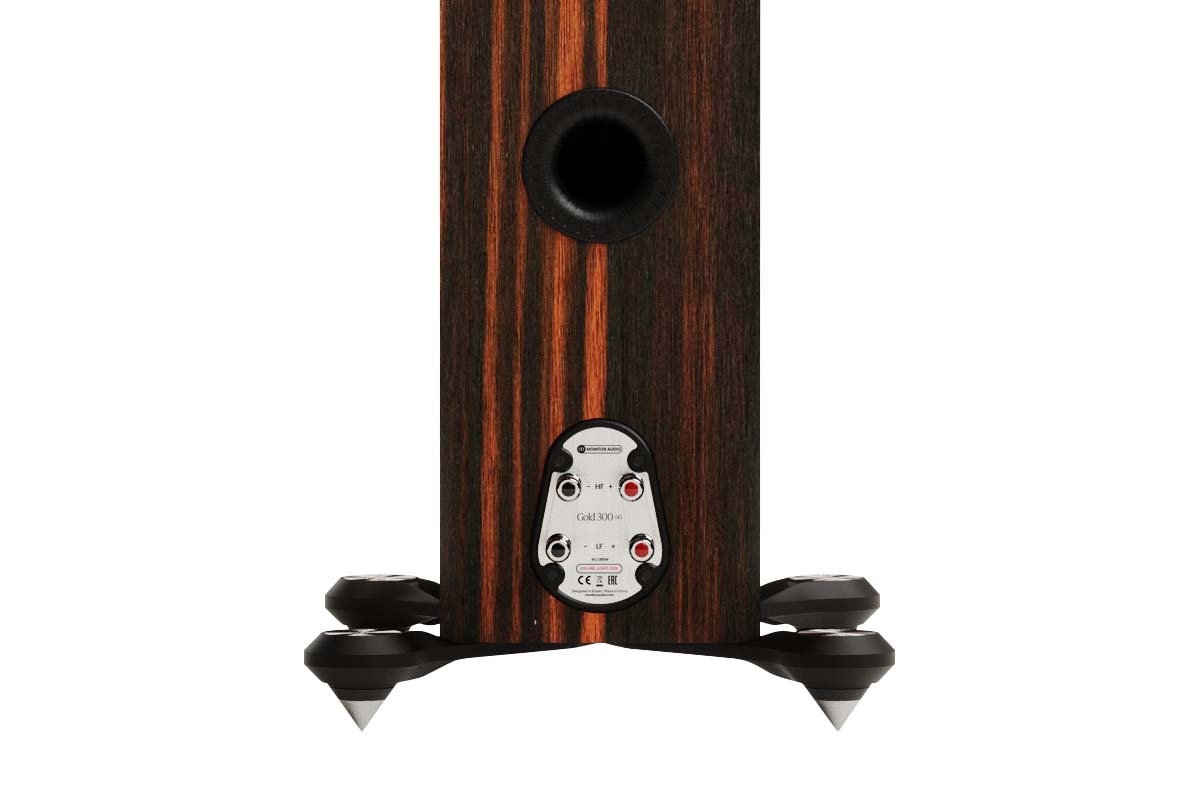
What you don’t see (or only barely) is the abundance of clever, unusual technical solutions inside: the hex-patterned driver diaphragms are made from a ceramic-coated aluminum-magnesium alloy and are often heavily redesigned from one generation to the next. The drivers aren’t screwed in at the basket rim but mounted via a central through-bolt that runs the depth of the cabinet, tensioning the structure and stiffening the entire assembly. Even the way the speakers couple to the floor is more sophisticated than it appears: the outrigger feet attach to a steel plate that is isolated from the cabinet by a neoprene-like damping pad. None of this calls attention to itself; everything stays tastefully in the background and serves the music, not the show.
Misconception No. 2: Gold = Stripped-Down Platinum
“Trickle-down” is a proven concept because it makes sense: new technologies start in the high-end segment, where higher prices can absorb development costs. Once those costs are recovered, the innovations – sometimes in slimmed-down form – become available to a wider market.
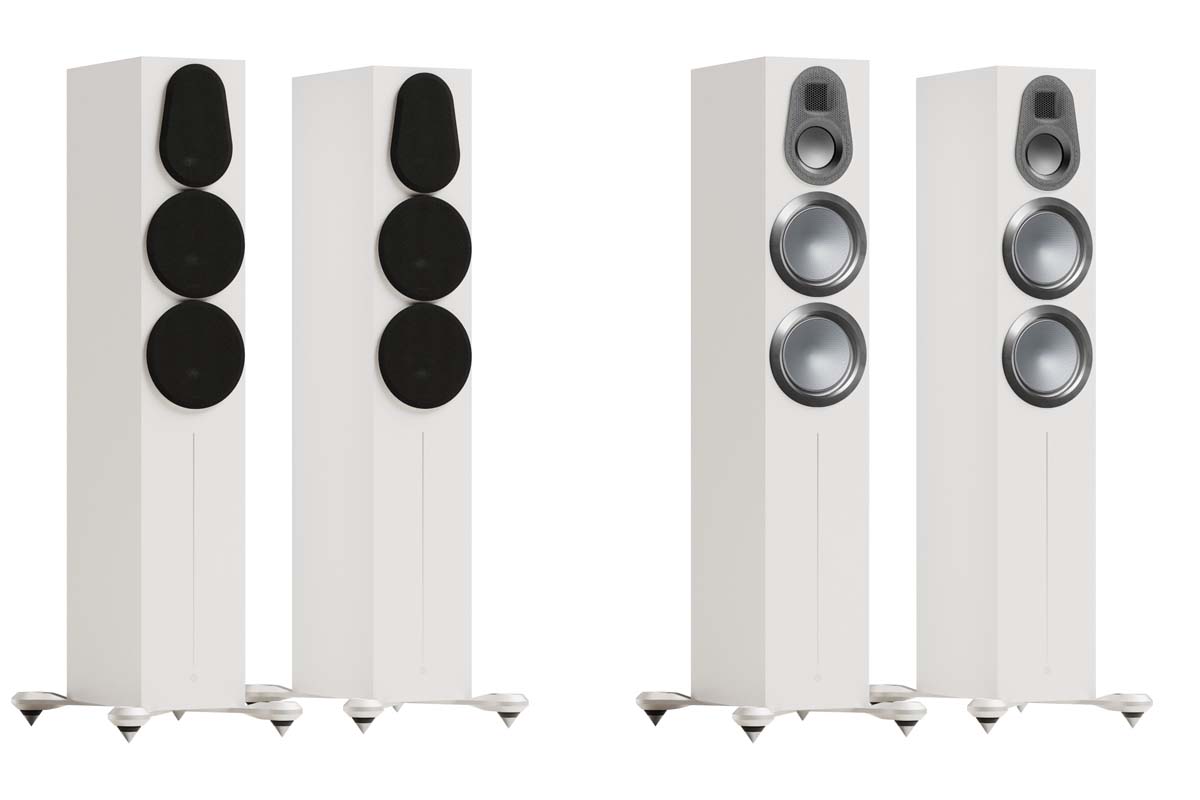
Although Monitor Audio did incorporate ideas and insights from the Hyphn and Platinum series into the Gold line, the cone drivers are actually completely new designs. Instead of looking where they could cut corners compared to the top models, they drew from their deep technology pool – built over decades – to assemble the optimal set of ingredients for this price class.
Where higher-end parts were borrowed, they were adopted essentially unchanged: the AMT tweeter, for instance, is the same one used in the brand’s flagships. Unlike its predecessor’s rectangular unit, the new one is square, promoting more even vertical dispersion.
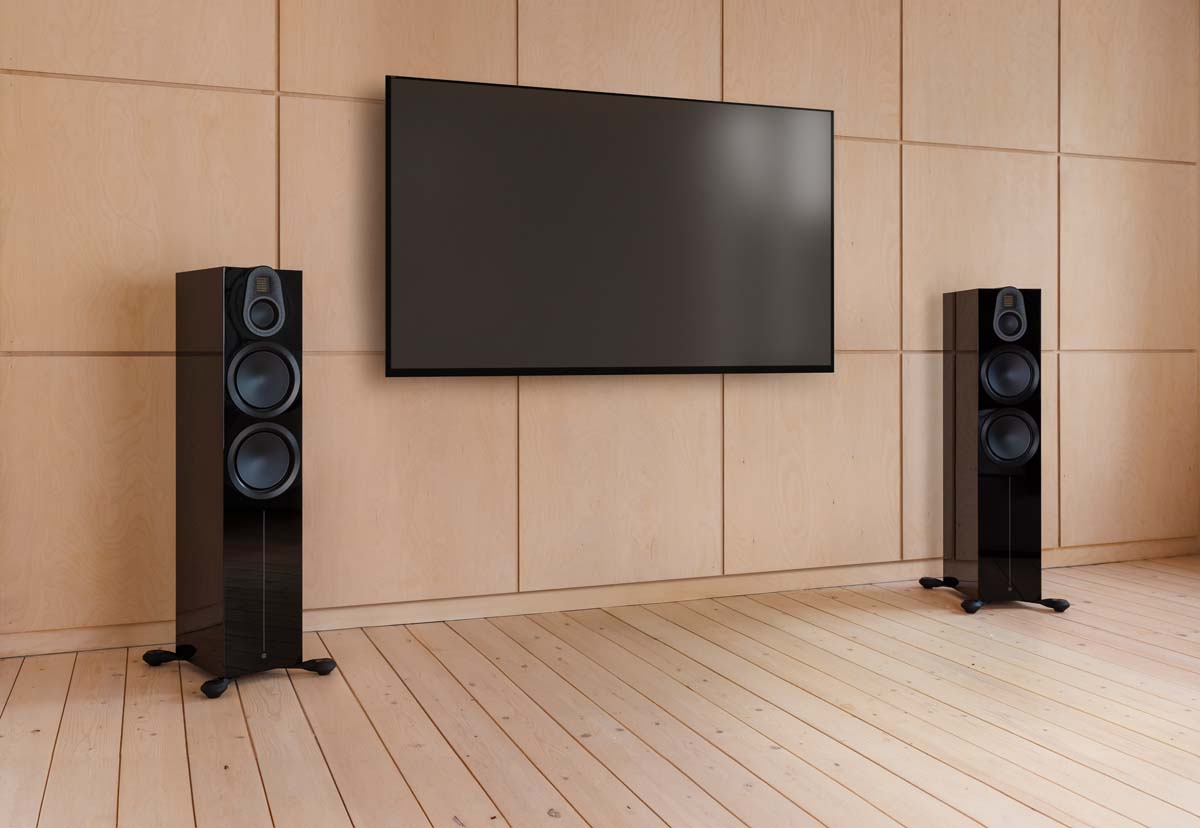
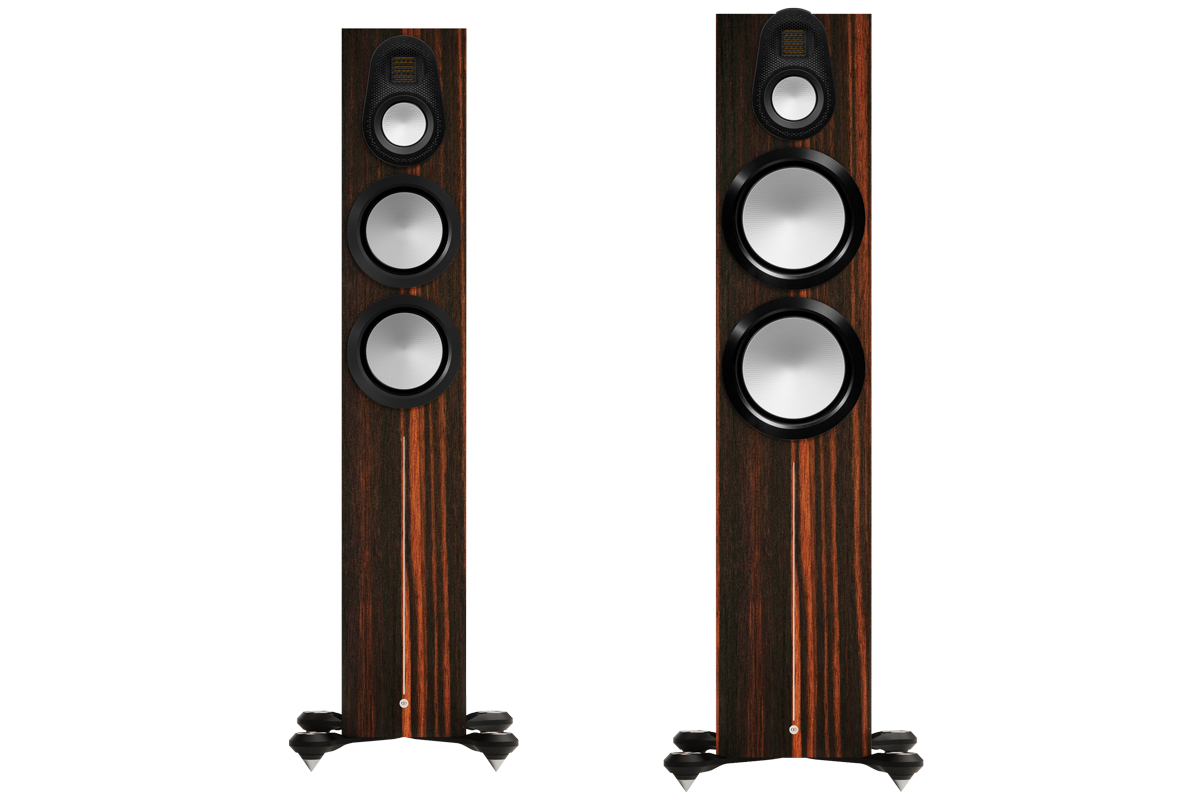
Speaking of dispersion: this raises the question why we’re looking at not one, but two similarly sized models in the same series. Jens Ragenow from the German distributor pointed out a subtle but important difference before delivery: the larger model differs not only in cabinet volume and woofer size (8″ instead of 6″), but also in the aluminum “gummy bear” that frames the midrange and tweeter. On the 500, this assembly isn’t flush with the upper cabinet edge; instead, it breaks the line and rises into a ridge on the top panel.
The practical benefit was obvious to me immediately: the “sight line” made toe-in a breeze. But Michael Hedges had something else in mind – he wanted to tame edge diffraction. This occurs at wavelengths corresponding to the distance between tweeter and cabinet edge and creates time-delayed interference that can smear timing and phase relationships, preventing the soundstage from detaching cleanly from the speaker.
By elevating the tweeter, this distance varies dramatically – from nearly zero (upwards) to half the cabinet width (sideways), and even to wavelengths beyond the operating range. As a result, the unwanted reflections spread out across a wide frequency band and become far less noticeable. Because the 300 also has a relatively high tweeter placement, it benefits somewhat – but the full effect, including the sculpted top surface, is reserved for the larger and pricier 500.
All new Gold models were also designed as easy electrical loads without wild impedance swings. The modest sensitivity may not reflect this, but the minimum impedance of about 4 ohms – matching the nominal rating – certainly does.
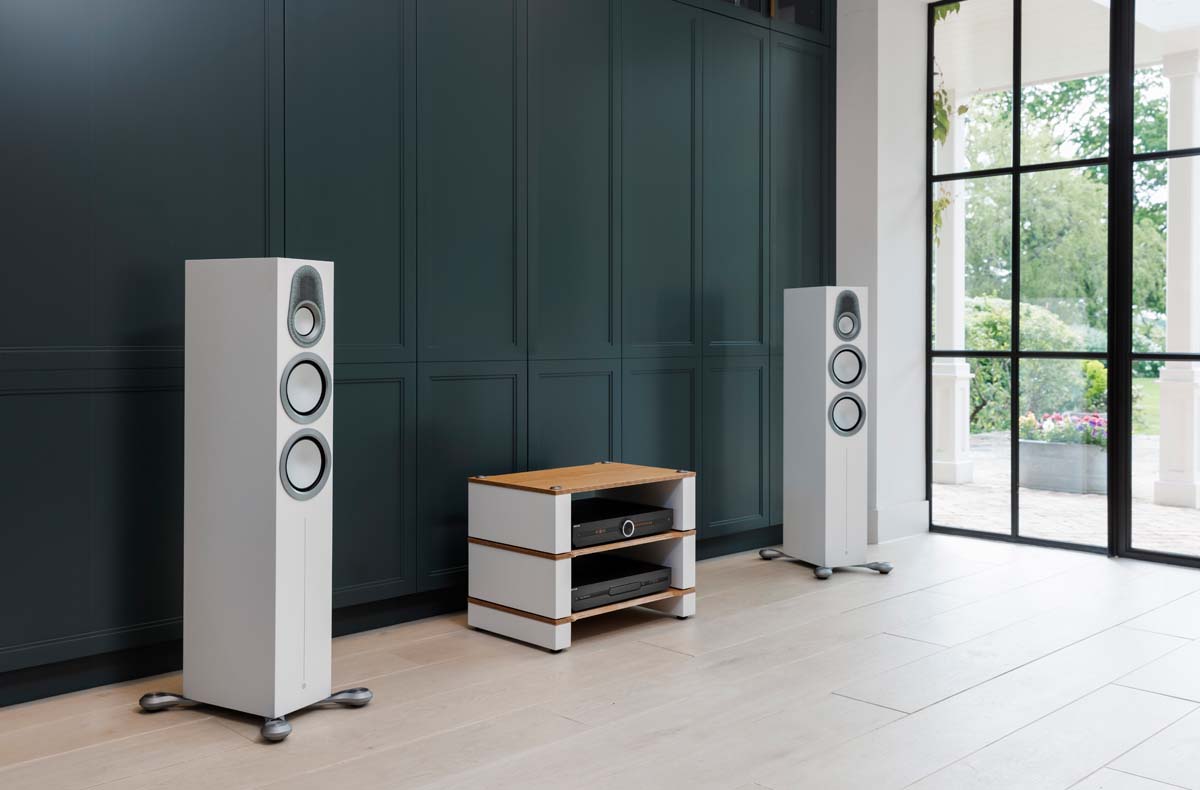
On that note, I have to praise the refreshingly honest specs: the –6 dB low-end figure of 44 Hz for the 500 would, in today’s marketing world, sound like it belonged to a bookshelf speaker – but here it’s simply a more believable number. Time to head into the listening room and find out what’s really in them. They do need a bit of work before they shine: even the larger model shouldn’t sit too far from the wall, and some experimentation with spacing and toe-in works wonders for locking in the center image.
Misconception No. 3: Tame Looks = Tame Sound
Granted: up until a couple of years ago, this assumption wouldn’t have been entirely correct. Monitor Audio was known for a cozy, warm, sometimes perhaps overly relaxed sound. That changed dramatically under Hedges’ leadership, as we’ve confirmed more than once in our listening room – and the Gold 300 is no exception. Despite its decent amount of diaphragm area, its bass is, if anything, on the leaner side; it plays crisp, tight, and explosively dynamic when the recording calls for it.
“Blue Monday” by New Order – with its characteristically thin ’80s production – won’t tell you much about deep bass extension, but its punchy kick drum is very revealing in terms of transient response. Through the Monitor Audios, that synth drum hits with such abrupt force that it’s a delight, while the bass line bounces along happily.
But I do want to know whether the deep end really goes all the way, so for a tempo shift I put on Bic Runga’s “Ruby Nights” (from Birds) – a dark, richly produced ballad full of reverb, rounded drums, and deep thunder rolling through the mix. The heavy, ponderously rolling soundscape floods the room with dense, warm, dark tonal clouds – nothing missing in the foundation.
The Gold 500 digs a few Hertz deeper on such bass-heavy material – but what stands out more is how impressively transparent it projects sound into the room. The diaphragms now dissolve any audible connection between the musical events and the physical drivers. In this regard, the C-CAM drivers faintly recall Accuton ceramics – not quite as corporeal as paper cones, but with a resolution that lets me peer into every last nook and cranny of the recording. Every flickering background sound is placed with striking clarity, every whispered side vocal is revealed with an ease likely never intended by the producers.
With the Gold 300 – and even more so with the larger 500 – you can hear genuine high-end qualities, and that’s not something many speakers in this price range can claim.
Accompanying Equipment
CD-Players: Ayon CD-3sx, Audio Note CD 3.1x | Network player/Streamer: Lumin P1 | Preamplifiers: Soul Note P-3, Phasemation SA-1500 | Integrated amplifiers: Aavik I-588, Valvet I4 | Power amplifiers: Burmester 216, Soul Note M-3x | Loudspeakers: Sonoro Grand Orchestra Signature, Odeon Audio Orfeo | Racks: Solidsteel, Finite Elemente, beaudioful | Cables: AudioQuest, HMS, in-akustik, Vovox
Monitor Audio Gold 500 6G Loudspeaker
Design: 3-way floorstander, passive, bass-reflex | Driver complement: 2× 8″ HDT woofers, 1× 3″ midrange, 1× MPD-III tweeter | Crossover frequencies: 700 Hz, 2.6 kHz | Terminals: Bi-wiring with metal links | Frequency response (±6 dB, free-field): 44 Hz–60 kHz | Nominal impedance: 4 Ω (minimum: 4 Ω @ 150 Hz) | Sensitivity: 88.5 dB | Recommended amplifier power: 130–600 W | Continuous power handling: 300 W | Max SPL: 122 dB | Special features: Damped/decoupled foot assembly, midrange driver with rear steel enclosure | Finishes: Black gloss, satin white, Makassar faux veneer | Weight: 26.5 kg | Dimensions (W/H/D): 38 × 116 × 48 cm | Warranty: 5 years | Price per pair: approx. €6,500
Monitor Audio Gold 300 6G Loudspeaker
Design: 3-way floorstander, passive, bass-reflex | Driver complement: 2× 6″ HDT woofers, 1× 3″ midrange, 1× MPD-III tweeter | Crossover frequencies: 800 Hz, 2.7 kHz | Terminals: Bi-wiring with metal links | Frequency response (±6 dB, free-field): 45 Hz–60 kHz | Nominal impedance: 4 Ω (minimum: 3.9 Ω @ 165 Hz) | Sensitivity: 87 dB | Recommended amplifier power: 130–500 W | Continuous power handling: 250 W | Max SPL: 117 dB | Special features: Damped/decoupled foot assembly, midrange driver with rear steel enclosure | Finishes: Black gloss, satin white, Makassar faux veneer | Weight: 21.2 kg | Dimensions (W/H/D): 34 × 110 × 46 cm | Warranty: 5 years | Price per pair: approx. €4,800