
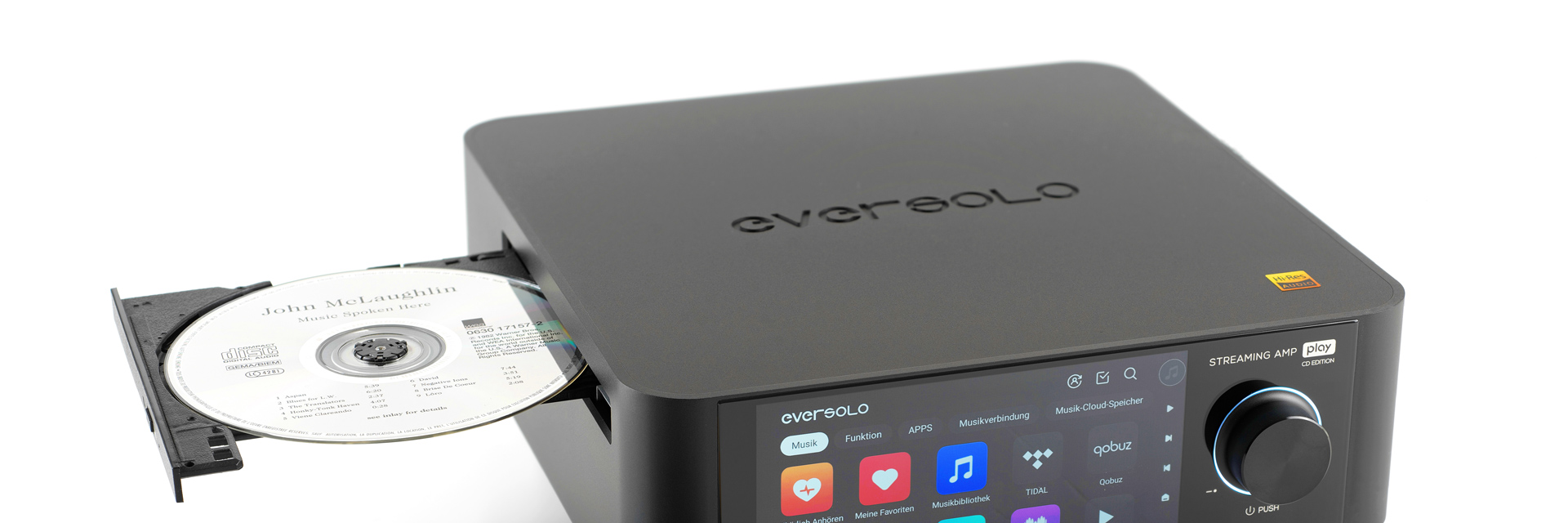
It can do digital, doesn’t shy away from analog fare either, and feels perfectly at home in any network: the Eversolo Play is an all-rounder – and affordable to boot. But does it deliver sonically as well? Let’s find out …
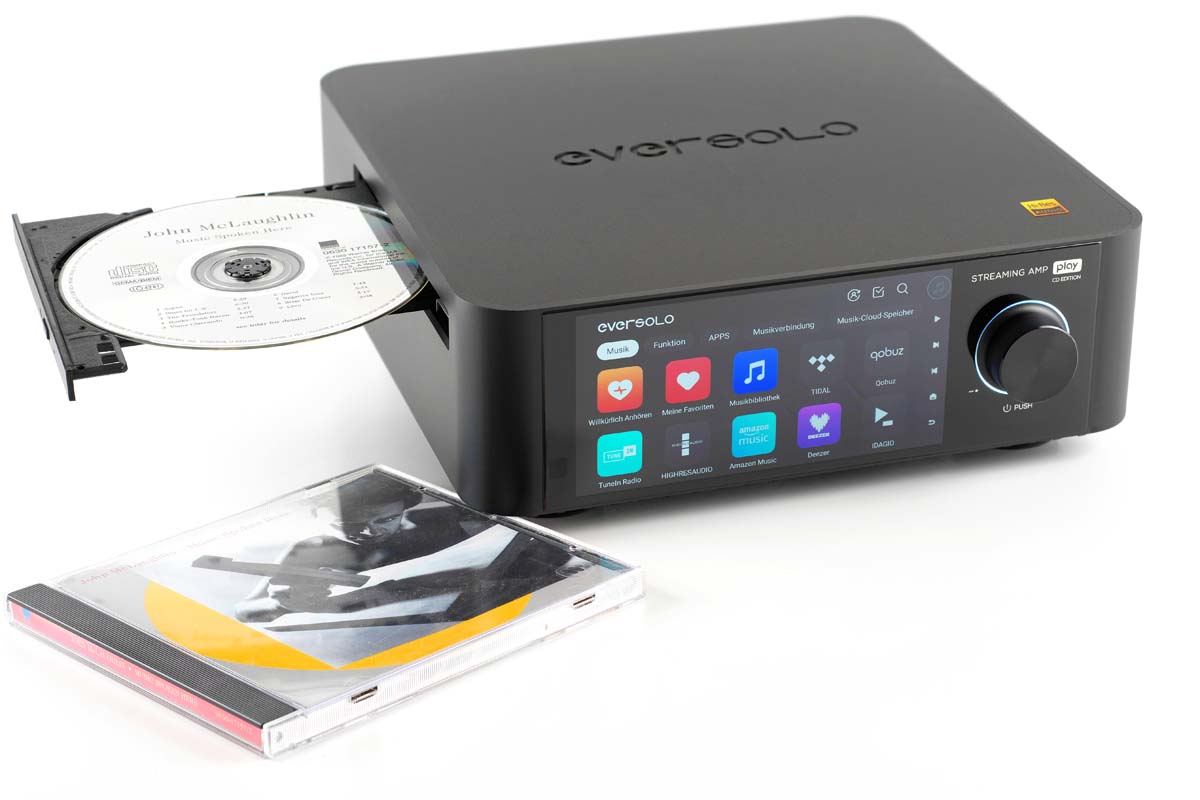
Hi-fi components from China have built up a considerable reputation in recent years, because they routinely offer generous feature sets and well-balanced sound at attractive prices. Eversolo Audio, a young brand from the AV/video specialist Zidoo, has already caused quite a stir with its products – such as the Digital Media Player DMP-A10 – and the product portfolio keeps growing. The latest addition is the Eversolo Play, a streaming integrated amplifier. It positions itself as a central hub for refined hi-fi music enjoyment, drives passive loudspeakers, can stream and convert, and even includes a phono preamp. All of this – and, as we’ll see, quite a bit more – can be yours for just under 700 euros. Add a manageable extra hundred, and you get the Eversolo Play CD Edition with a Hitachi CD drive, opening up numerous options for serving your music collection to discerning ears.
Ready for Anything
Even with the CD drive, the Eversolo Play is a comparatively compact device that, as an Apple user, reminds me of the Mac Studio, whose dimensions it only slightly exceeds. The computer comparison fits quite well, because at its core we’re dealing with a music computer: the Play runs a heavily customized version of Android, with a nimble quad-core processor (ARM Cortex-A55) handling all functions. The aluminum chassis also evokes thoughts of bitten apples and conveys a sense of quality.
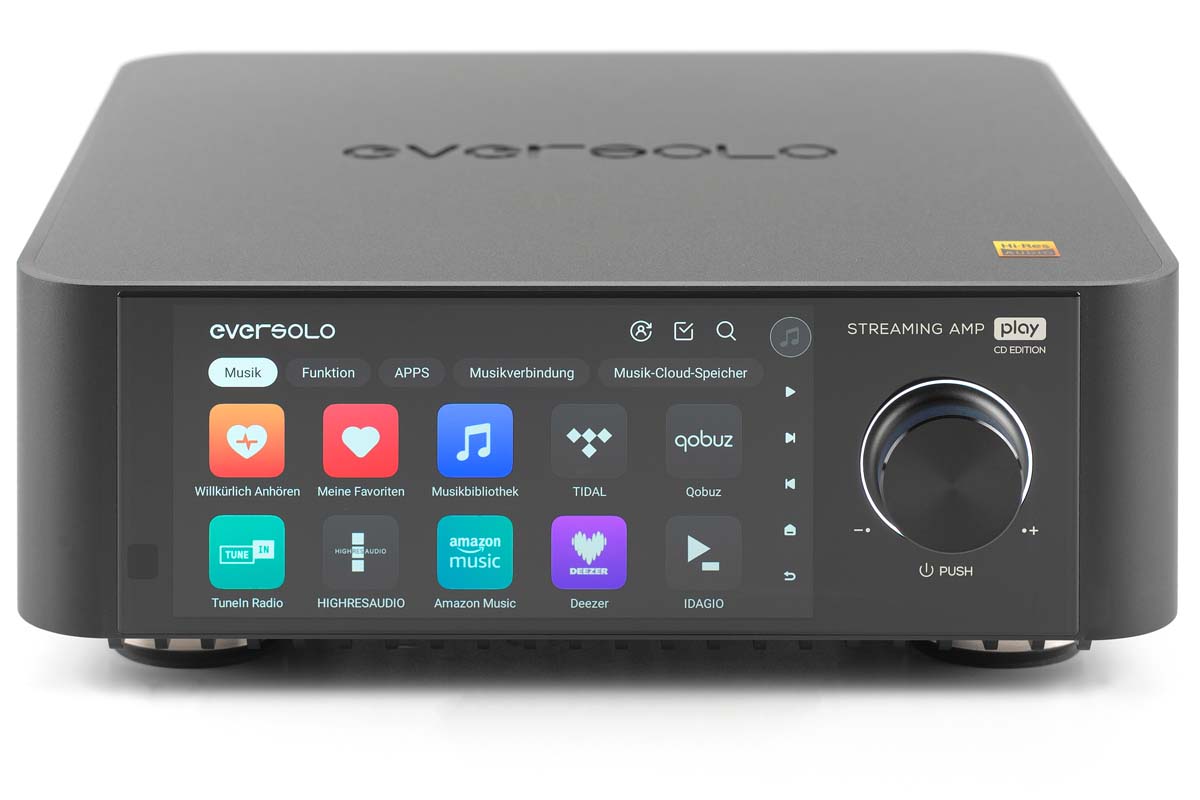
Contemporary hi-fi also means streaming, and the Play is very well equipped here. All relevant streaming platforms such as Tidal, Qobuz, and Spotify are directly accessible; Amazon Music, HighResAudio, and Apple Music are also included – along with several others. Streaming protocols like Roon Ready and Tidal Connect are supported, access to local NAS and cloud storage works smoothly, and wireless streaming is problem-free. An Ethernet port is provided, and Wi-Fi works excellently even without a visible antenna.
The Eversolo Play outputs sound digitally or analog. On the digital side, the maximum resolution of 32-bit/768 kHz at the USB 3.0 audio output is impressively high, allowing suitable DACs to be connected via USB. There is also an S/PDIF output with a maximum resolution of 24-bit/192 kHz, enabling quick integration into an existing digital-based system.
But the Play is also an integrated amplifier. Accordingly, passive stereo speakers plus a subwoofer can be connected and driven. D/A conversion is handled by the well-regarded AKM 4493SEQ, while two Class-D amplifier stages delivering 60 W/110 W (8/4 Ω) drive most compact speakers with ease. The in-house “EVC engine” prevents rounding errors during volume adjustment; overall, distortion and noise figures are said to be exceptionally low. For power-hungry or low-efficiency speakers, the amplifier modules (TI TPA3255) are admittedly somewhat on the modest side – but given today’s speaker capabilities, this shouldn’t be much of an issue. This is primarily due to the built-in power supply, which has to be somewhat smaller – mainly due to space constraints, but certainly also for cost considerations. What’s interesting is that passive heat dissipation is handled via cooling fins on the underside of the chassis, an elegant solution for a compact amplifier. At least my compact Geithain ME 25 speakers worked solidly with the Eversolo.
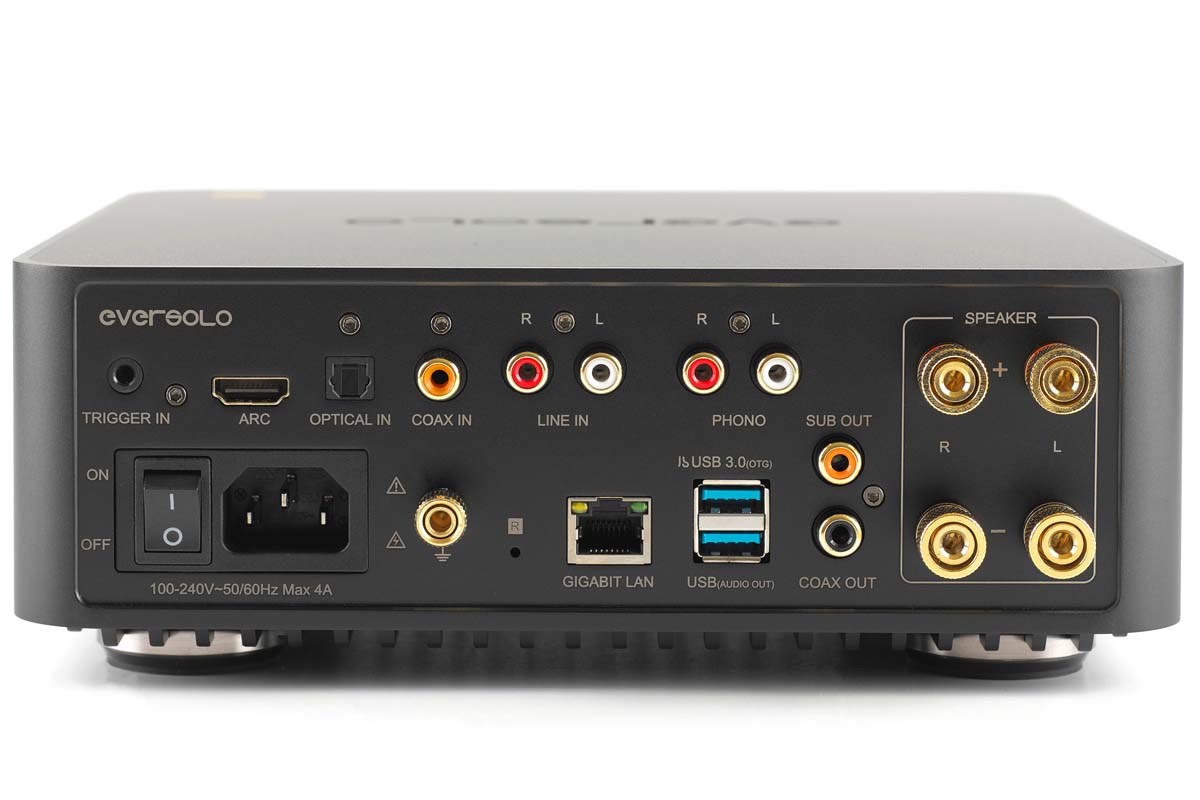
A turntable can also be connected, as the Play includes a phono preamp compatible with both MM and MC cartridges. Equalization and filtering are handled digitally, including noise reduction. You shouldn’t expect a proverbial high-end performance here, but for the likely partners in this class, the phono stage is very well matched.
A Digital Heart
Let’s remember: the heart of the Eversolo Play beats digitally. Incoming analog signals – whether from a turntable or other sources connected via line-in – are digitized at a pleasingly high resolution (24-bit/192 kHz), a solution well aligned with the concept, chassis size, and price. As expected, tone-shaping options via a parametric EQ are extensive; the presets hold no surprises, and personally, I shrug them away, leaving the EQ disabled as usual – it’s there for those who need it. The developers have also integrated a room-calibration function. This can be used – less sensibly – with a smartphone and its microphone, or – strongly recommended – with a proper USB measurement microphone. While no miracles can be expected, the results are quite good. Experimenting is definitely worthwhile, and it goes without saying that outrageously expensive room-correction systems operate in an entirely different galaxy.
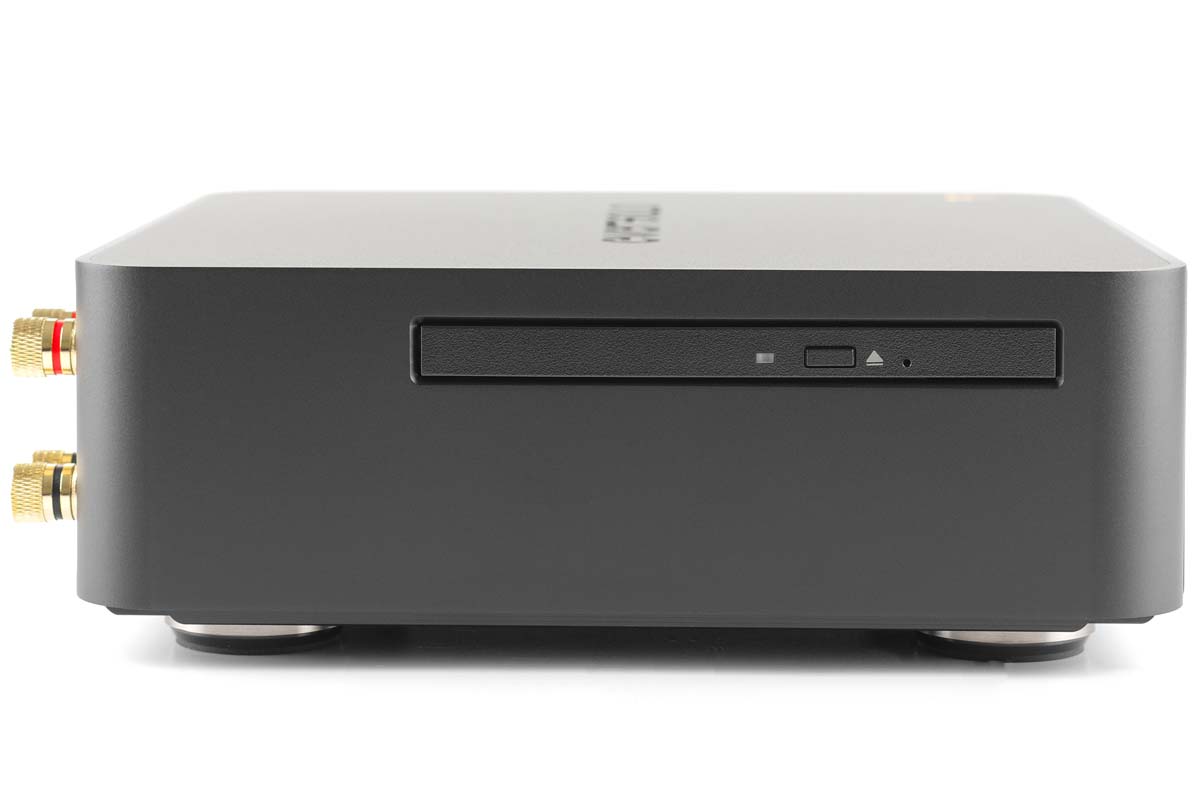
The Hitachi CD drive is of good quality and impresses with low operating noise. Those who forgo the CD drive for cost reasons can always connect a USB drive to the USB data input. The Play then offers identical functionality – including CD ripping. This is quite fast, by the way, and if the internal storage weren’t limited to just 32 gigabytes, I would have parked more albums on the Play during the test.
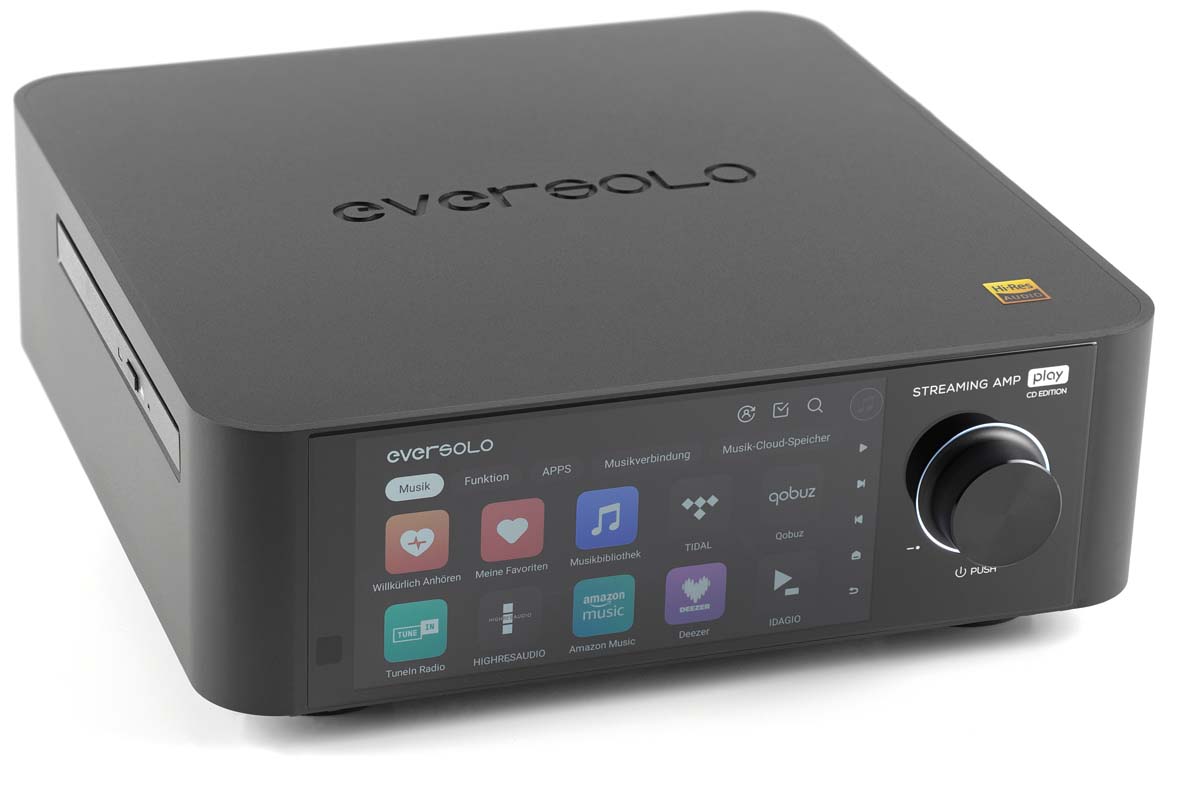
The Eversolo Play can be operated comfortably and intuitively via its excellent touchscreen in combination with the large rotary/push knob. The system is continuously being improved: during the test period alone, there were three updates. Clearly, the manufacturer isn’t asleep at the wheel. If desired, the Play can also be controlled via an app, which mirrors the touchscreen. A special feature is the set of applications found under “App.” These are not preinstalled at the factory but can be downloaded and installed directly. In the case of Apple Music, this is highly recommended, as it then allows lossless streaming – although the resolution, unlike streaming via a Mac, is limited to 24-bit/48 kHz. Hi-res music from the LAN or via removable media is, of course, played bit-perfectly, as are streams from the well-known platforms.
A Reliable Interpreter
For the listening test, I focus – purely for quality reasons – on treasures from my own music collection. One example is the little-known yet magnificent instrumental album Guitarero by Peter Horton, an elaborate 1985 production that was never released on CD. I listen to the LP – my Violectric PPA V600 is connected to the Eversolo Play via line-in – and to my own 24-bit/88 kHz digitized and self-remastered version for comparison. In both formats, the level of detail and transient accuracy with which the music pours into the listening room are convincing. Horton’s flamenco guitar rises with its crisp tone from the excellent fusion ensemble around keyboardist Kuno Schmidt, superbly recorded by engineer Carlos Albrecht. Even if the spatiality and precision of my active reference setup are not fully matched by the Play/Geithain ME 25 team, the result is definitely audiophile and pleasing even to discerning high-end ears. As long as you don’t expect PA-like SPL from the Chinese contender, it delivers more than respectably. I like it so much, in fact, that I spend three very pleasant listening afternoons with the streaming integrated amplifier. If the Everplay Solo also had a pre-out, I might well add it to my stable. Yes – this affordable all-purpose weapon really is that good, sailing confidently and unflinchingly on a hi-fi course.
Accompanying Equipment
USB interface and D/A converter: Mutec MC3+USB, Mytek Digital Stereo192-DSD DAC, Violectric V800 | Music server: Audiodata MusikServer II | Turntable: Sony PS-9X | Phono preamplifier: Violectric PPA V600 | Headphone amplifier and headphones: Violectric V280, AKG K702 Studio, Fostex T50RP, Beyerdynamic Aventho Wireless | Active loudspeakers: Geithain RL 906 | Passive loudspeakers: Geithain ME 25
Network Receiver Eversolo Play CD Edition
Concept: Streaming integrated amplifier, DAC, CD player (CD Edition only) | Inputs: 2 × analog stereo RCA (line in), 2 × analog stereo RCA phono (MM/MC), 1 × trigger in, 1 × coaxial S/PDIF, 1 × optical S/PDIF, 1 × HDMI ARC, 1 × USB-A (media) | Outputs: 2 × speaker terminals, 1 × RCA mono subwoofer out, 1 × coaxial S/PDIF, 1 × USB-A for external USB DAC | Amplifier type: Class D (TI TPA3255) | Output power (RMS @ 8/4 Ω): 60 W / 110 W | D/A converter: AKM 4493SEQ with internal 32-bit/768 kHz | Maximum resolution: 24-bit/192 kHz, all common audio formats and DSD Native 512 | Network: Ethernet, Wi-Fi, Bluetooth 5.0 | Streaming: AirPlay 1, Roon Ready, Tidal Connect, DLNA, Qobuz Connect, internet radio | Music services: Tidal, Qobuz, HighResAudio, Amazon Music, Apple Music, among others | Operation: 5.5″ LCD touchscreen and rotary/push control, app (Android and iOS) | Internal storage: 32 GB | Special features: Multiroom functionality, parametric EQ, room-calibration function, phono preamp for MM and MC cartridges, CD ripper, Wi-Fi without antenna | Included accessories: Power cord, manual | Finish: Black aluminum | Dimensions (W/H/D): 20/7/23 cm | Weight: 2.6 kg | Warranty: 2 years | Price: around €800 (CD Edition; base version from €700)
audioNEXT
Isenbergstraße 20
45130 Essen
Phone +49 201 5073950