

The Bioscope project brings together Steve Rothery & Thorsten Quaeschning – two of the most creative minds working between electronic music and progressive rock.
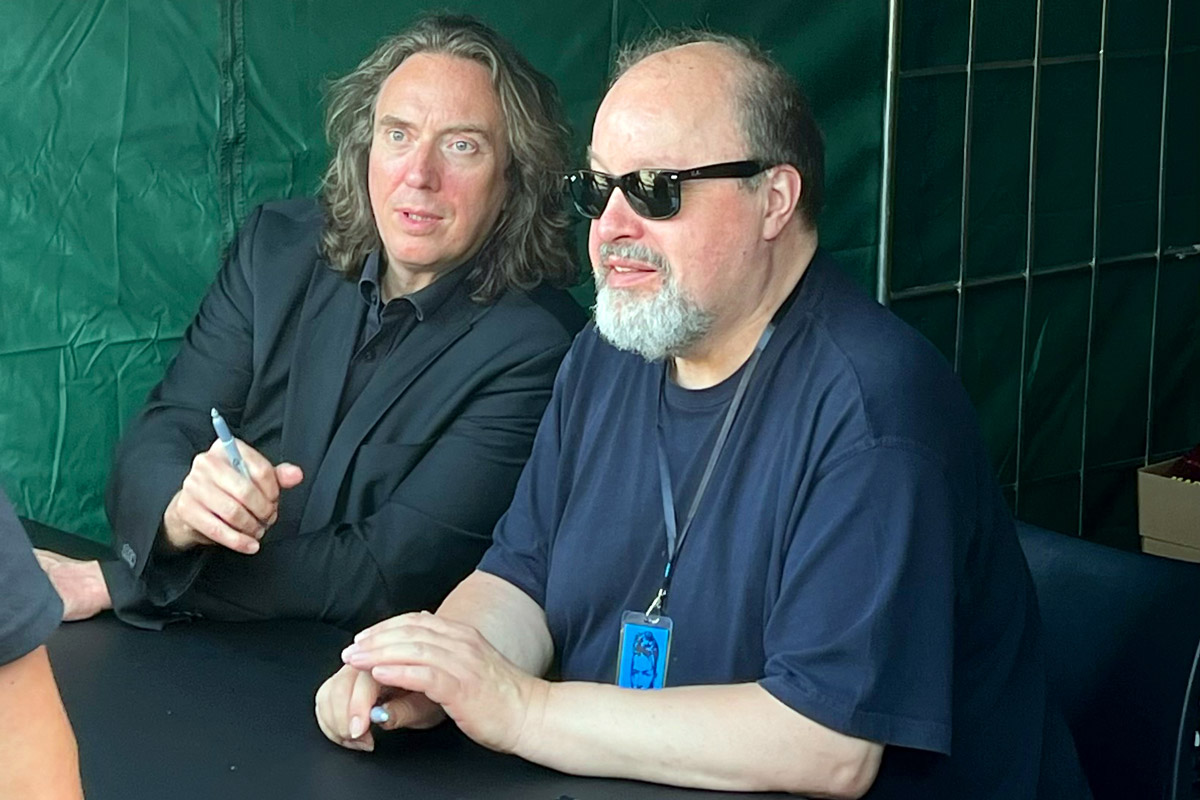
In today’s music world, which is often rigidly categorized by formats, genres, and target audiences, artists who consciously position themselves beyond such boundaries have become rare. Steve Rothery and Thorsten Quaeschning are among those exceptions. Their musical biographies could hardly be more different – and yet their collaboration on the Bioscope Project reveals a deeper kinship that goes far beyond sonic aesthetics. While Rothery has, for decades, stood for a form of writing that places carefully measured emotion above flashy effects, Quaeschning is a systems tinkerer, a composer who works from surfaces, loops, and structures. What unites them is not style, but attitude: an understanding of music not as a means of self-presentation, but as a space in which depth and atmosphere can unfold.
Two artists, two systems, one language
Steve Rothery, born in 1959 in Yorkshire, rose to prominence in the early 1980s as a founding member and guitarist of Marillion, a band he remains part of to this day. His playing is defined by a restraint that refuses superficial virtuosity. Rothery favors melodies that do not demand the spotlight – and for that very reason linger in the memory. Every note seems carefully weighed, every pause deliberately placed. His music is fully composed, carried by an inner calm that gives the listener time – to perceive, to empathize, to remember.
Thorsten Quaeschning’s artistic background could hardly be more different. Born in Berlin in 1977, he is deeply rooted in the tradition of German electronic music, particularly the school associated with names such as Tangerine Dream and Klaus Schulze. As musical director of Tangerine Dream, he has for many years been leading one of the most important projects in electronic music into a new present. Quaeschning doesn’t work with fixed forms, but with open systems: modular synthesizers, algorithmic structures, improvised sound fields. Where Rothery composes, Quaeschning constructs. His music often emerges live, developing in the moment, fed by variation, repetition, and controlled chance. It is less a narrative in the classical sense than a spatial experience – an acoustic environment in which meaning reveals itself through repetition and transformation.
Rothery seeks expression in organic sounds, in warm, melodic lines that are never intrusive but always present. Quaeschning, by contrast, works with synthetic textures, rhythmic sequences, and atmospheric layers that stack, fracture, and condense. One composes from the line, the other from space. And yet both meet in a finely tuned sense of atmosphere, in the art of achieving impact through reduction. Their deep understanding of the associative power of sound and structure connects them – despite the differences in their means, they pursue a similar goal: to create music that tells a story without naming it, that leaves room for interpretation and imagination.
In the sound space of Gentō – the voices behind Bioscope
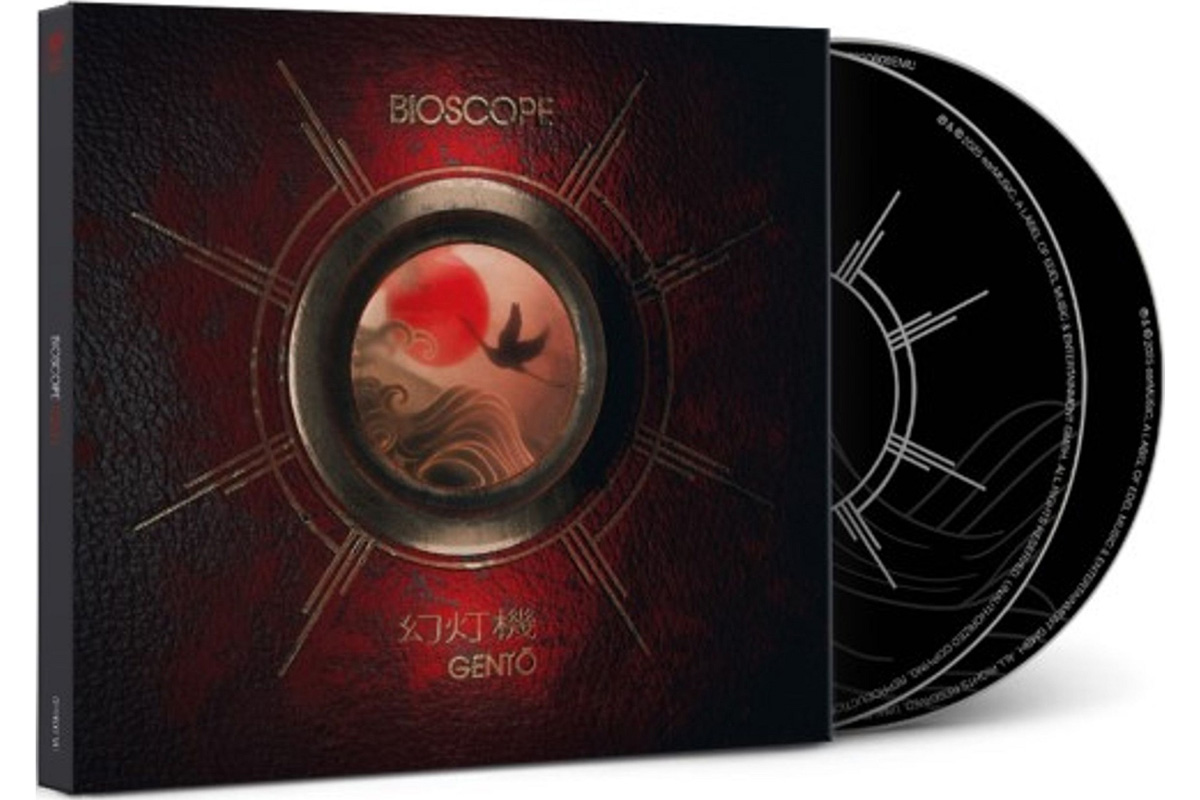
The name Bioscope itself already carries poetry: derived from Greek (bios = life, skopein = to look), it once meant “view of life” – a precursor to cinema. Rothery and Quaeschning did not choose the term by chance: their project aims to offer a musical view of life, multifaceted, atmospheric, and narrative. The track titles on Gentō are equally rich in meaning: names such as “Vanishing Point,” “Kinetoscope,” “Bioscope,” or “Kaleidoscope” refer to technological methods of capturing images, to fleeting perspectives, to mechanisms of seeing – and they are translated into sound.
Gentō was created through an extended stop-and-go process that began around 2020 and unfolded over several years, through recurring multi-day sessions, until 2024. Rothery describes the creative collaboration as “a musical conversation, free of grand calculation, trusting what happens in the room. There was a lot of mutual respect. I found what we were doing very inspiring – and I believe Thorsten felt the same way. No egos, just the joy of music. When it’s instrumental and you don’t have a singer to focus attention, you have to be creative and find small melodies and motifs to engage people. That was a challenge, but also very rewarding.”
And so Rothery’s guitar lines speak with emotional clarity, while Quaeschning’s detailed sound design shapes the music’s inner architecture. In short: a carefully considered dialogue between two established musical masterminds who have managed to amalgamate what could have been a massive overload of material into a compact event. Quaeschning’s equipment list alone includes two dozen pieces of hardware and various software systems; Rothery, too, draws on a good dozen guitars and effects units. All the more impressive, then, is the compositional coherence of the individual tracks.
Gentō remains visible without images. Like a cinematic experience, the sound emerges, carries itself, tells a story, and moves the listener. The music becomes an ongoing film without pictures – immersive and rich in detail. Added to this is a gently driving, never demanding rhythmic structure, provided in a perfectly complementary way by Alex Reeves, drummer of Elbow. What began as an artistic encounter between two very different musicians has, with Gentō, condensed into a work that makes the common ground – rather than the differences – audible in sonic perfection. And the greatest compliment one can pay this release is its distance from all previous projects by the two musicians: it never sounds like Marillion, never like Tangerine Dream, but always like an independent, unheard-of original.
Bioscope – Gentō
Label: earMUSIC
Format: CD, double LP, DL 24/48