
Electricity comes from the power strip – and you can get power strips at the hardware store. Or you can transform power supply into an Olympic sport with the new power conditioner from Audes.
When the Rolling Stones rolled into Berlin’s Olympic Stadium in June 2018, they brought along a lot more than Keith’s Telecaster. It took 250 trucks to transport all of their equipment, and while many of the trailers contained guitar amps and drums, some of them brought the power supply.
For an event of that size, you don’t just need electricity by the truckload, but you also need it to be uninterrupted, with stable voltage, and as free from interference as possible. Therefore they use generators in conjunction with an extensive set of measures: PA, mixers, lighting, and video are put on separate loops, voltage stabilizers, automatic circuit breakers, and power conditioners ensure clean juice. Even in recording studios – at least those running more than a laptop – power doesn’t typically arrive through run-of-the-mill hardware store power strips. The equipment lineup is diverse, and analog consoles can be just as electricity demanding as vintage tube amps, DACs, or preamps.
In your living room, you don’t typically face audiences in the tens of thousands. And while the power supply significantly contributes to amplifier quality, ensuring the overall cleanest possible mains power tends to be an afterthought. Thus power conditioners are often viewed skeptically, if not outright derided as hi-fi esotericism. After all, who really wants to spend big on a power strip?
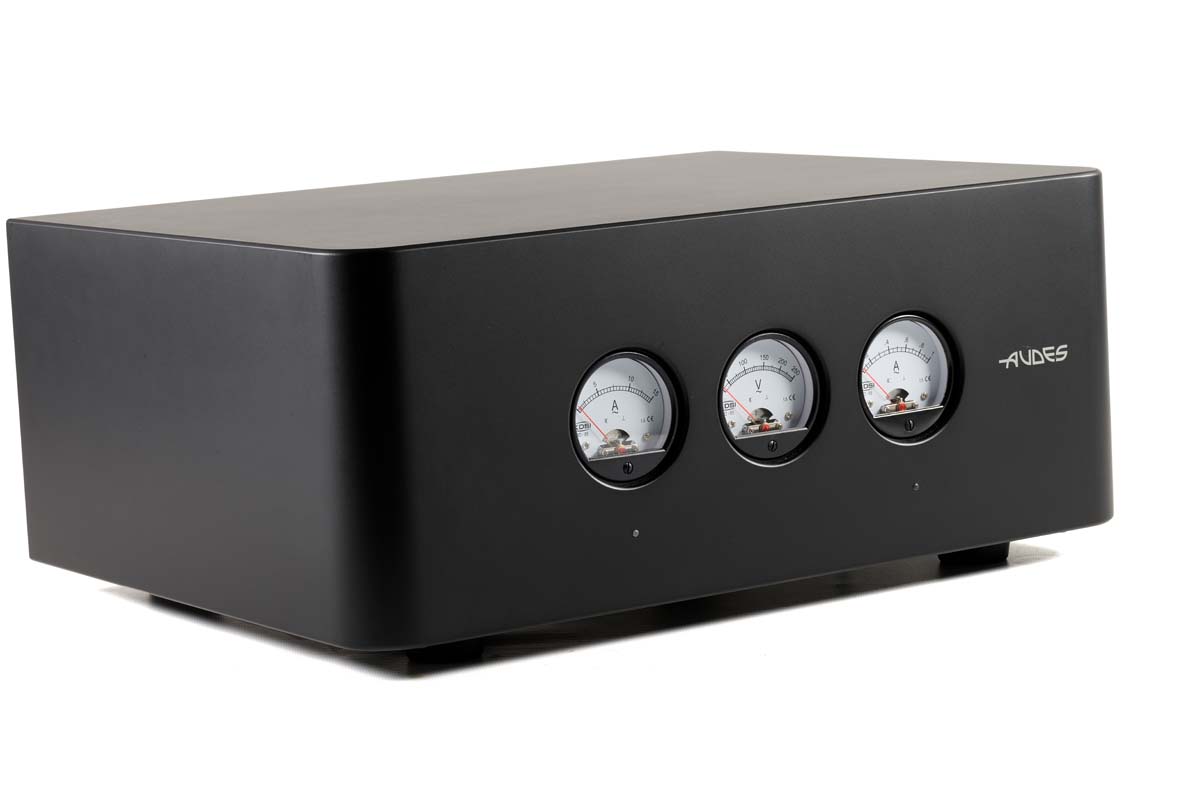
Enter the Audes TT-3200 DC – a power conditioner with a total of eight connection points for source devices and amplifiers. At a price of around 6,500 euros, that comes out to 800 euros and change per outlet. To sweeten the deal, you get a free workout session added in: the box ships via freight and weighs 40 kilograms. This not only provides an impressive demonstration of how creatively older guys can curse in a stairwell, but also inspires confidence. Clearly, its internals must be quite substantial stuff.
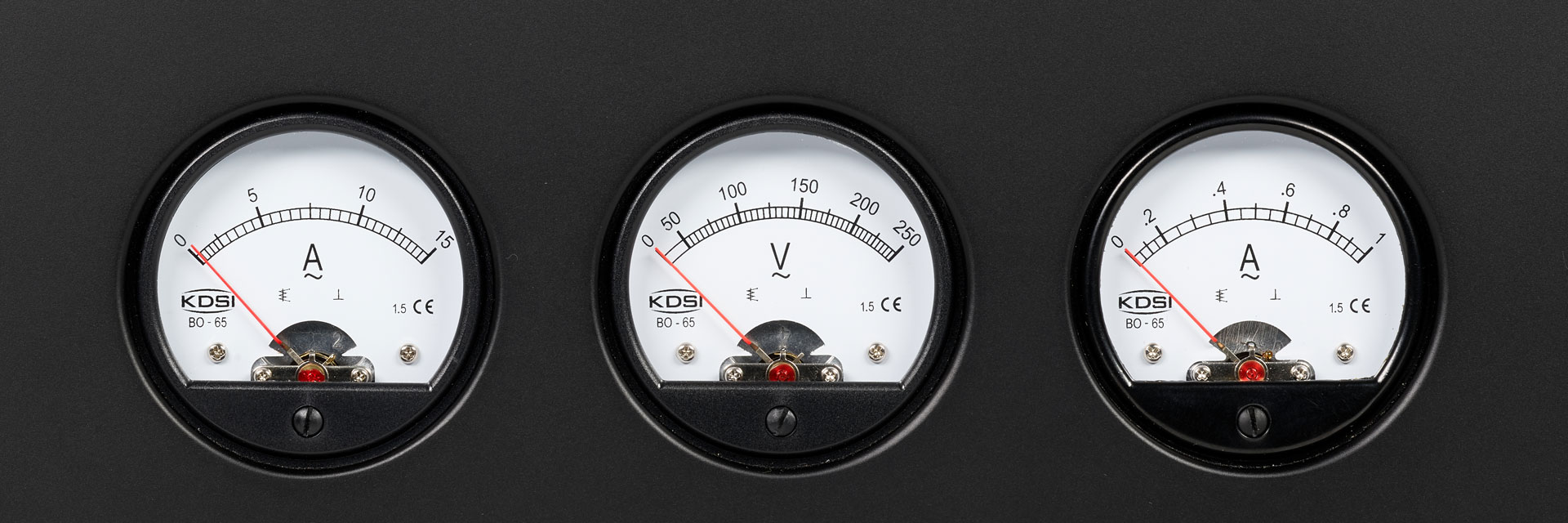
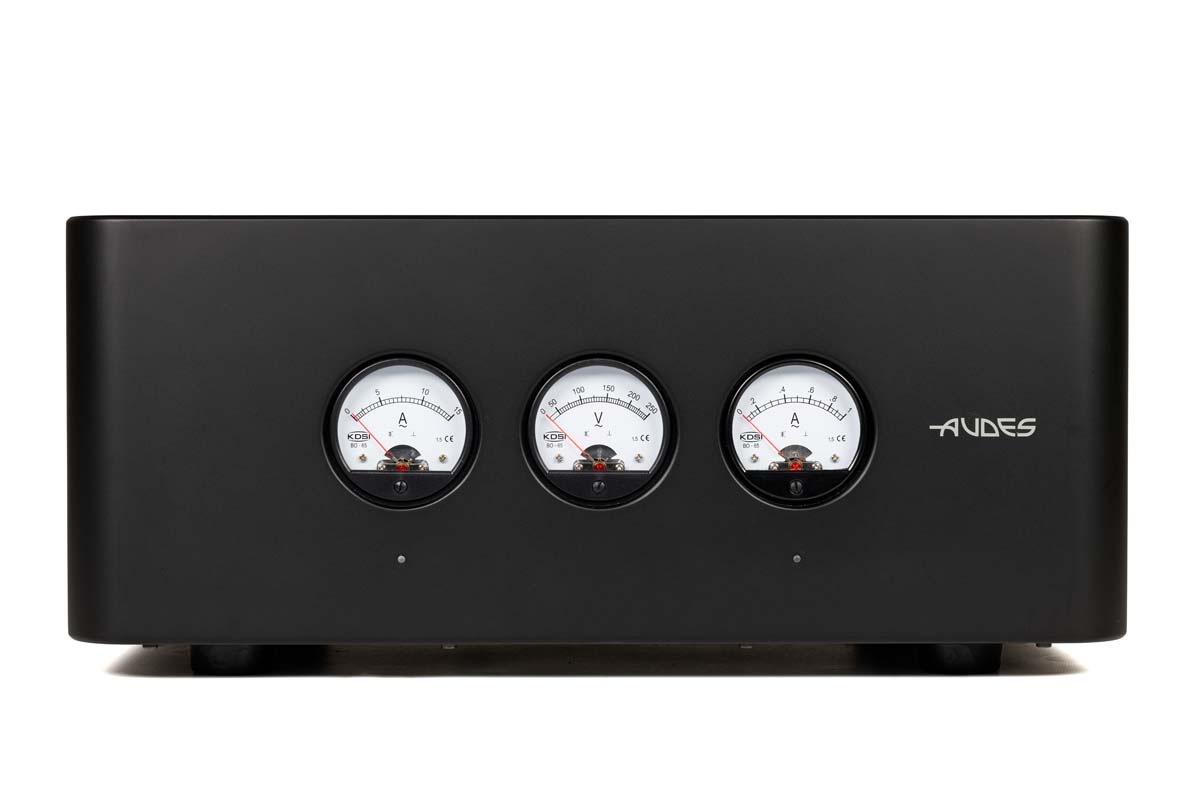
Indeed, the TT-3200 DC is a large, mighty device that exudes visual elegance with its rounded corners, two ammeters, and a centrally placed voltmeter. Two softly glowing LEDs indicate the operating status of the transformers. The double T in the product name gives it away: “TT” stands for “Twin Transformer.” And there are indeed two of them – a first for Audes’ power conditioner lineup.
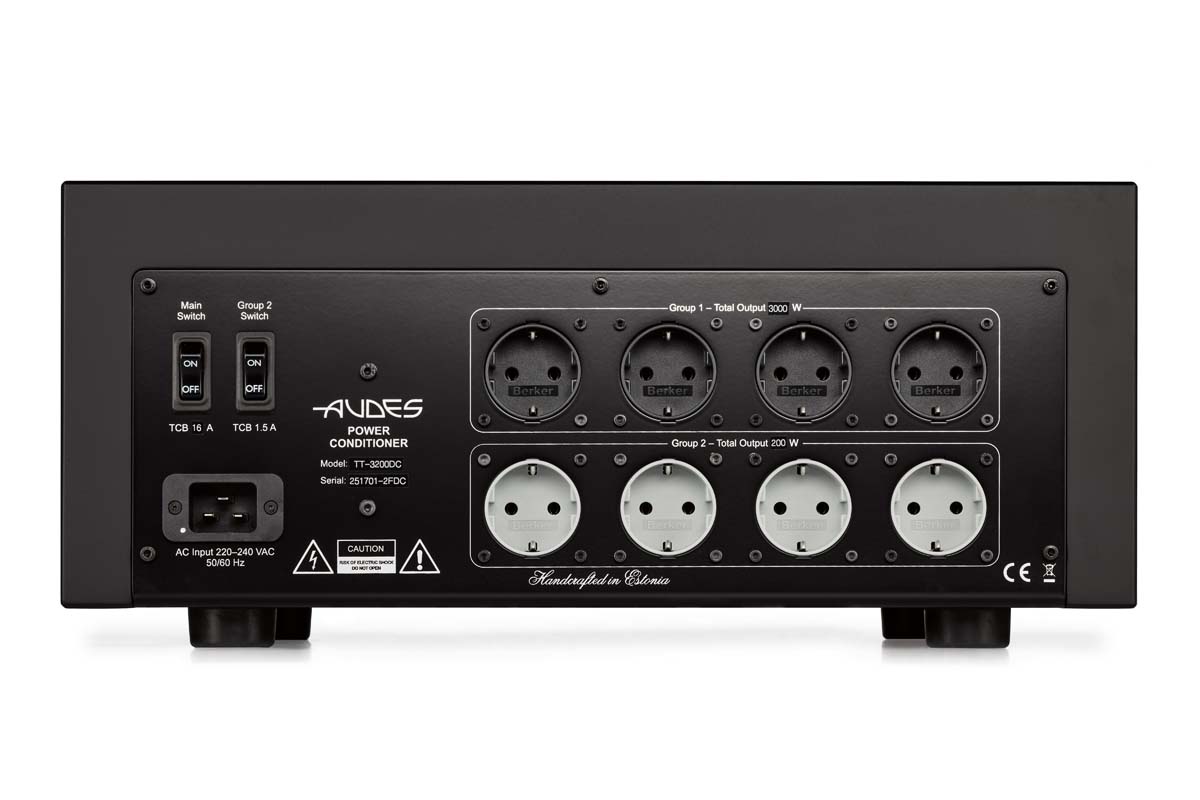
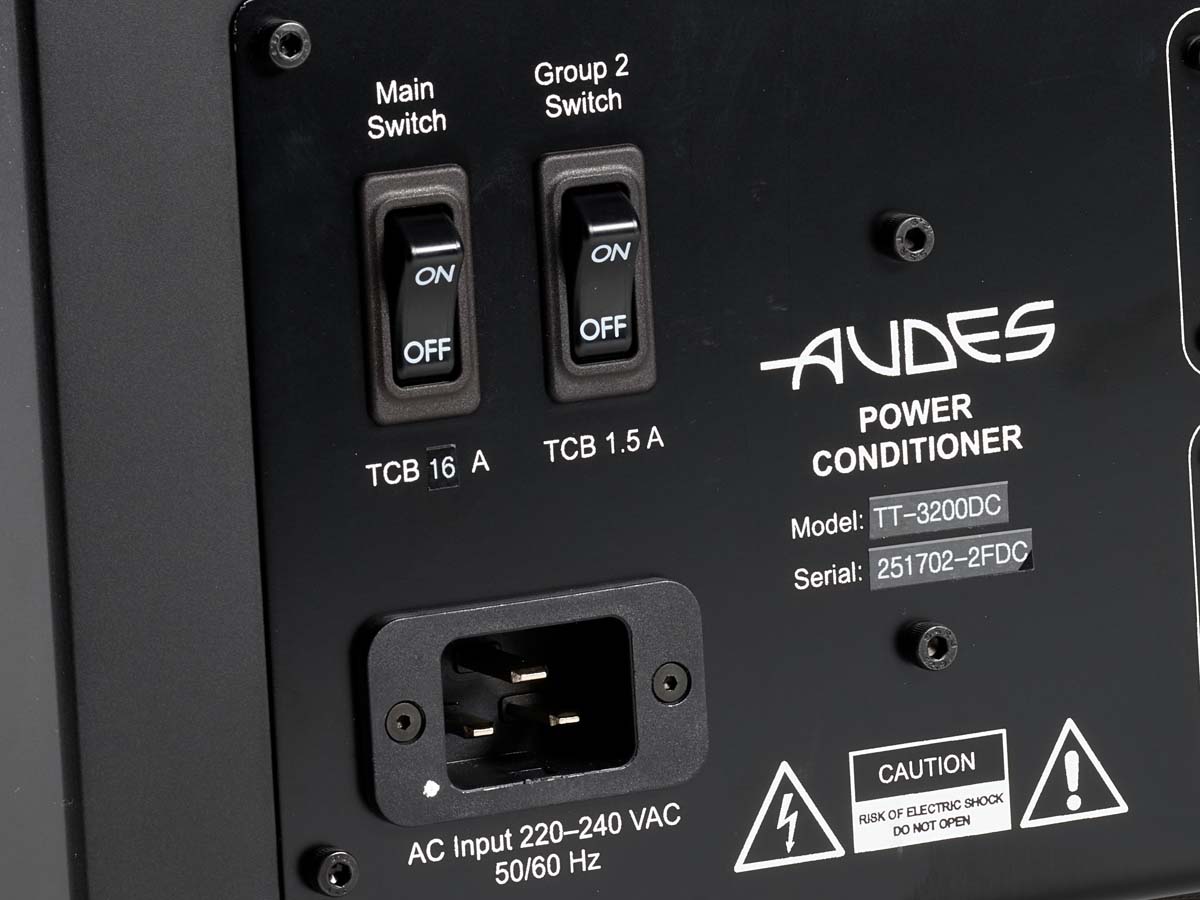
On the back, unsurprisingly, are the outlets arranged in two rows. The upper row is intended for power-hungry devices such as amplifiers, while the lower row has a significantly lower rated capacity and is intended for source devices. In particular this lower row is meant for those with switching power supplies, which by design can produce high-frequency noise, hum or interference, and pass it on to other devices on the same power line. Furthermore, the order of connections on the low-power section makes a difference in terms of sound quality. The rule goes like this: Power-hungry consumers go at the end, and especially high-quality ones go at the beginning. The upper row uses a star-wired power layout in which each outlet is supplied via its own dedicated line.
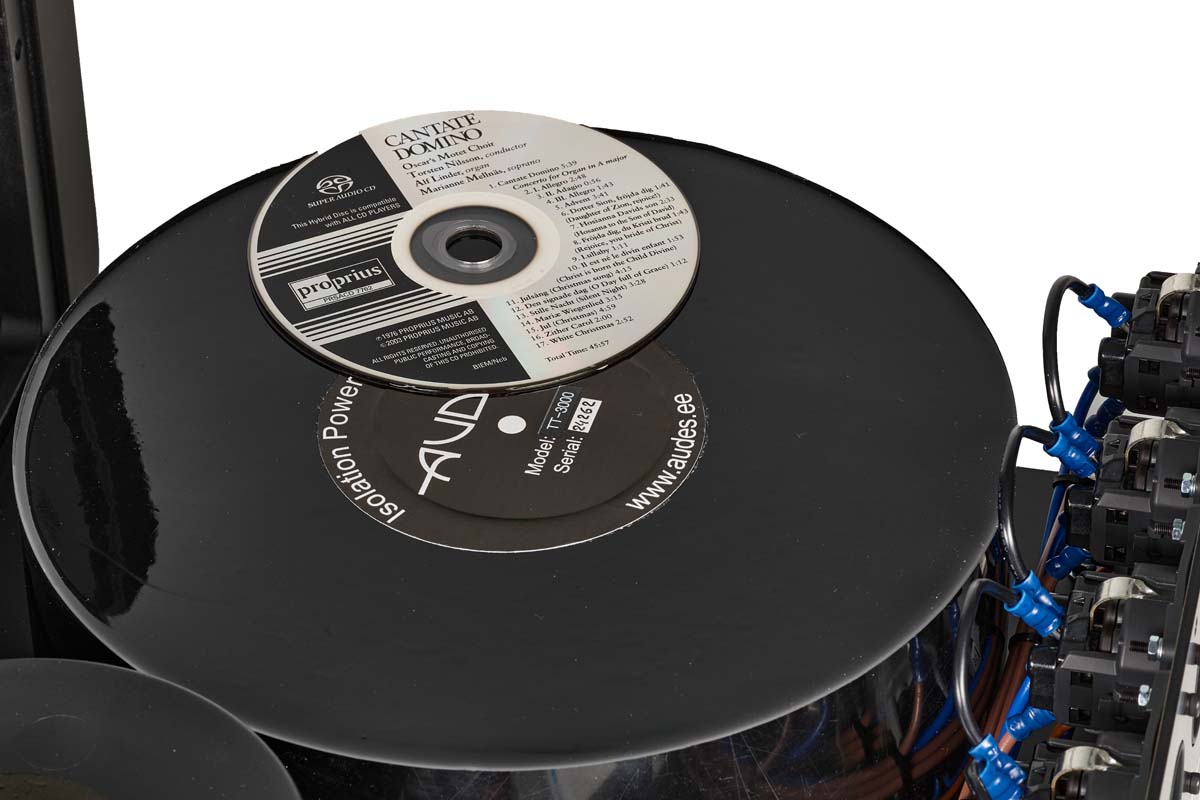
Each of the two connection groups is supplied by its own toroidal transformer. They provide galvanic isolation from the grid and filter out hum or high-frequency garbage from the chargers, routers, or LED lamps that might be operating elsewhere in the home. And they are, well, big: The total of 3200 volt-amperes is enough for any monoblock on earth. Moreover, they can be delivered in short bursts and continuously. All of this means that peaks are no problem thanks to the low output impedance.
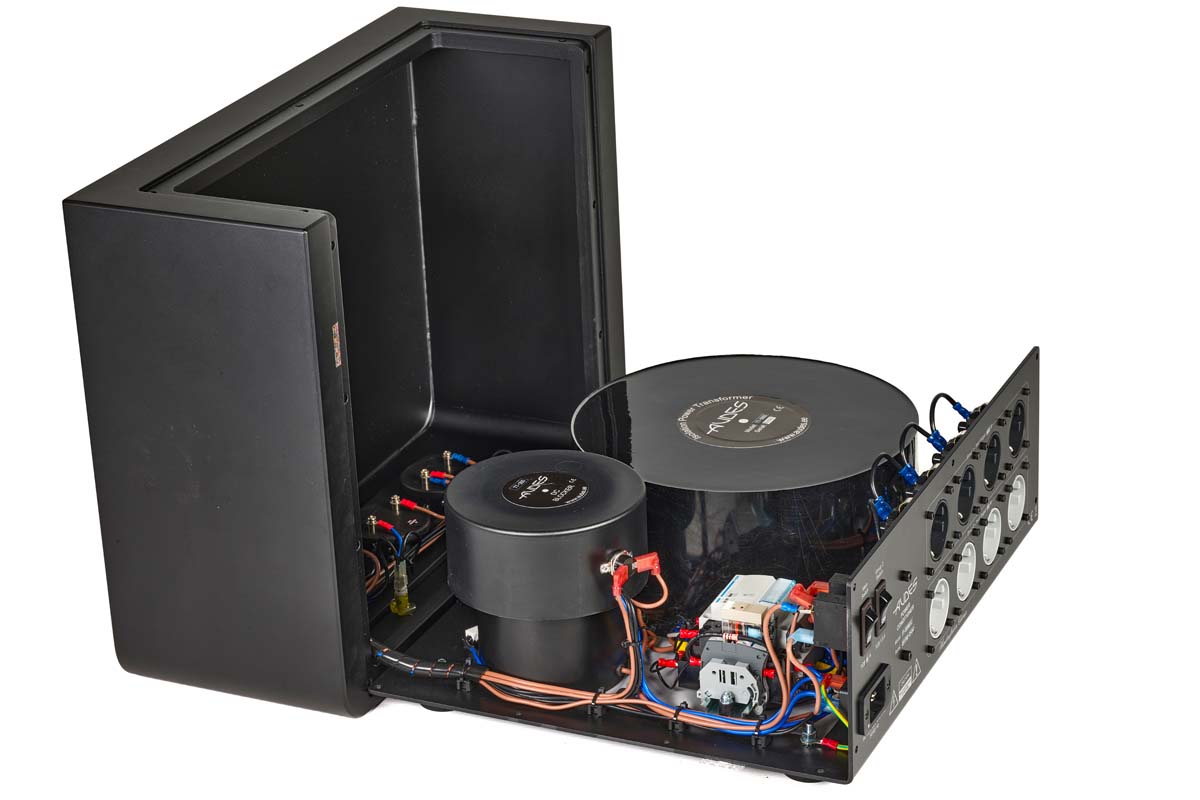
It goes without saying that Audes of Estonia ranks among the very best in the world of transformer manufacturing for audiophile applications. Eckhard Derks, managing director of the distributor TCG, speaks vividly to this. He talks about gigantic machines at the factory, 75-year-old electrical engineers and a regional craft tradition: “Everything there is big, mighty, heavy. And as far as transformer cores are concerned, there’s really no replacement for displacement.”
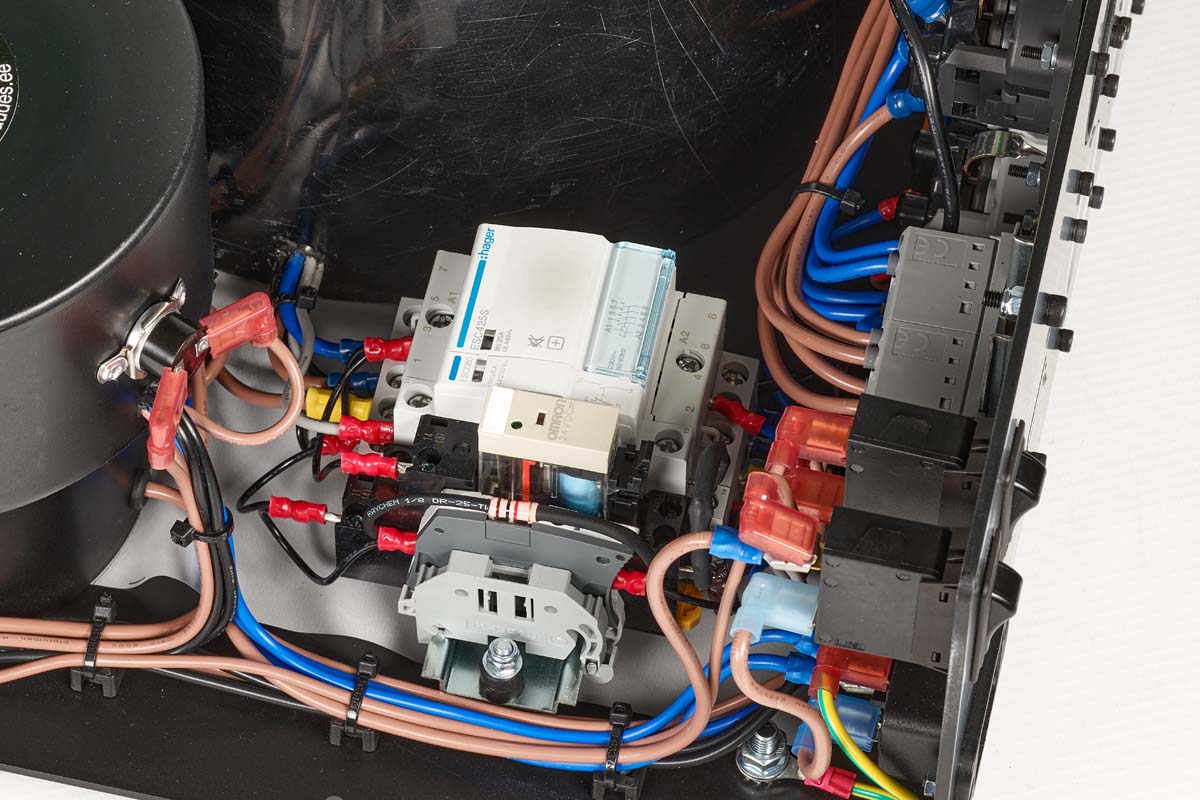
Upon power-up, a delay engages downstream of the switch and circuit breaker to avoid giving your fuse box too much of a scare. Before electricity even reaches the transformers, the DC blocker filters out any DC components that may cause hum or generally reduce performance. “It’s basically the simplest circuit on earth,” says Derks. But as it turns out you need the right number of the right capacitors in exactly the right layout. And today the DC content in the grid is noticeably higher than it used to be: “Twenty years ago you may not have needed this, but today, the sonic improvements of DC blockers are becoming more and more obvious.”
My test environment could hardly be more ideal for a power conditioner: an old building with many tenants in the middle of Berlin. The city is a load sink – it has huge energy demands but covers very little of that with local generation. Electricity is brought in from northern Germany, and the distribution network integrates additional decentralized photovoltaic systems, wind turbines, and CHP units. It’s safe to assume that all manner of irregularities and interference comes with this demanding power supply scenario. And goodness knows, some of my neighbors might just use dimmers.
Once the Audes TT-3200 DC is in place, starting it up is refreshingly simple. The initial sonic impression is – there’s actually no other way to put it – surprising. The transients of the side stick on Massive Attack’s “Teardrop” seem carved out with a knife, the bass is projected voluminously into the room across a wide stage, yet its contours remain finely delineated.
So far, the sonic picture matches my expectations: Transparency increases, stereo imaging is more stable, attacks have more punch and bass lines are rendered with more grip and definition.
Yet something really grabs my attention when this is compared with the household wall outlet: The music sounds louder, and significantly so. An attempt at “loudness compensation” yields a perceived difference of at least 1 decibel. That’s of course impossible, and also admittedly pretty amazing. The imperceptible veil that previously lay over everything must have been even more substantial than I thought. After a while of listening, the initial excitement fades. It’s not just clarity and contour that improve, and it’s not just width and depth that increase: there’s a swelling sense of effortless flow. And I don’t just mean because macro- and micro-dynamics are being flattened, which can happen with some other power-filtering concepts. In this case, the music emerges out of nothing and shines with nuance against a completely dark background.
This effect can be heightened by adding a phono preamp (which should be placed at a measured distance from the power source). Of course, this lets you enjoy old Pink Floyd, Dire Straits, or Friday Night in San Francisco with delight. But material not specifically tailored for audiophile beauty also benefits: The Great Rock ’n’ Roll Swindle by the Sex Pistols – created without Johnny Rotten and largely assembled by Malcolm McLaren from rehearsal tapes – truly sounds fantastic. Just the percussion on “Black Arabs”! You realize that even if the recording quality is questionable, the mixing and especially the mastering are excellent.
The Audes TT-3200 DC demonstrates quite impressively the deep value of interference-free power at a first-class level. The difference is not subtle, instead it’s tangible and immediately perceptible. Transparency, dynamics, and above all sonic authority all improve audibly.
What’s long been a standard in large-scale event technology can also make the fine but decisive difference in the home living room – depending on how good the power from your wall outlet happens to be.
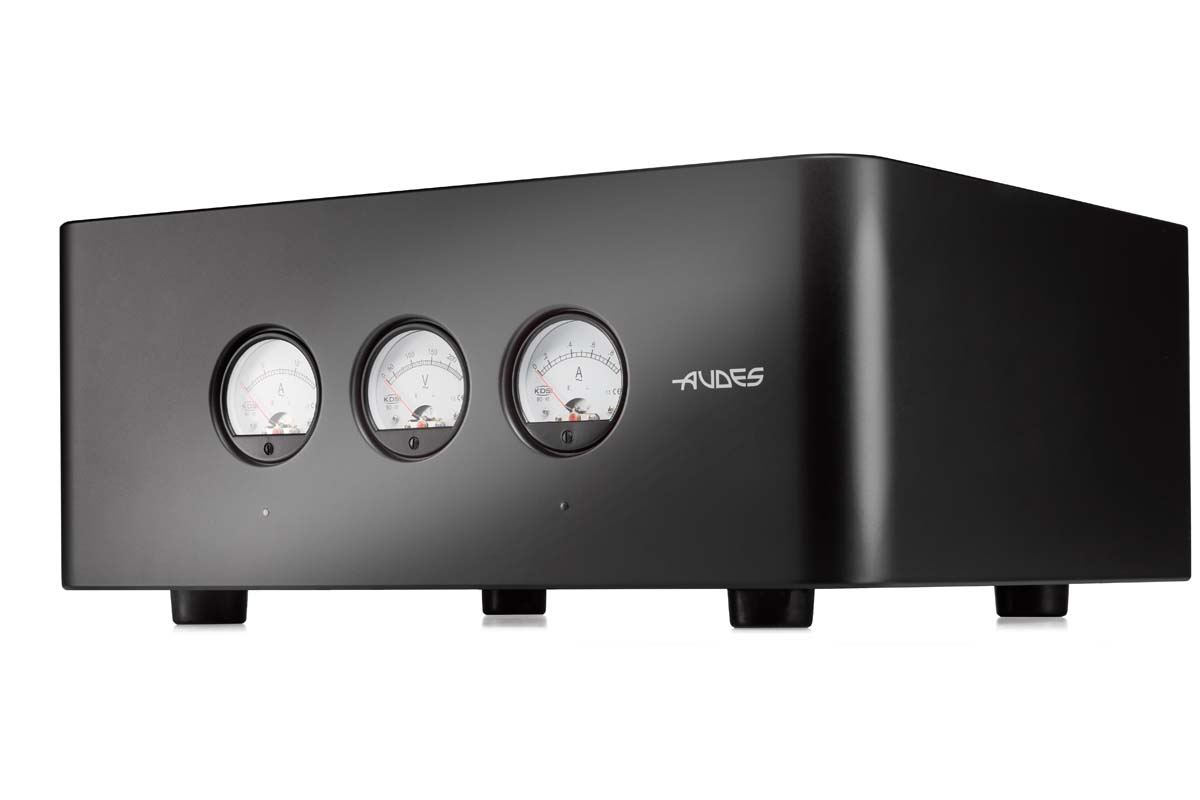
Power Conditioner Audes TT-3200 DC
Concept: Isolation transformer with DC blocker | Rated power: 3200 VA total; 3000 VA (Group 1), 200 VA (Group 2) | Outputs: 8 × 16 A/250 VAC Socket CEE 7/3 | Finish: black or white metal housing | Dimensions (W/H/D): 48/21/37 cm | Weight: 37 kg | Warranty: 2 years | Price: around € 6500
TCG
Döppers Esch 7a
48531 Nordhorn
Phone +49 5921 7884927
info@tcg-gmbh.de