
The “Tube MOSFET Transformer” M90 from Mavis Lab doesn’t simply turn electricity into music – it transports emotions. This is a trait often attributed to tube amplifiers, but at the same time, their low wattage limits the choice of suitable loudspeakers. Thanks to its powerful Class A power stages, the M90 has no such problem.
34 degrees in the shade, the oven preheats to 175 °C in anticipation of a yeast dough that will rise beautifully at these temperatures. The M90 also contributes a not insignificant share to the room temperature. To season this summer day with a bit of Caribbean flavor, one silver disc after another from the Trojan Dub Box Sets spins in the player. The bass-heavy grooves are effortlessly pushed into the room by the Mavis M90. The dub masterpieces by Lee Perry and others from the 1970s were created in modestly equipped Jamaican studios, into which the amplifier would have visually blended in seamlessly. The Mavis brand (the name stands for “Master Audio Visual Solution”) was introduced to the market in 2019. It is a sister label of the established Thivan Labs from Vietnam, founded by Mr. Nguyen Hoang Thi and Joe Nguyen, his wife, who serves as Sales Manager and answered my questions about the review unit in numerous emails. Both product lines are manufactured in the same workshop, but they have completely independent research and development departments that naturally benefit from one another.
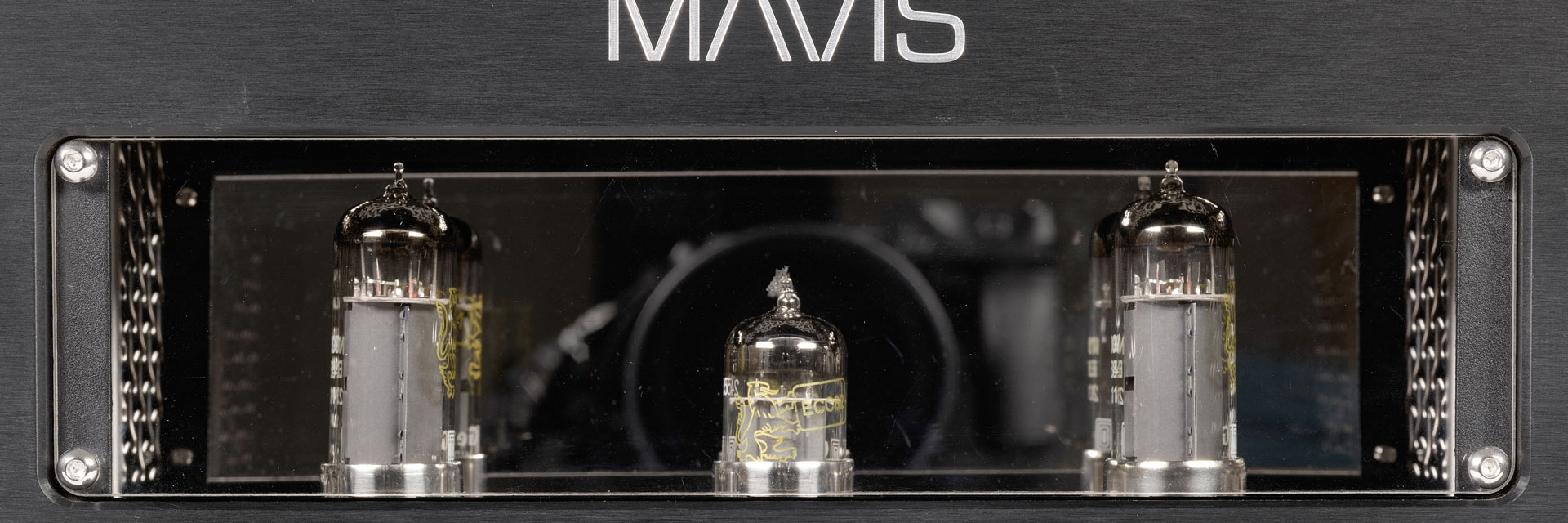
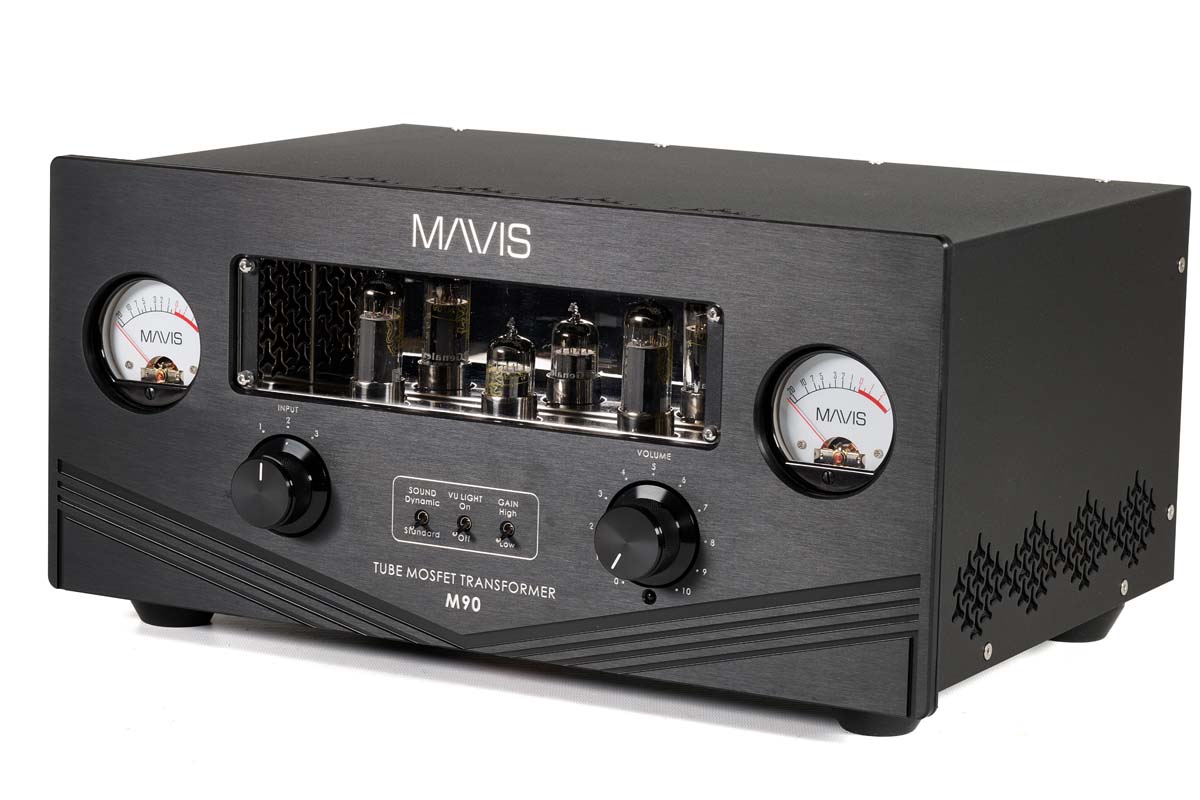
After hoisting the solid 33-kilogram integrated amplifier onto my rack, I am greeted by knobs, toggle switches, and VU meters. Centered in the massive aluminum front panel, an acrylic window reveals the mirrored tube aquarium in which two EL84s and a 12AU7 go about their work. The overall pragmatic design – charmingly out of time – appeals to the author, who harbors a certain aversion to large displays and touchscreens. The rest of the chassis is made of black-coated steel sheet metal with ornamental ventilation openings. Generous rubber feet ensure a stable stance.

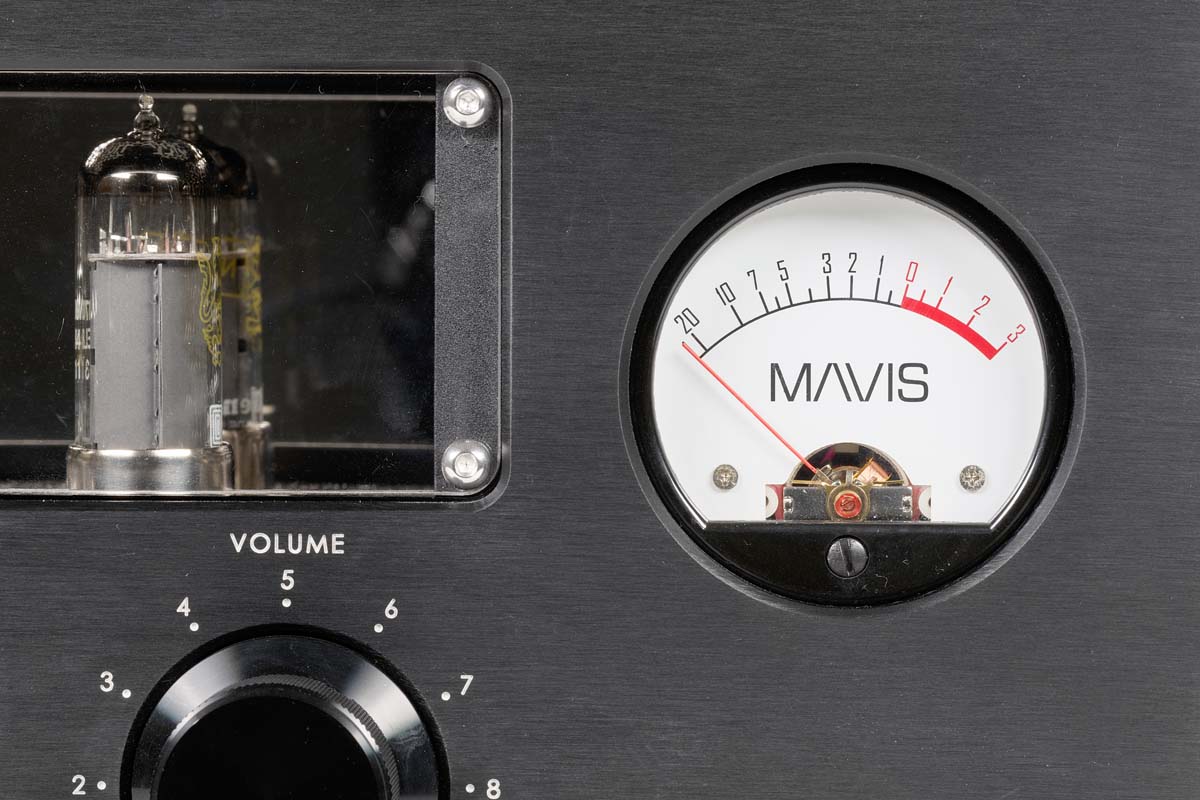
The feature set of the review sample is limited to the essentials: the left rotary switch selects the source (2 x RCA and 1 x XLR), the right controls the volume. Two of the centrally located toggle switches are responsible for the illumination of the VU meters and gain adjustment (Low/High). With the third (“Sound”), the bass character can be switched between “Standard” and “Dynamic.” The latter changes the bias setting of the tubes, as the manufacturer explained to me. By the way, the combination of “Gain Low” and “Sound Standard” worked best in my setup. The rear panel is just as clear and self-explanatory. A large portion of the surface is taken up by two aluminum heat sinks; on the sides are the speaker terminals, line-level inputs, a power inlet, and fuses. All connectors are of good quality and securely fastened. Centered above the heat sinks, two blanking plates indicate possible options: Mavis lists a DAC with Bluetooth as well as a phono option as potential upgrades. In addition to the plain black metal enclosure, there is also a version with wooden side panels.
I eventually discovered the initially missed power switch on the underside of the chassis. Once you know where it is, it’s easy to reach. The purist feature set fits well with the general concept of the Mavis M90. Inside the chassis, things get more unusual. Mavis builds its hybrid amplifiers according to a special design principle: the single-ended Class A preamp sends its signals via an interstage transformer to the MOSFET output stages, which in turn deliver their power boost to the speakers, again via transformers. Class A character with Class AB efficiency – that’s how the manufacturer describes its concept. For the user, this means that from 30/45 tube watts (4/8 ohms), a substantial 100/140 MOSFET watts emerge, enough to keep just about any loudspeaker under control. And all without negative feedback, which Mavis places special emphasis on in the interest of clear, linear reproduction. The hybrid design naturally requires the double use of transformers, which explains the considerable weight of this compact integrated amplifier.
The initial startup of the M90, however, dampened my anticipation of the expected musical enjoyment. The amplifier announced itself with a fairly strong hum, which fortunately subsided after a few minutes. The soundstage, however, seemed lacking in space, and especially the frequencies at the upper and lower ends of the spectrum were not rendered particularly satisfactorily. Well, I thought, the lad has been on a trade show and demo tour – give him some time. It wouldn’t be the first time that tube-equipped gear reacted crankily after transport. The failing batteries in the remote control also suggested extended prior use.
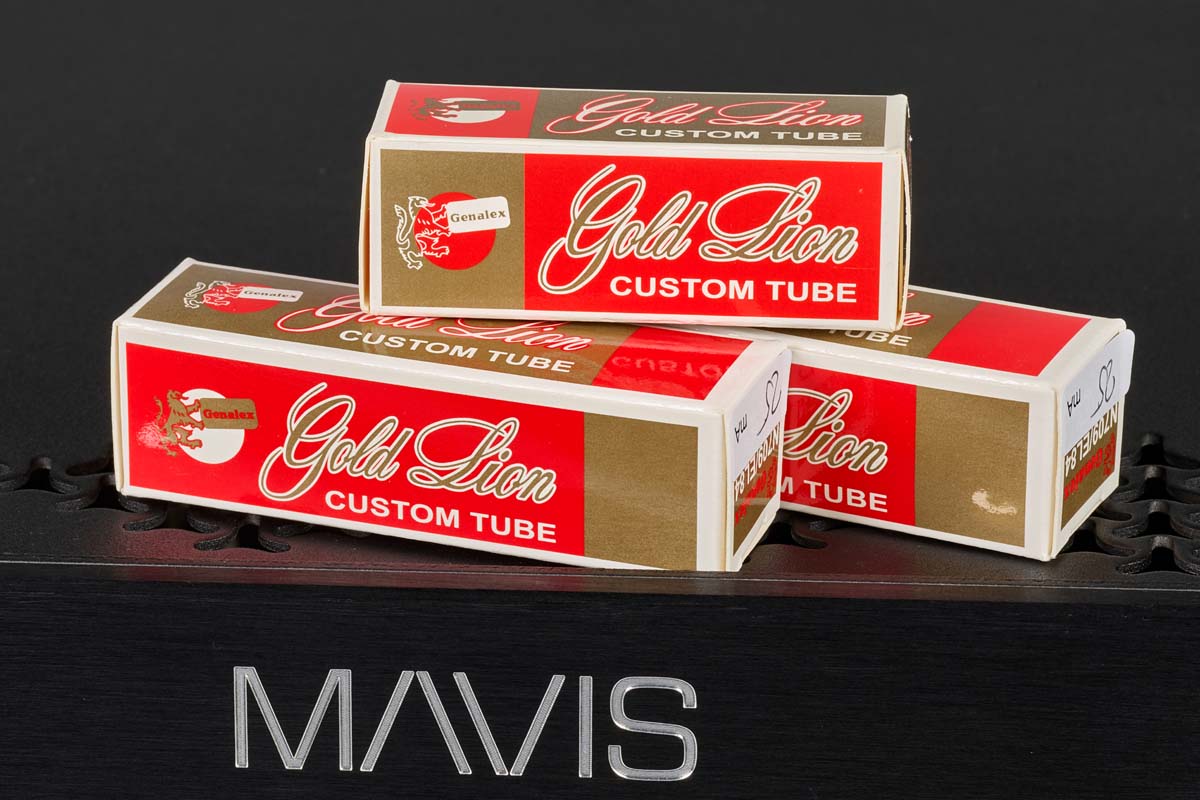
After a week, the sound quality gradually improved. In good spirits, I put a CD into the player and listened. That was better already, but after just a few minutes, a swelling hum built up again, accompanied by microphonic effects. I suspected that at least one of the tubes was on its way to nirvana. In such a case, a call to Michael Kaim, Managing Director of BTB Elektronik, helps. He promptly sent me a set of the Genalex Gold Lion tubes he recommends, consisting of a 12AU7 and a matched pair of EL84s. I can already reveal that he was absolutely right with his recommendation. The swap was quickly done, as only the viewing window needs to be removed. The user manual explicitly suggests “tube rolling” to tailor the sound to personal taste by selecting specific tube brands. Since the EL84 and the 12AU7 are produced by many manufacturers, this opens up a wide field of possibilities.

Test mode reset: eagerly, I flipped the power switch and heard … nothing. Relief. After about a 20-second warm-up phase, not the slightest noise could be detected. Even during the break-in period of the new bulbs, I was able to enjoy the music reproduced by the M90. One outstanding trait of the hybrid amplifier – the homogeneity of its playback characteristics – was already apparent: the entire spectrum was transmitted beautifully balanced, without favoring individual frequency ranges. Vocals had neither an overemphasized chest tone nor did they sound flat. The low frequencies benefited from a well-balanced relationship between volume and contour; only the very lowest octave was reproduced somewhat reservedly. The high-frequency range was detailed with a gentle roll-off. After a good 50 hours of operation, the Mavis M90 had fully made friends with my Audio Physic Spark speakers and was performing at its peak. This was evident, among other things, in the fully awakened spatial presentation. The clear localization of instruments and voices, both in width and depth, and the perception of the space made a realistic impression on me. When the recording allowed, even vertical layering became apparent. Jazz trios played in club-like intimacy; with large-scale orchestral classical music, the size of the concert hall became evident. The naturalness of the tonal colors was convincing, without any added, artificial sweetness.
To begin, I put Mordechai by the Texas trio Khruangbin on the platter. This extraordinary mix of ’70s soul and funk, surf and desert rock garnished with elements from the Middle East all the way to Thai funk, creates a completely relaxed atmosphere that occasionally drifts into the mysterious. The sound also revives the sonic aesthetics of the ’60s and ’70s. Thus, bass drum and electric bass are largely free of overtones – it goes “pop!” and “duuumm!” – tight, springy drumheads and finger noises that are often provoked in “audiophile” recordings are nowhere to be found. (Just as an aside: bassist Laura Lee said in an interview that she hasn’t changed her bass strings since 2010 …) The sparingly used choral passages sound like they’re from an Italian Western and float spatially slightly above and far behind the band. The Mavis M90 playfully seduces me into drifting away with this music.

Different genre, different era: John Coltrane’s album Stardust, released in 1963 (recorded in 1958 by Rudy Van Gelder), conveys a completely different mood, which the Mavis transports just as effortlessly. The title track delights me with the sonorous saxophone with subtle breath noises, just as much as the full tone of the flugelhorn played by Wilbur Harding. The top-tier band swings with complete ease; I catch myself snapping my fingers along to the rhythm. In addition to tonal coherence, the positions of the individual musicians in the studio are precisely locatable. With the next recordings, I wanted to test whether the M90 could maintain clarity with more complex material. To that end, I fed the Michi Q5 with Klaus Doldinger’s Passport To Morocco and Marcus Miller’s Renaissance. Many a component has stumbled over these recordings, and the Mavis also couldn’t quite follow the deep, fast bass runs with ultimate attack. The last ounce of high-frequency sparkle also seemed to be missing. How to judge this is a matter of personal taste. In my opinion, exaggerated detail retrieval becomes boring over time and distracts from the overall work. The character traits of the Mavis M90, however, make classical and early music a true delight – thanks to its rich tonality, harpsichord and strings gain a substance that can be lost with overly lean-sounding systems. And so, to conclude, I enjoy Arcangelo Corelli’s Concerti grossi op. 6 and realize that the Mavis M90 shares my love of early music.
Tube integrated amplifier Mavis M90
Concept: tube integrated amplifier with MOSFET booster output stages | Inputs: 1 x XLR, 2 x RCA | Tube complement: 1 x 12AU7, 2 x EL84 | Power (4/8 Ω): 100/140 W | Frequency response (0 dB/−3 dB): 20 Hz to 20 kHz / 8 Hz to 50 kHz | Input sensitivity: 420 mV | Input impedance: 100 kΩ | Power consumption: 220 W | Special features: suitable for speakers with nominal impedance from 4 to 16 Ω; tube replacement very easy thanks to removable glass window; up to two upgrade options (DAC/phono) | Accessories: remote control, power cord | Dimensions (W/H/D): 45/22/35 cm | Weight: 33 kg | Warranty period: 2 years | Price: from €6,800
Accompanying equipment
Turntable: TW Acustic Raven GT2 | Tonearms: TW Raven 12.9″, 10.5″ and 9.5″ | Cartridges: Skyanalog Reference, Sumiko Starling, Excalibur Platinum | CD player: Rotel Michi Q5 | Amplifiers: Electrocompaniet EC 4.8, Electrocompaniet EC AW250R, Lab 12 Melto2 | Loudspeakers: Audio Physic Spark on Solidsteel SS-5 | Power supply, cables: IsoTek Aquarius and Syncro, AudioQuest PowerQuest 3, AudioQuest Yukon and NRG-Z3, Zavfino Gold Rush, Kimber 8TC
Mavis Lab – Audio Offensive
Münchener Straße 5
14612 Falkensee
Phone +49 3322 2131655
WhatsApp +84 902888924
mavislab.sales@gmail.com