
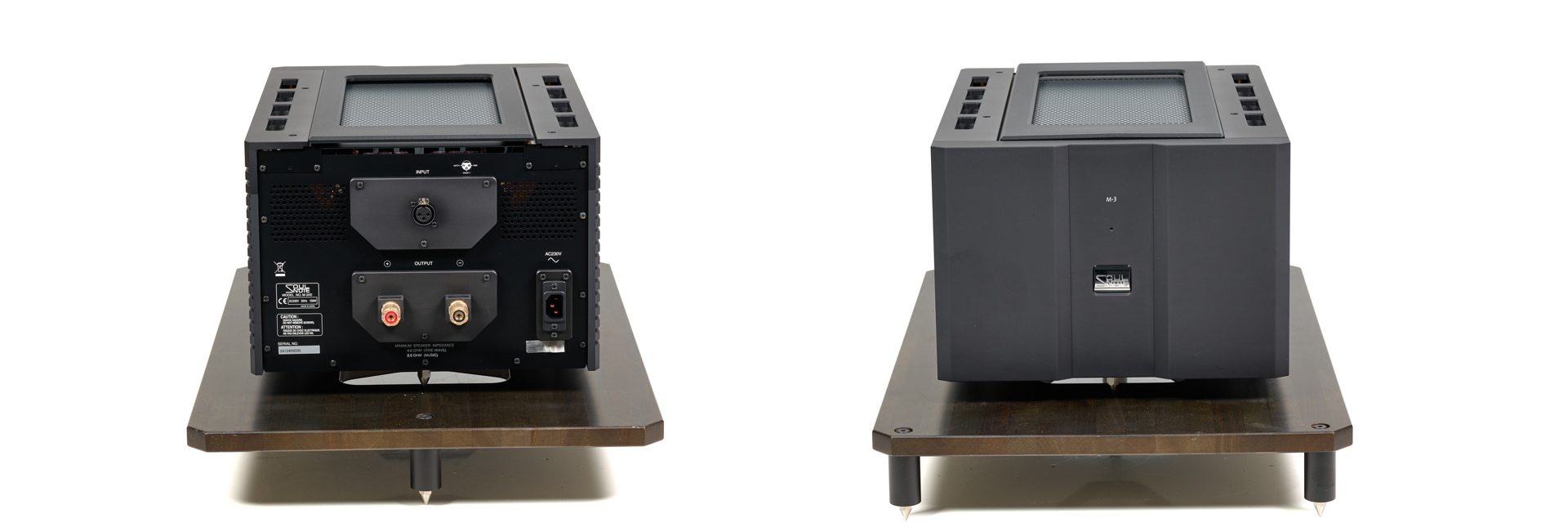
A small difference with a subtle, yet sometimes decisive effect – Soulnote offers its flagship mono power amp M-3 in a standard version and as the M-3X with double the current capacity. We placed these two outstanding powerhouses side by side and went looking for differences.
There are manufacturers who cultivate certain quirks – one or two small distinguishing features in circuit design that make their machines stand among a million others. Then there are true innovators who bring entire bundles of original ideas and concepts to the table. That’s where the air starts to get noticeably thin. The tightly interwoven Linn ecosystem or the exceptional components from Aavik come to mind as examples. Japanese engineer Hideki Kato goes one step further: his components are conceived and executed so differently that I don’t even know where to begin listing their peculiarities.
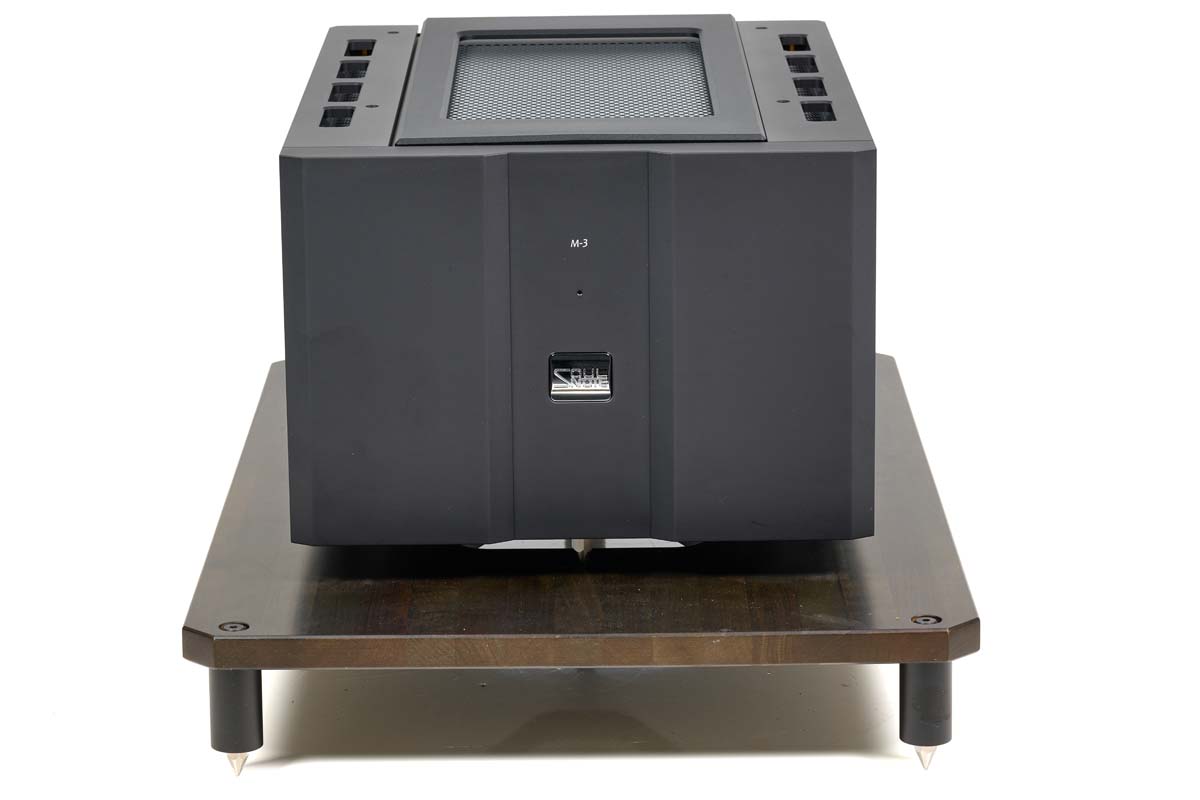
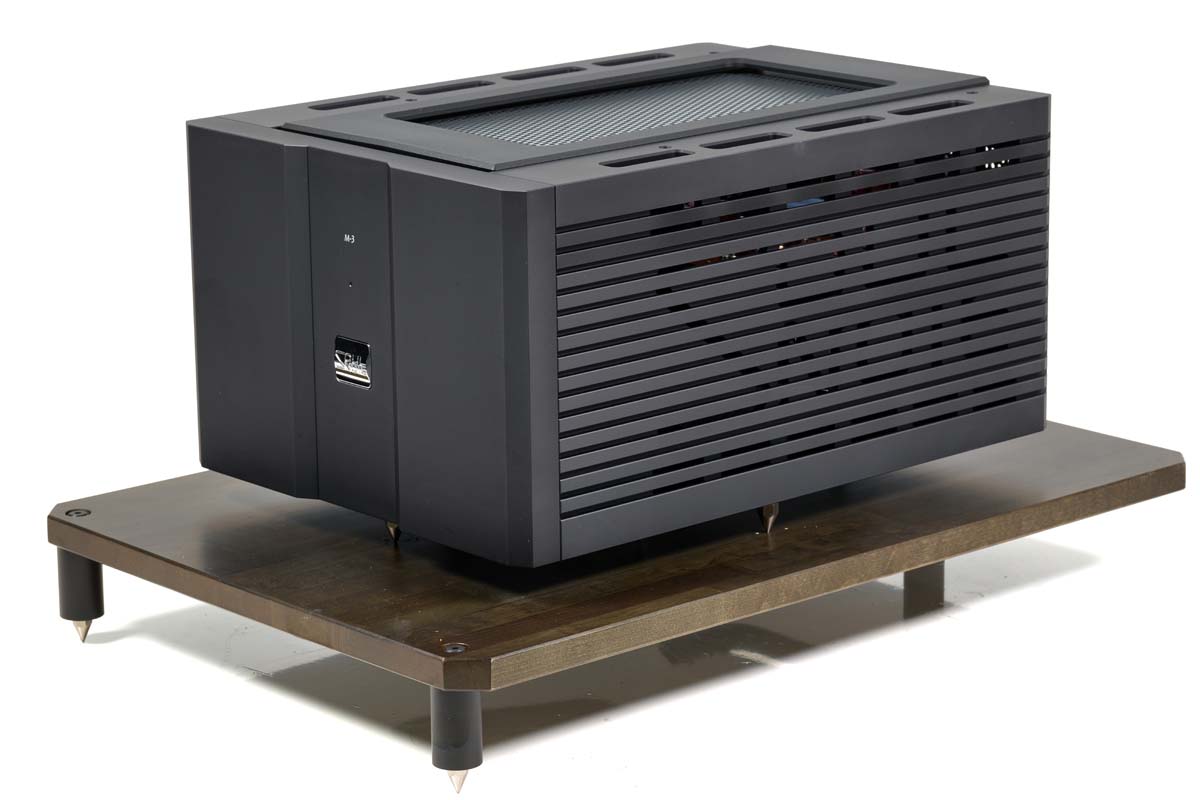
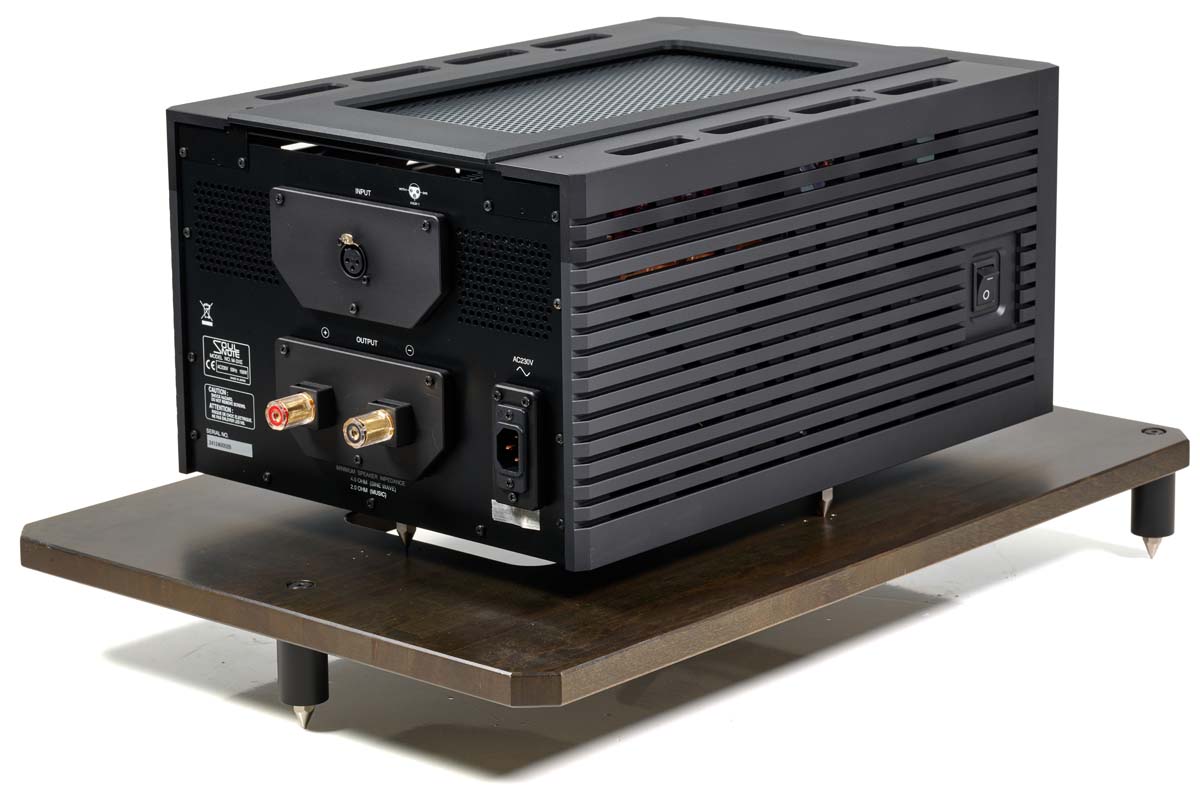
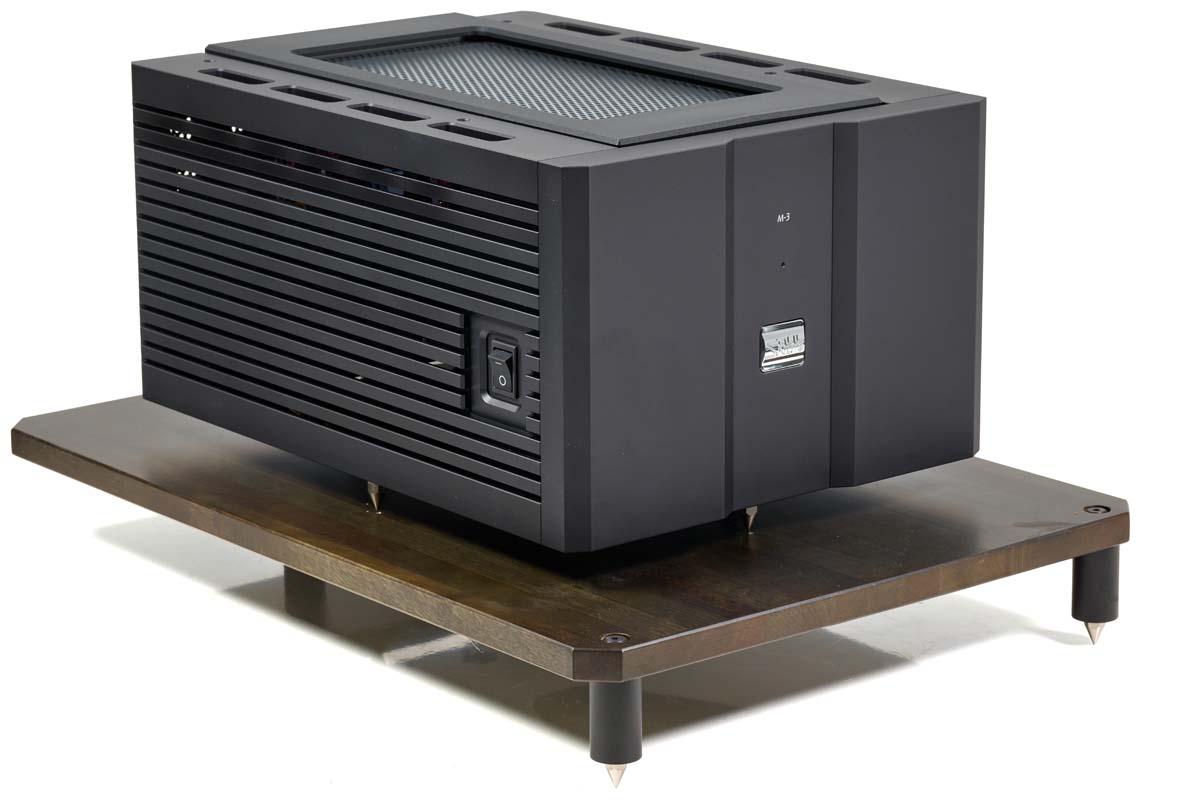
This becomes clear as soon as you unpack and set up the hefty M-3 power amps. After freeing the superbly protected monoliths from layers of film and several magenta foam pads, your eye is immediately drawn to four massive, high-gloss safety bolts protruding from the top panels. Unscrewing these bolts – preferably in a cross pattern – triggers things inside that you wouldn’t expect from a massive power amplifier. The entire signal processing section is suspended in an isolated support frame. With the bolts removed, this frame disengages and briefly takes on a disconcerting life of its own before settling into its resting position. Only the large toroidal transformer remains anchored behind the front panel.
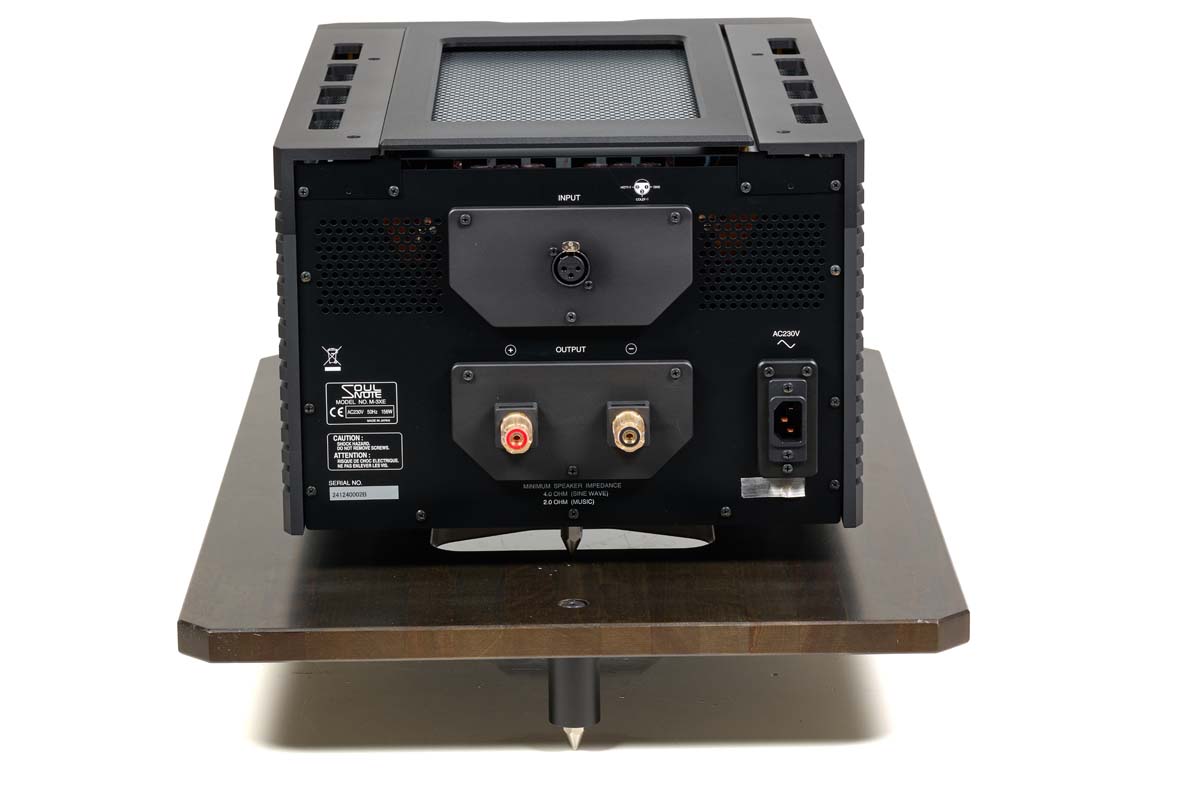
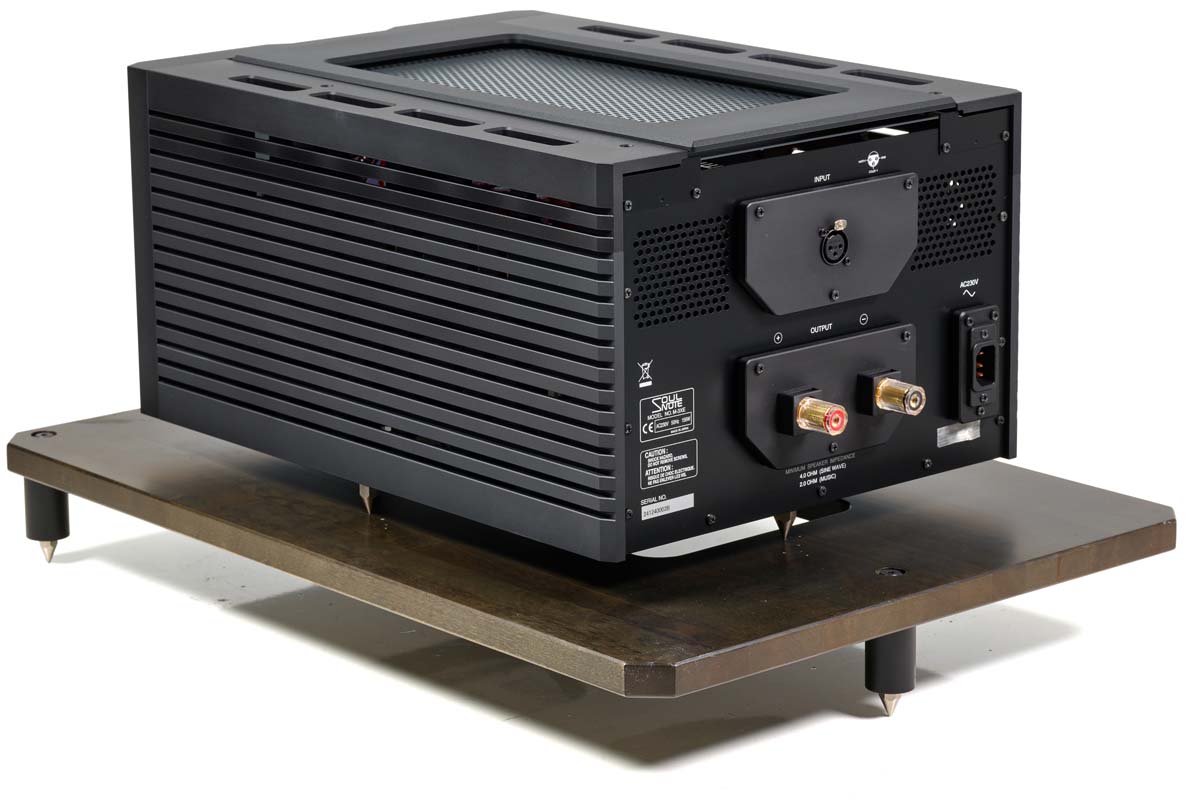
This brings us right to the heart of one of Hideki Kato’s core design philosophies. For him, mass is indeed an obligation – but one tied more to tactile satisfaction and the expectations surrounding mono power amps in this price class. Each M-3 weighs 31 kilograms due to its multi-layered enclosure and the need for a reliable power source, i.e., the transformer. Electrically, however, the designer favors lightness – and in a way I’ve never encountered before. Not only is the tray containing the critical components decoupled from the enclosure, but assemblies such as the rear terminals, the power inlet, and even the capacitors are free to move. The top panel can shift by a few millimeters, while the visible base and the outer walls attached to it form a kind of cage. Three of the six spike feet – serious enough to require a permit, metaphorically speaking – are attached to this structure, while the remaining three are bolted through large openings to the internal tray. In this way, the enclosure with transformer and the signal processing section stand isolated from one another, each on its own “feet.” To allow the enclosure concept to quite literally “take hold,” each M-3 comes with a lightweight wooden base with its own feet. This board, essential to the sonic concept, not only provides optimal support but also features large openings that ensure perfect air circulation for the purely passively cooled amplifiers.
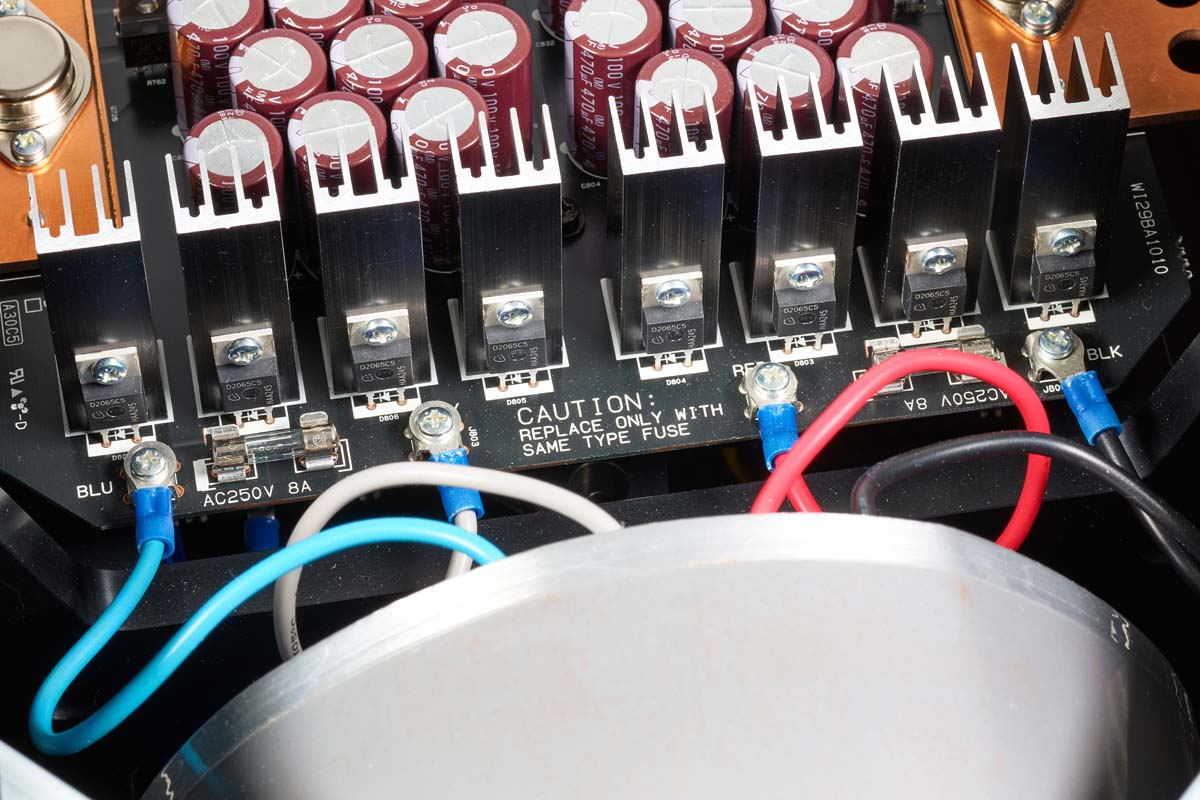
The looseness of the components serves a purpose found, in varying degrees, across all Soulnote devices. In Kato’s view, it would be fatal to suppress the electrical vibrations of components through mass, damping, or similar measures – that would simply cause unwanted energy to build up. Far better, he argues, to let it dissipate as easily as possible: in Soulnote designs, capacitors and resistors are free to vibrate and release their resonances into the air volume inside the amplifier. This approach requires not only a very specific construction but also suitable components. For example, the large 1600 VA toroidal transformer – mechanically decoupled from the inner chassis – sits in its shielding enclosure without the usual epoxy potting, giving it room to move. Apart from this copper block, you won’t find a single component in the M-3 larger than a fingertip. Instead of relying on “soda-can” capacitors, Hideki Kato favors a power supply that draws its capacity from many small 470 µF capacitors – tiny, featherweight parts arranged in a high-speed phalanx that have no trouble dissipating vibrations into their surroundings.
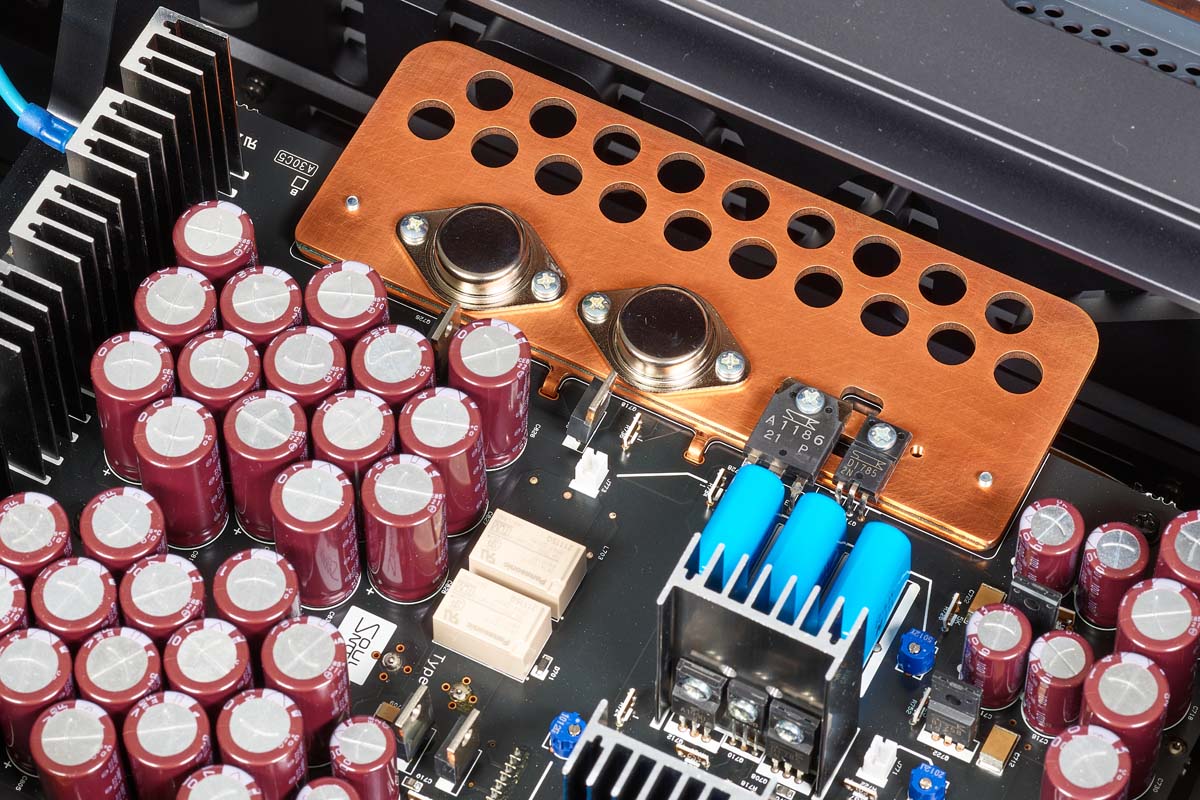
The actual voltage amplifier is implemented in a layout that Kato, with a wink, calls a “Type-R” circuit. The “R” stands for “Reference,” which could be translated as “the best I can do.” The fundamental principles of the circuit can be summarized as purism and the absence of feedback – so important to the designer that his Non-NFB (no negative feedback) philosophy appears on T-shirts and logos. This purism is reflected in the fact that from emitter follower through voltage amplification to the differential stage, only a single transistor is used. The final single push-pull power amplification stage is similarly ingenious, delivering a solid 160 watts into 4 ohms across an impressive bandwidth from 2 Hz to 200 kHz. The four-stage Darlington circuit uses round TO-3 transistors mounted directly onto large copper rails attached to the enclosure walls – rails that serve as both current paths and heat sinks. A textbook case of killing multiple birds with one stone.
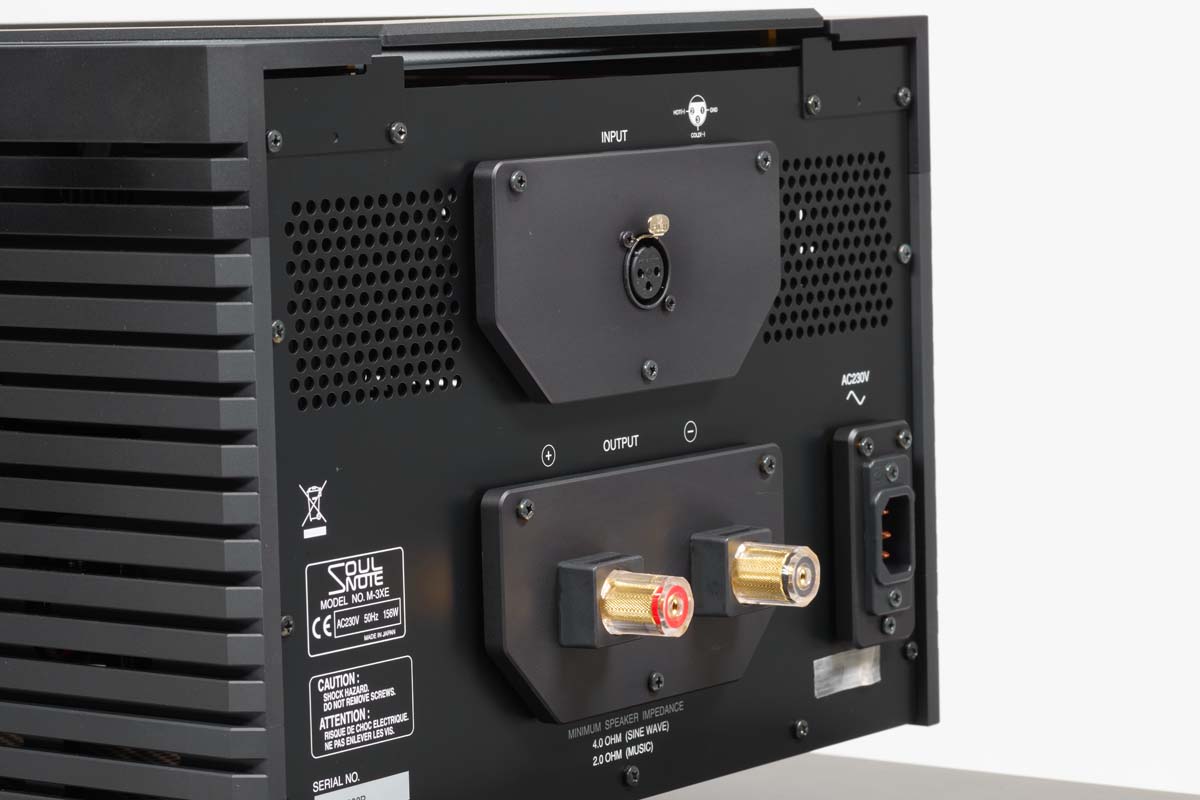
It goes without saying that the feature set follows the same purism and clarity: signals enter via a single XLR input and exit through a single-wire terminal (spade/banana), which proved sufficiently robust in testing and held every connector securely. By his own admission, Kato has an aversion to unnecessary buttons, selectors, and switches. Anyone wishing to operate an M-3 should be capable of flipping the power switch on the side – that’s all there is to it.
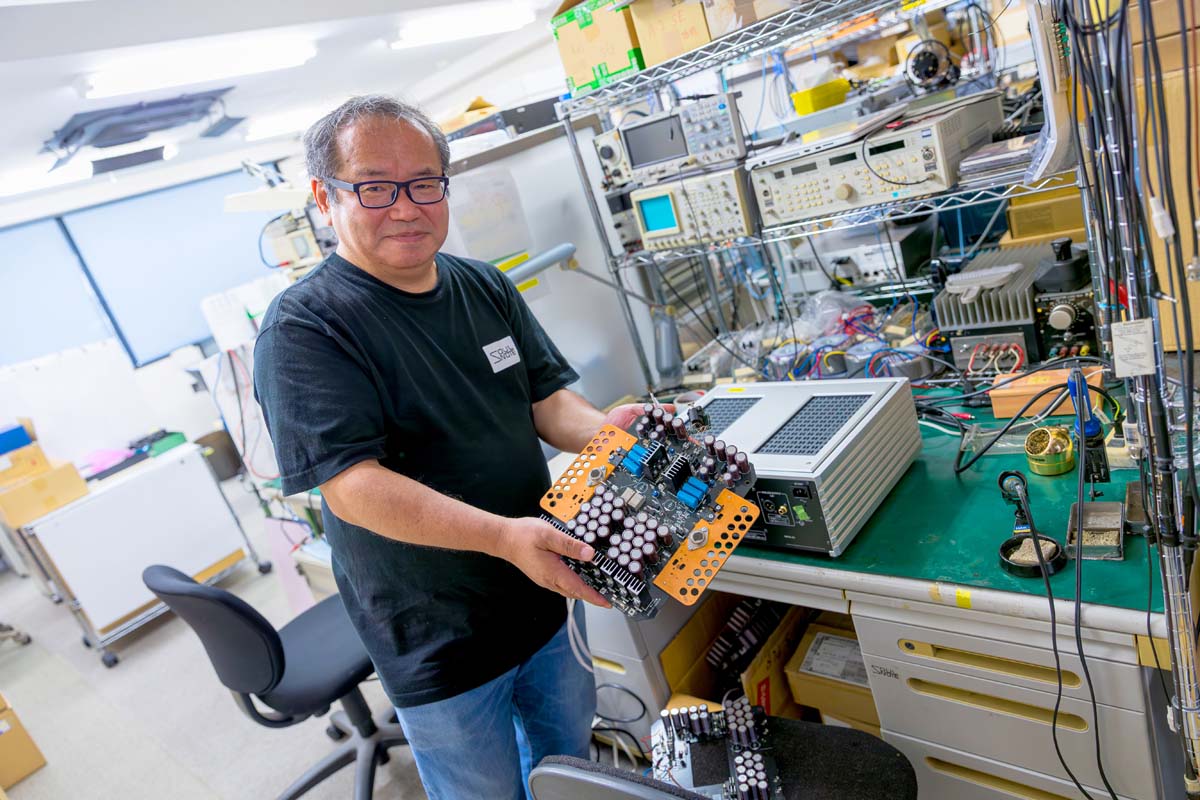
That covers the key design aspects, and of course I’m aware that Kato – who can speak for hours about the details and nuances of his components – might raise an eyebrow at some of my shortcuts. More interesting, however, is a look at the developer’s background, which reveals much about the systematic nature of his designs. Before founding Soulnote, Hideki Kato worked for Marantz, developing many of the company’s AV receivers in the 1990s. That may not sound like high-end at first, but in the relentless pursuit of shaving off every penny possible, he had to engage deeply with his circuits and find alternative solutions in ways that still influence him today. Moreover, a mass manufacturer like Marantz focuses not on building a single excellent amplifier but on producing thousands of units with consistent quality.
And just as a cat can’t stop hunting, Kato hasn’t been able to shed this part of his past. Although Soulnote’s Series 3 now occupies a class far beyond anything his former employer touches, the components are still manufactured by a supplier in northern Japan whom Kato first worked with during his Marantz days. And because he can design not only PCB layouts but complete CAD construction plans, the M-3 and its relatives are engineered so that errors are virtually impossible even in mass production – another area where many competitors fall short.
But enough about wattage and blueprints. I should perhaps explain that this review of Soulnote’s M-3 is something of a mirror image – the “other side” of an article you may have already read here. The Monday after the HIGH END show, we were visited by Wilson Benesch and distributor IAD. They set up the unforgettable Omnium in our listening room, and since we were somewhat short on amplification at the time (another trade show phenomenon), a pair of M-3s along with the matching P-3 preamp had already arrived a few days earlier, initially as bystanders. I’m not particularly emotional – especially not about hi-fi. But what these partners conjured onto our listening room floor within minutes was so harmonious and captivating that even I was left speechless. A performance that’s not easy to put into words despite all enthusiasm. The M-3 is, in a sense, a powerhouse without a sonic signature – and that’s meant as the highest praise. If I’ve ever experienced an amplifier creating a direct connection between source and speaker, it was here. The real achievement of these mono amps lies in what they omit: these ultra-wideband amplifiers add absolutely no coloration or filtering. And the purism of their circuits keeps phase and impulse exactly where they belong. Translated, that means timing and musicality in their purest form.
In conversation with the distributor, we learned that a further developed version of the amplifiers would be available in the summer – externally identical to our test units, distinguishable only by the “M-3X” label on the back. The idea of trying these models as well gradually took shape.
The difference comes down to a small but crucial internal detail: where the M-3 uses single push-pull, the M-3X employs parallel push-pull. Evidence of this can be found in the additional set of TO-3 transistors on the combined power/heat sink rail. As Hideki Kato explained, this changes nothing in terms of the amplifier’s basic specs or performance figures. We’re still dealing with 80 watts into 8 ohms and 160 watts into 4 ohms. However, the M-3X has double the current capacity. This becomes noticeable with speakers that have unusual impedance curves or particularly low efficiency. Such exotic designs can be driven more stably by the “X” without sacrificing the advantages of the lightning-fast push-pull circuit. The real challenge, Kato said, was matching suitable transistor pairs. It was nearly impossible to find pairs that behaved identically. The hFE (current gain factor) changes over time due to factors like operating temperature and current fluctuations, and each transistor responds slightly differently. It took quite some time to identify the decisive parameters. Soulnote measures the required characteristics of the TO-3 transistors and averages their behavior using a complex set of mathematical formulas that also had to be developed. Only this made it possible to build parallel output stages that approach the symmetry and precision of the single configuration.
The differences between the amplifier generations (M-3 and M-3X are offered in parallel) are indeed subtle and initially led me astray: in direct comparison with the Wilson Benesch Omnium, Auer Acoustics Versura V4, or Wilson Audio Sasha DAW, I initially assumed a power difference. Tonally, the M-3X is virtually identical to the M-3, but it seemed just a touch louder. This impression was reinforced by an oversight: while the M-3 is listed at 160 watts (4 ohms), Soulnote specifies only the maximum output of 240 watts at 2.7 ohms for the M-3X – though this figure also applies to the M-3. In reality, the M-3X seems to handle the individual quirks of these ostensibly easy-to-drive flagship speakers slightly better than the M-3. With one (Wilson Benesch), it may be the bass concept; with another (Auer), the sealed enclosure; and with Wilson Audio, the much-praised midrange presence, which the M-3X controls or reveals more effectively. This resulted in deeper blackness and calm in the bass with the Omnium and a delicate silkiness in the mids with the Sasha DAW – qualities we didn’t want to give up after repeated A/B comparisons.
So to sum up: with the M-3, Soulnote has created a precision instrument that, despite all its technical finesse, has a keen sense for emotion. Or perhaps I should say: it passes on the drive, musical accuracy, and groove of a recording remarkably unchanged to the speakers. When a bassist and drummer lock in at the studio and find their swing, the M-3 makes it tangible without adding or subtracting anything. This magic is generated by an entire catalog of unique technical and structural measures that are without precedent!
Mono Power Amplifier Soulnote M-3 and M-3X
Concept: mono power amps with single push-pull (M-3) or parallel push-pull (M-3X) amplification | Output (8/4 Ω): 80/160 W | Maximum output (2.7 Ω): 240 W | THD (1 W): 0.1% | Frequency response (±1 dB): 2 Hz to 200 kHz | Input sensitivity/impedance: 2 V/25 kΩ | Maximum gain: 22 dB | Power consumption (operation/idle): 156 W/38 W | Accessories: manual, floorboard, power cord, safety bolts | Finishes: silver, black | Dimensions (W/H/D): 34/26/51 cm | Weight: 31 kg each | Warranty: 2 years (3 after registration) | Price per pair: M-3 approx. €39,800, M-3X approx. €41,800