

Erik Satie (1866–1925) was something like the eccentric uncle of the French music scene—the one who, at family gatherings, doesn’t play as expected but instead shows up deliberately late in a velvet suit and tells everyone he now writes only “two-minute pieces.”
Born in Honfleur in Normandy, Erik Satie moved to Paris as a young man, where he soon worked as a pianist in the cabarets of Montmartre. His early works, including the famous Gymnopédies (1888), sounded so simple that contemporaries took them for sketches—yet Satie regarded them as finished art. He loved the unfinished, the quirky, music that worked “differently than expected.” His eccentricity extended far beyond music: Satie always wore the same brown velvet suit, collected umbrellas (often without using them), and wrote instructions in his scores such as “Play as if a pumpkin were watching you.” He avoided large orchestral works and preferred small, sharply pointed forms that felt more like miniatures—often with absurd titles such as Trois morceaux en forme de poire (“Three Pieces in the Shape of a Pear”).
Musically, he fell between all the cracks: too playful for academic seriousness, too pared down for opera houses. And yet he influenced composers such as Debussy and Ravel, and later even John Cage. His closeness to avant-garde artists and writers brought him into contact with surrealist circles—he wrote stage music for Jean Cocteau, collaborated with Picasso and Braque, and took pleasure in not fitting into any mold. Satie loved repetition and subtle rhythmic shifts; one might say he was writing “loop music” long before tape recorders or sequencers existed. He was also a pioneer of musique d’ameublement—“furniture music”: pieces deliberately conceived as background music, not meant to be listened to attentively. At the time, this idea was considered an artistic provocation; today, in the age of streaming, it feels almost visionary.
He died in Paris in 1925, impoverished but with a lasting impact on music history. Today he is regarded as a forerunner of minimalism and a master of ironic distance—a man who managed to compose with both seriousness and a wink. Or, perhaps most aptly: the only composer for whom even the silences are pointed.
Dead for 100 Years—and Still Elusive: Erik Satie’s Barely Moving Discography
The year 2025 marked the 100th anniversary of Erik Satie’s death—but anyone hoping for a wave of new recordings was disappointed. Hardly any fresh releases, hardly any noticeable commemoration in the recording market. And yet his music is everywhere: as the soundtrack for commercials, as an atmospheric wash in films, as sonic wallpaper at gallery openings. Still, Satie remains—as ever—a phantom. He would have enjoyed this game of hide-and-seek.
One reason for the quiet anniversary may be that there are already more than a dozen complete recordings of his works from the past five decades. Pianist Alain Planès, a self-declared admirer of Satie, could not simply let the centenary pass by.

Playing an original 1928 Pleyel grand piano, he unfolds a panorama of Satie’s skewed, poetic, and often mocking music. He is joined by Marc Mauillon (voice) and François Pinel (as his four-hands piano partner), who travel with him through the musical miniatures of the master of Arcueil.
The Satie/Planès booklet is more than mere accompaniment: it includes drawings by Satie himself—as well as by the performer. A homage that is at once tongue-in-cheek and serious, entirely in keeping with its subject.
The second noteworthy release is, strictly speaking, not a new recording but a remaster: Jean-Yves Thibaudet’s 2001 album The Magic of Satie has been reissued in improved sound quality.
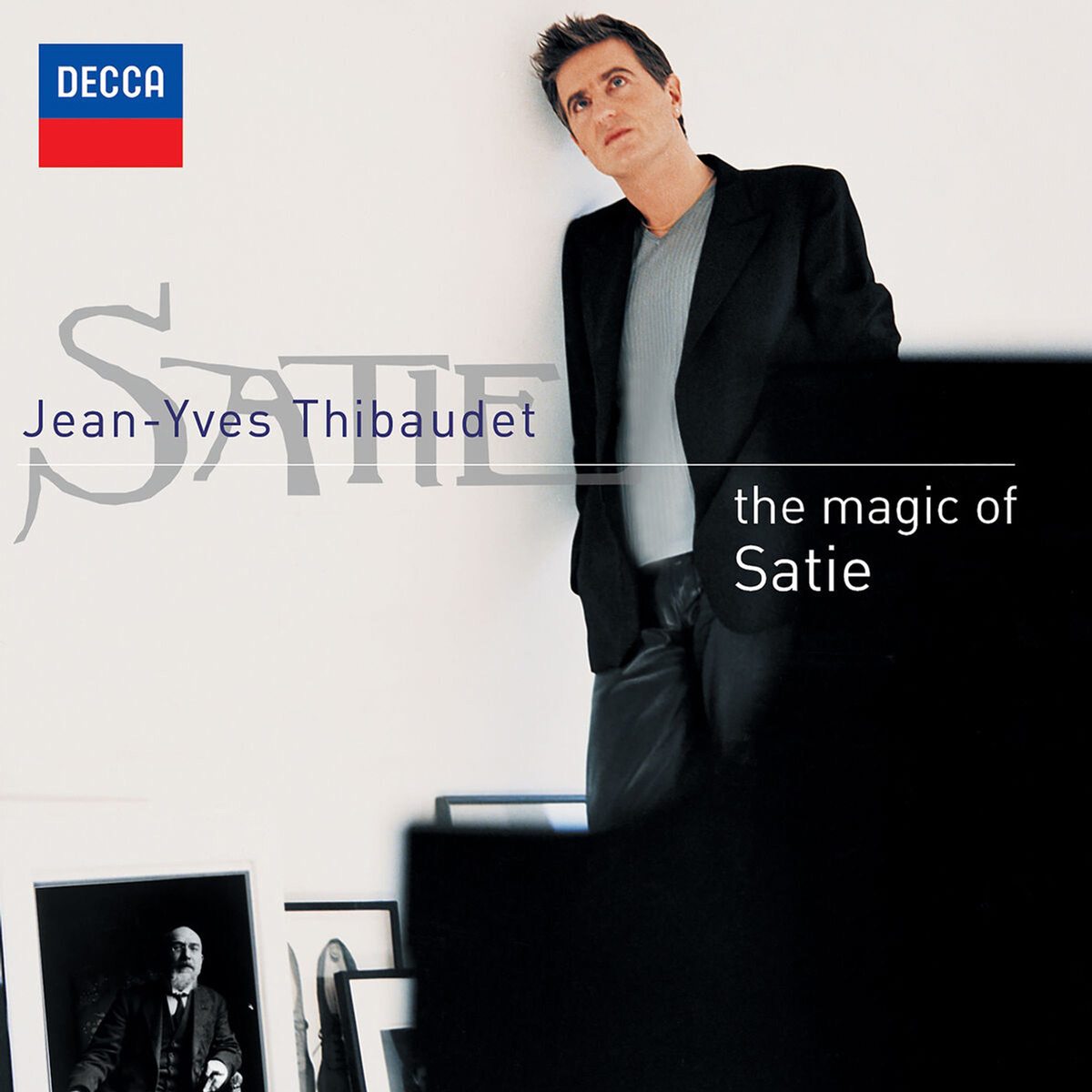
Thibaudet consistently opts for the original versions, which is by no means a given among Satie interpreters. His selection is well balanced: esoteric, dreamlike works sit alongside cheeky cabaret pieces. Above all, Thibaudet offers a fascinating counterpoint to Planès: where Planès presses forward, Thibaudet holds back. Instead of racing miniatures, we hear contemplative slow motion—without losing the spirit of the music.
Satie remains elusive—even 100 years after his death. Perhaps that is precisely why we don’t need many new recordings, but rather the right ones. And these show: one musician plays him like an anarchic dandy. The other like a Zen monk. Both sides belong to him.
A Composer Like No Other—and a Book That Does Him Justice: Oliver Vogel’s Erik Satie

Even a hundred years after his death, Erik Satie remains a mystery—a musician suspended between irony and seriousness. Musicologist Oliver Vogel has set out to trace this shimmering outsider, and with his Satie biography presents a work as multifaceted as its subject. Vogel draws on a vast trove of eyewitness accounts, letters, and sketches, creating a finely wrought portrait that does not reduce Satie to mere eccentricity but shows him in all his complexity: as a seeker, a skeptic, a musical tinkerer with a keen sense of structure and contradiction.
The book broadly follows a chronological path—from the early cabaret years in Montmartre through Satie’s stubbornly unconventional period of study to the later years, when he achieved fame against his will. Vogel makes one thing clear: this music is not just a style but an attitude—laconic, profound, subversive. What may seem playful at first glance reveals itself, in Vogel’s reading, as music with a multilayered substructure, an art of deliberate irritation.
That the book runs to nearly 700 pages never feels excessive—on the contrary, with every page it opens up deeper insight into an artistic life that was ahead of its time and yet strangely close to our own. Anyone who reads this book will not forget Satie. And may finally understand why even his silences are music.
Jean-Yves Thibaudet – The Magic of Satie
Label: Decca
Format: LP, CD, DL 24/48
Satie. Planès
Alain Planès, François Pinel, Marc Mauillon
Label: Harmonia Mundi
Format: CD, DL 24/96
Oliver Vogel – Erik Satie – The Skeptic Classic
Publisher: Bärenreiter/Metzler