
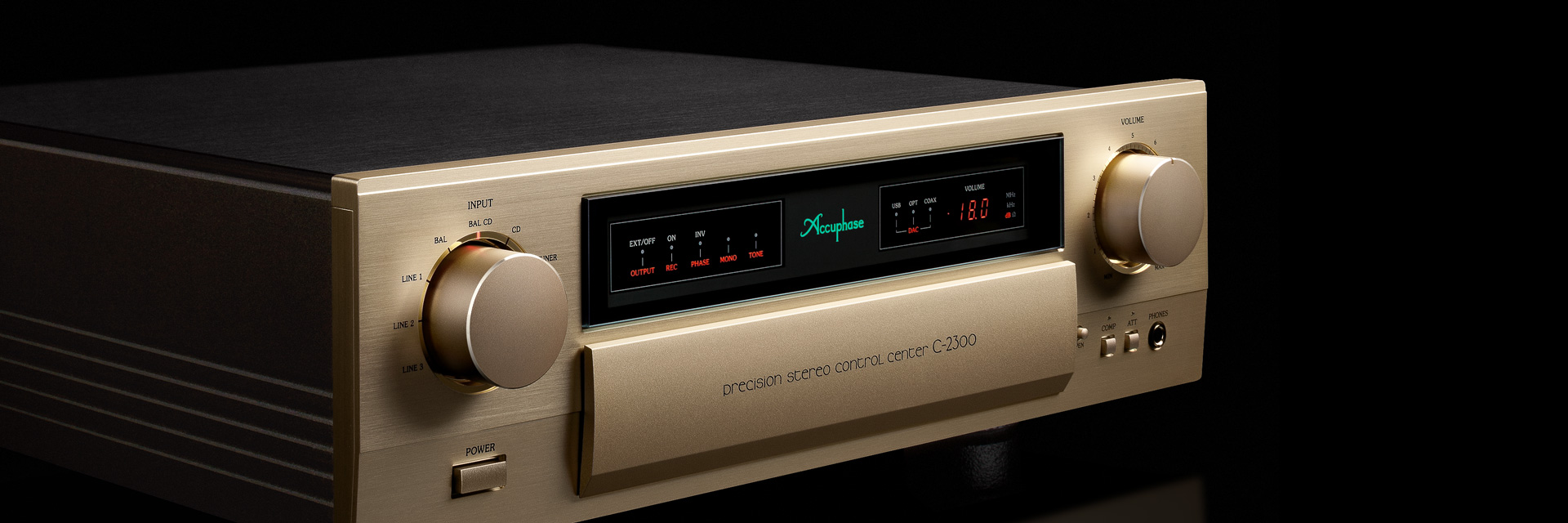
When you read these lines, the Accuphase C-2300 will already have left the FIDELITY premises. And if you’re reading acceptance of separation between these lines, you’re reading this right: Like every component from the Japanese manufacturer, this preamplifier demonstrates why to many audiophiles, Accuphase isn’t just a high-end manufacturer, but the high-end manufacturer.
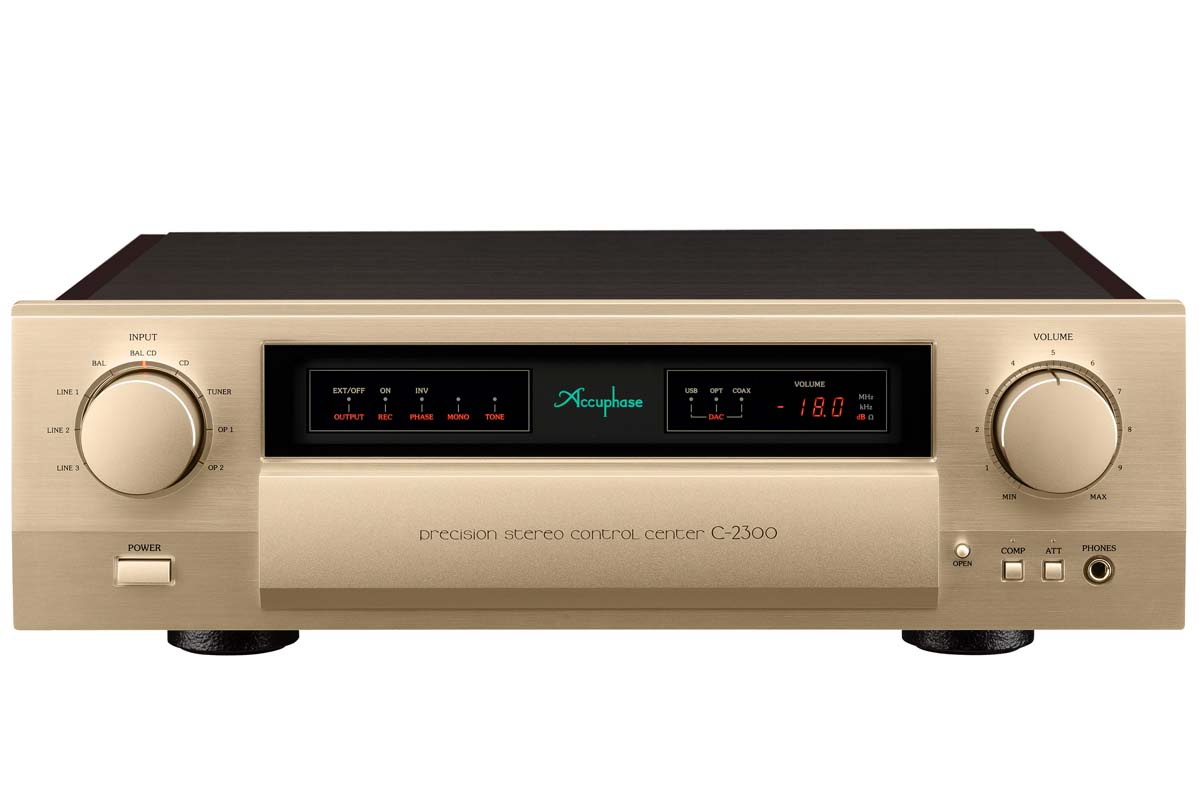
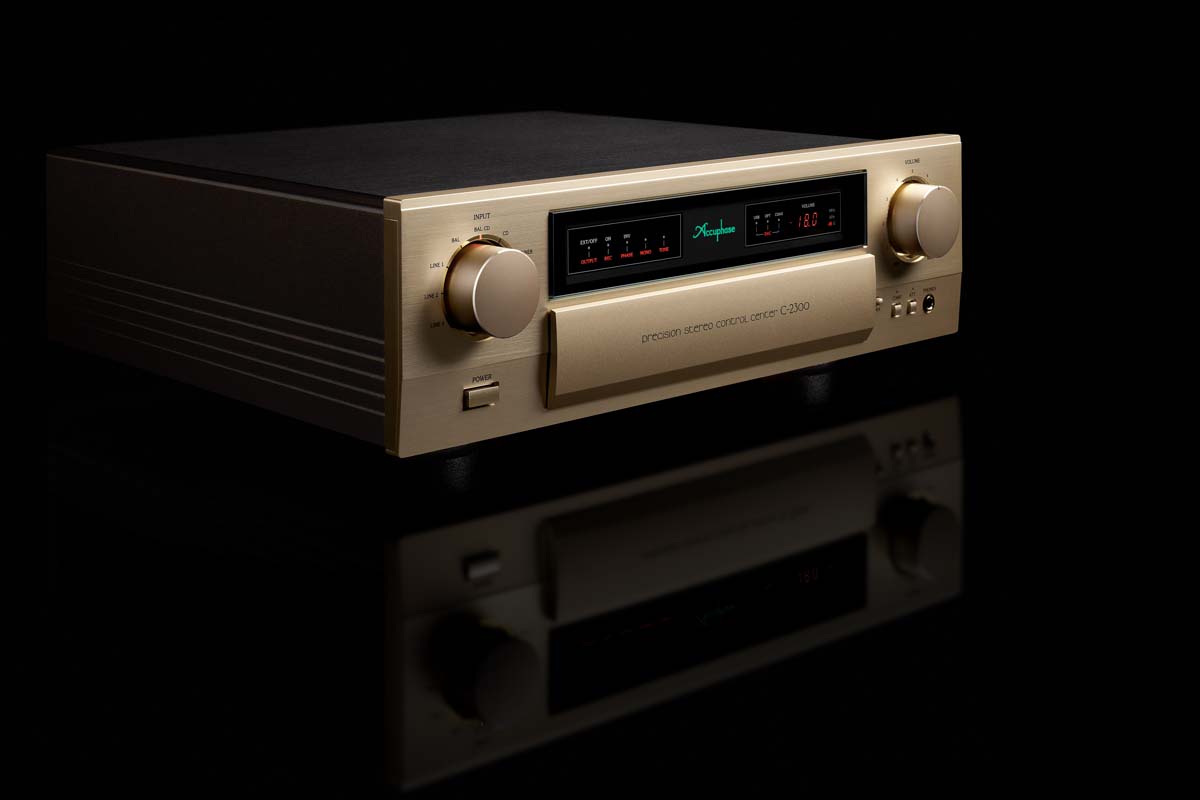
The presence of an Accuphase component is unmistakable. Anyone with more than a passing interest in hi-fi knows exactly what I mean. The classic look in the famous champagne finish certainly plays a role, but the distinctive exterior merely scratches the proverbial surface. The superbly finished front panel projects a reputation that may well be exclusive to this brand; a promise of quality that every connoisseur knows isn’t merely fulfilled in every conceivable respect, but consistently exceeded.
We have been able to operate the preamplifier in our listening room for quite some time now. You may remember: We reviewed the P-7500 power amplifier and were already suitably impressed. The German distributor P.I.A. had provided it to us together with a matching ecosystem consisting of the CD/SACD player DP-570 and, indeed, the corresponding preamp. The power amplifier delivered such a supremely confident performance that we decided to send it – at the distributor’s suggestion – to our external measurement technician. To no one’s surprise, the behemoth not only met its impressive factory specifications across the board, but exceeded them significantly in many respects. As expected, the story now repeats itself with the C-2300: Its outstanding performance in the listening room had long since convinced us, and the measurement reports we recently received from the lab once again prove that the ambitious-looking factory specifications are, in fact, conservative.
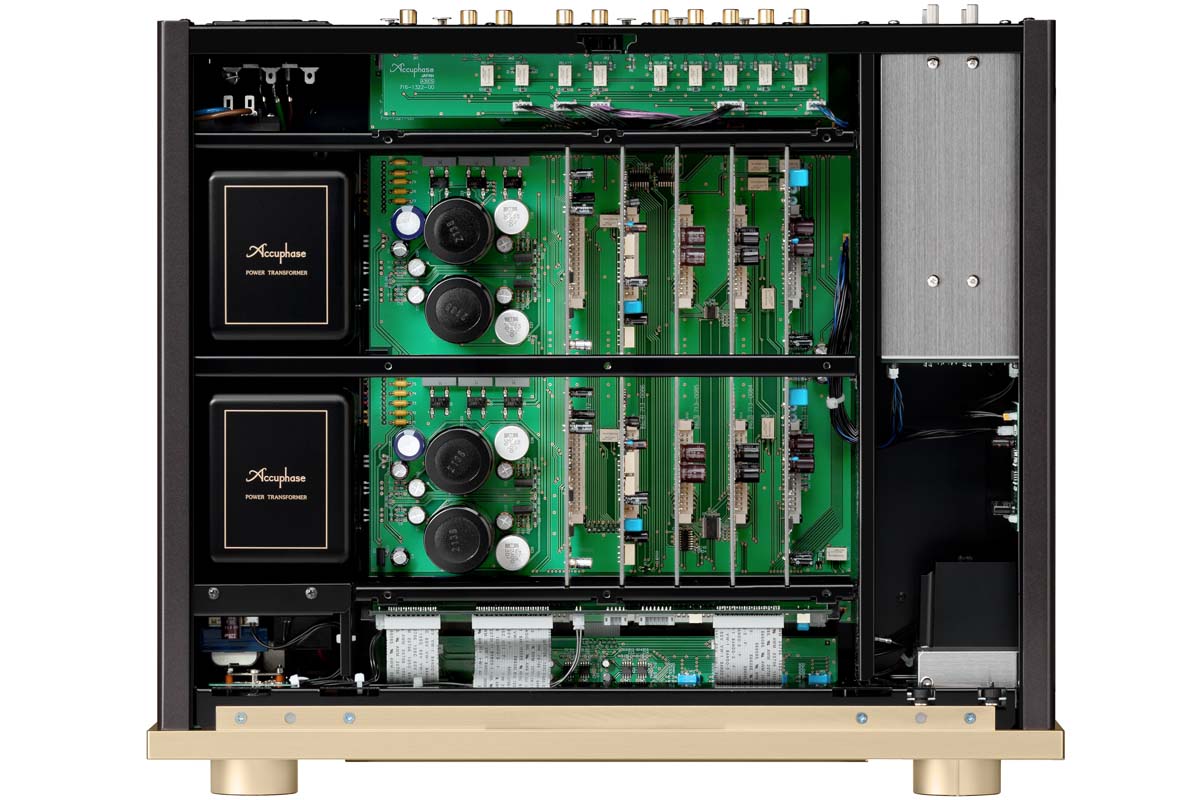
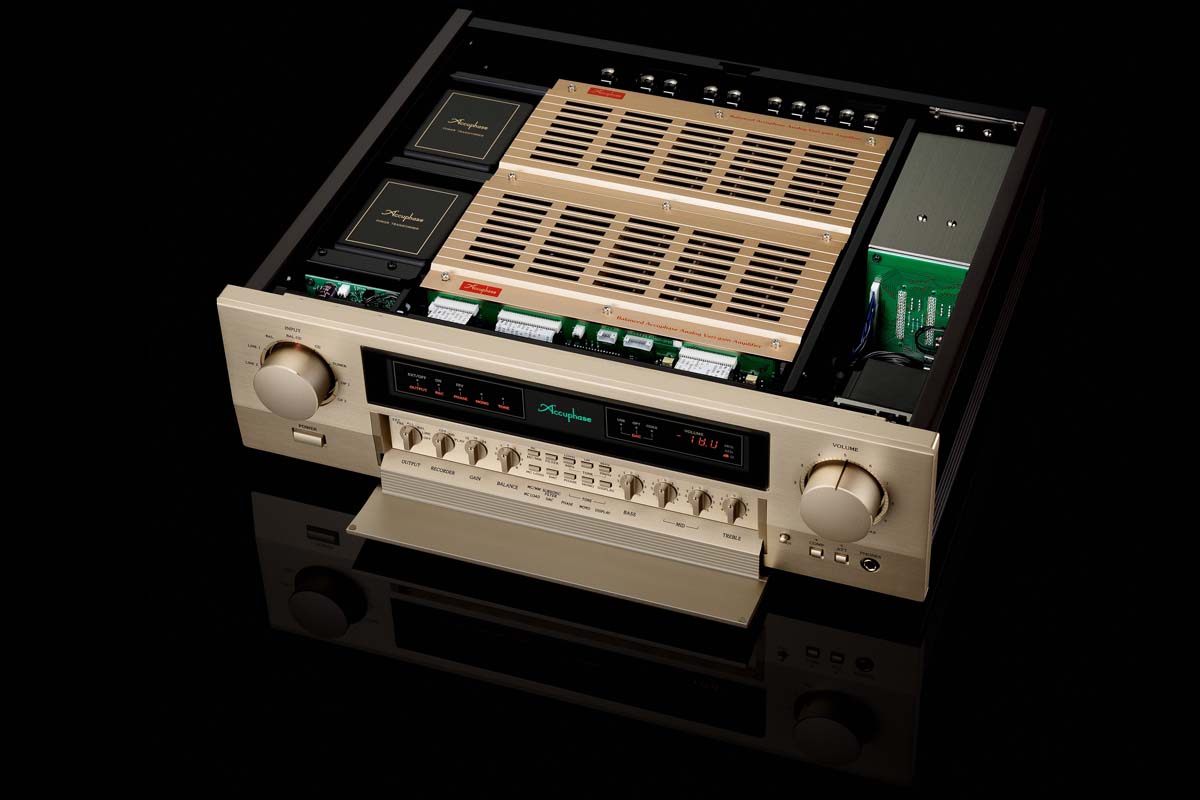
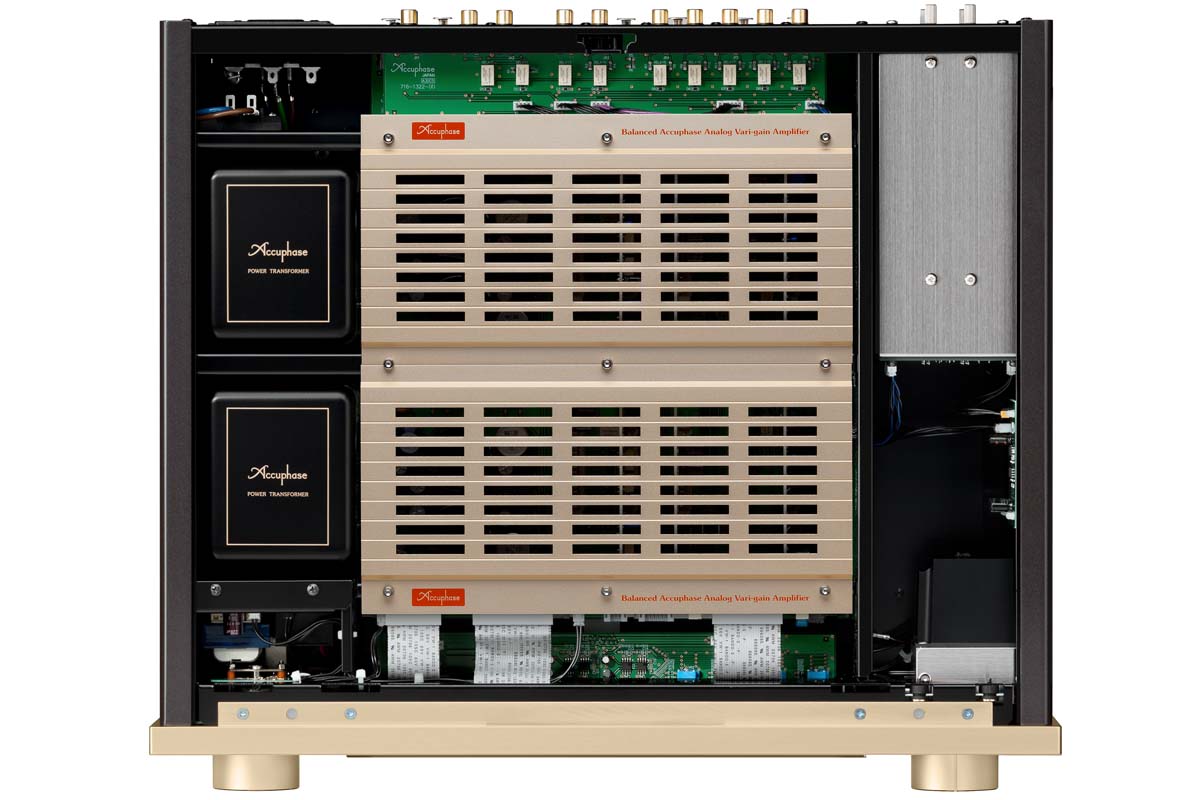
When dealing with Accuphase, the question arises time and again how the Japanese manage to stand out so consistently from the crowd in the world of high end – a world where there’s truly no shortage of outstanding components. I see two main reasons for this. The first must be the remarkable attention to detail with which the devices are developed and designed. “Attention to detail” is admittedly a somewhat tired phrase, but anyone who gets up close and personal with any of the Yokohama-made components quickly realizes that the people behind them operate on an entirely different level. Outstanding workmanship is something you naturally expect in this kind of price range, but the tactile quality of Accuphase components often elicits spontaneous expressions of astonished appreciation even from seasoned reviewers. From the firm, precise pressure points of the numerous buttons to the confident click of the rotary dials to the wonderfully silky volume control you get all the tactile goodness you expect from a high-end device – but it doesn’t stop there: it extends all the way into the interior, an area many owners will never see. Even the shielding grille revealed when removing the top cover is an absolute delight to the touch. Not a single screw is designed purely with cosmetics in mind; the device feet, for example, are made of what initially appears to be unremarkable cast iron, but the choice of alloy with a defined carbon content was made according to the criterion of optimal vibration damping.
The fact that the developers employ such an effective yet decidedly unheadline-worthy material here highlights what I’d consider the second reason, which might be described as “unagitated progress.” Just like the familiar exterior, refined to perfection over decades, every detail of the technical design reflects more than half a century of carefully curated evolution. The C-2300 is clearly not a device that tries to reinvent the wheel at every turn just so it can claim superficial novelties. And yet, generation by generation, new approaches gradually find their way into the circuit diagrams. Behind the volume control, for example, there’s no potentiometer or resistor network as one might expect. Volume control is arguably the most sonically decisive aspect of preamplifier design, which is why Accuphase pursues a proprietary approach here with its AAVA circuit – one that can rightly be considered sophisticated and genuinely innovative. Instead of first amplifying the input signal and then sending it through an inevitably lossy variable resistor, AAVA generates a whole series of identical signals with different amplitudes and recombines them according to the control position to achieve the desired output level, thereby circumventing the supposed necessity of signal attenuation.
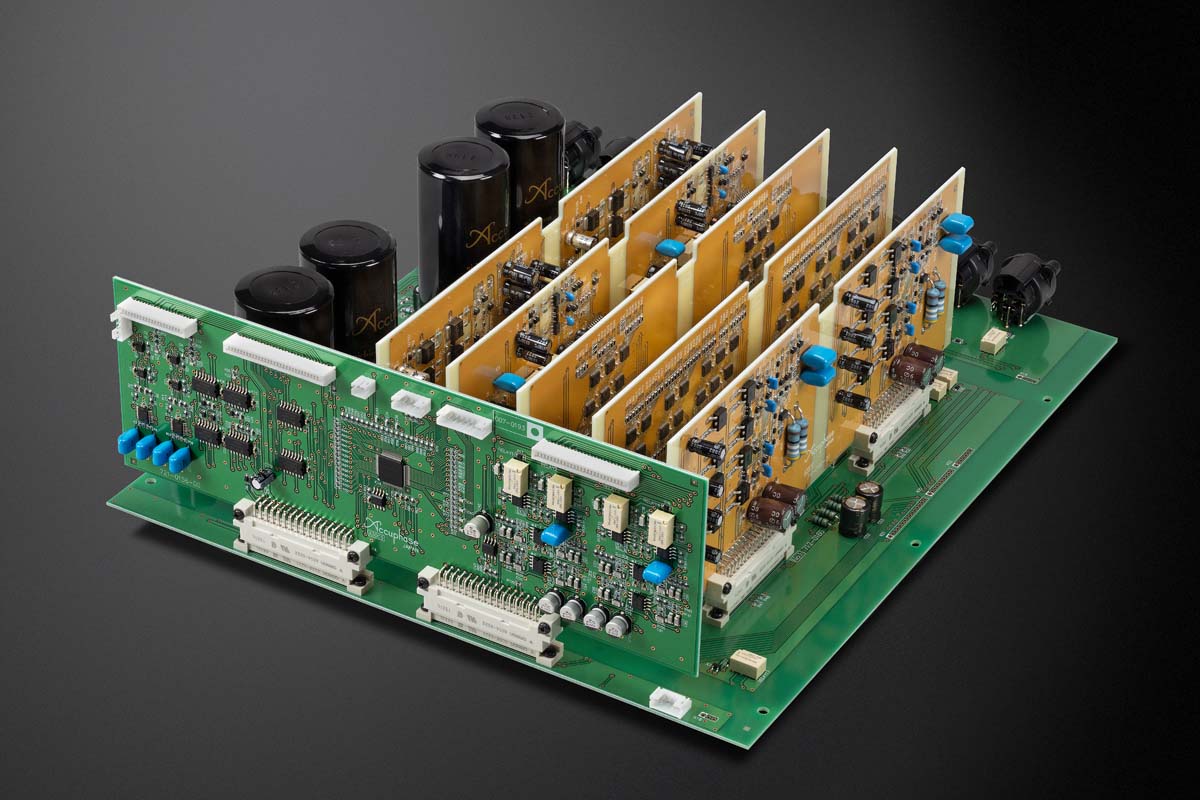
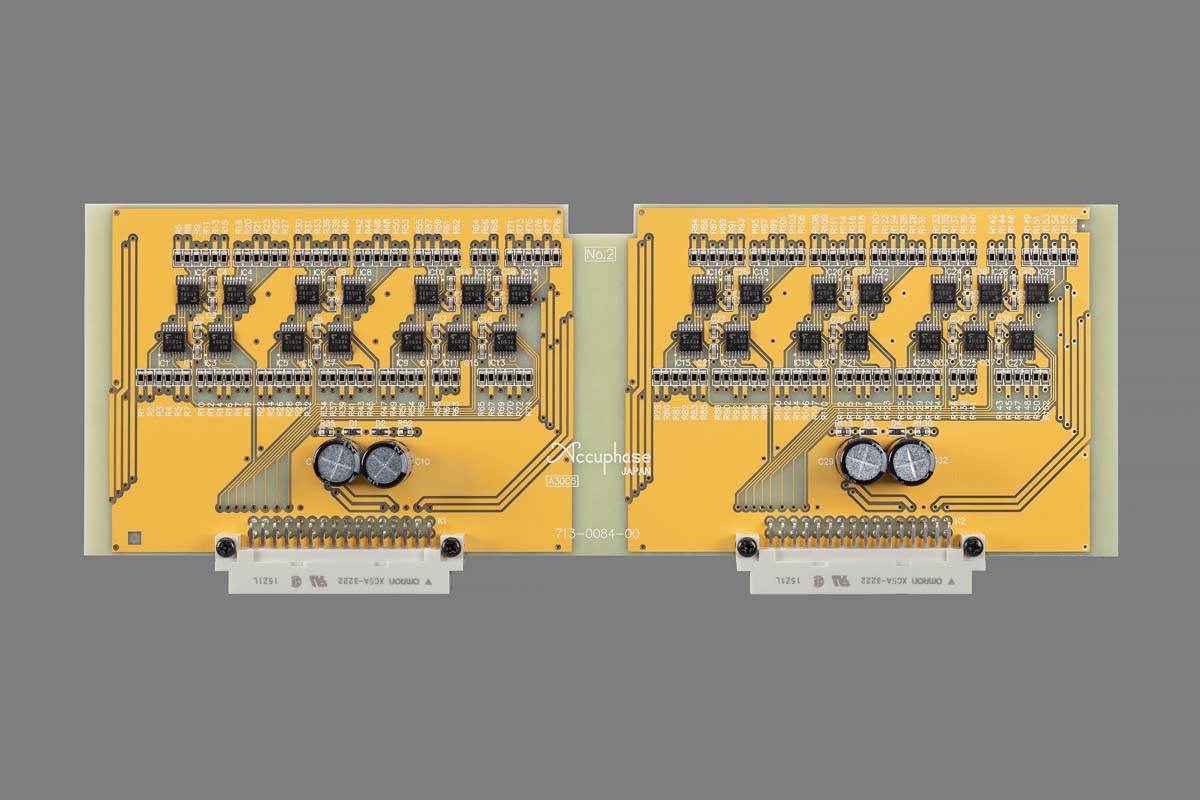
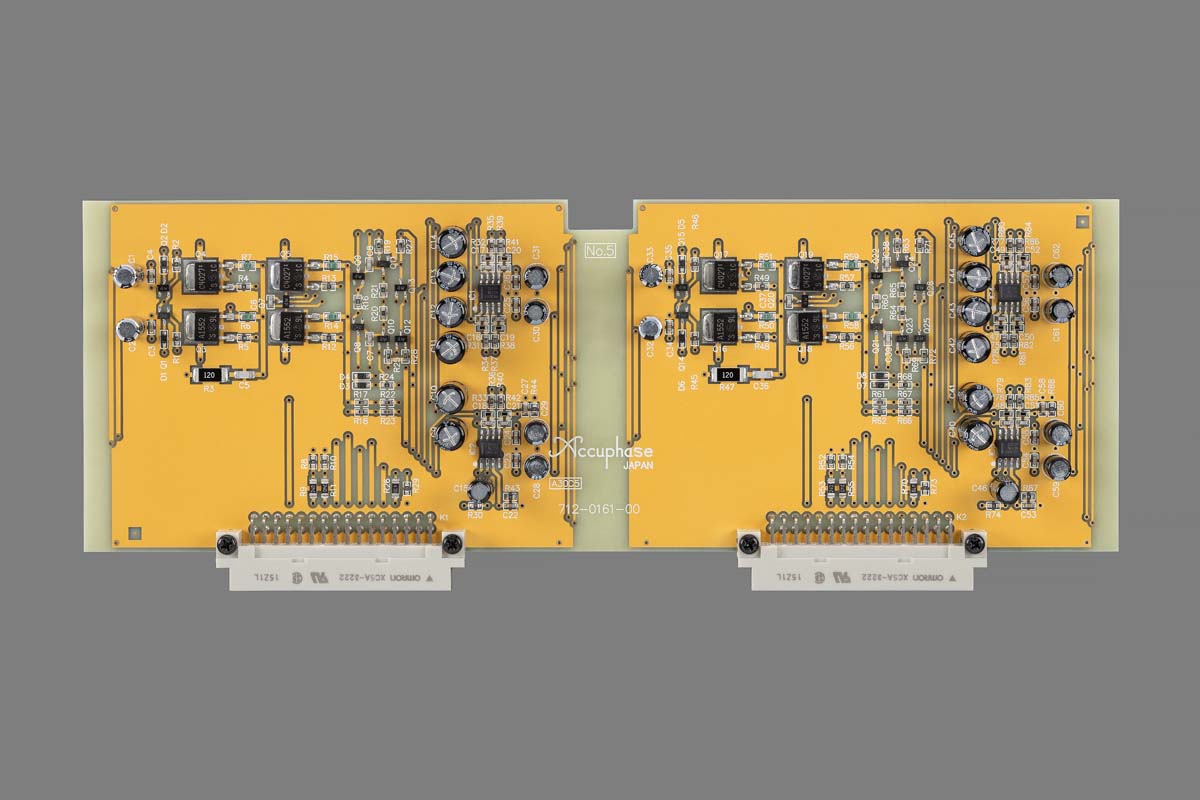
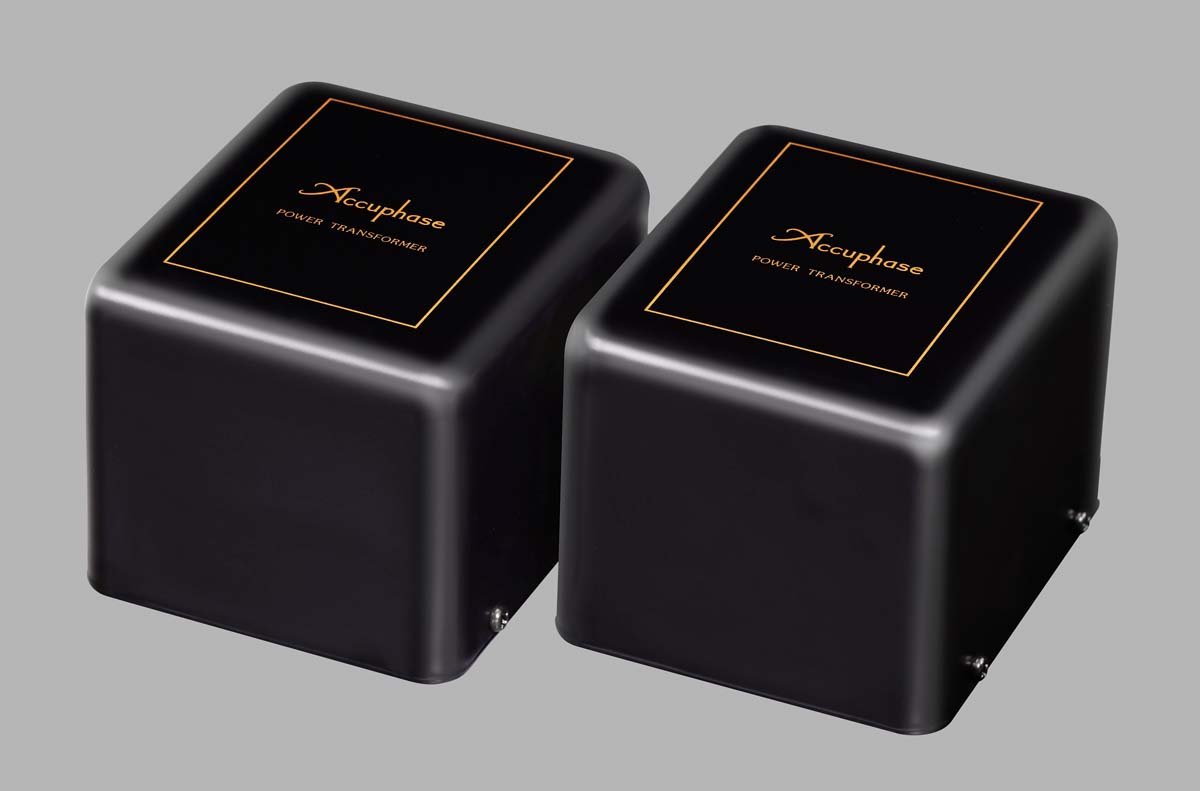
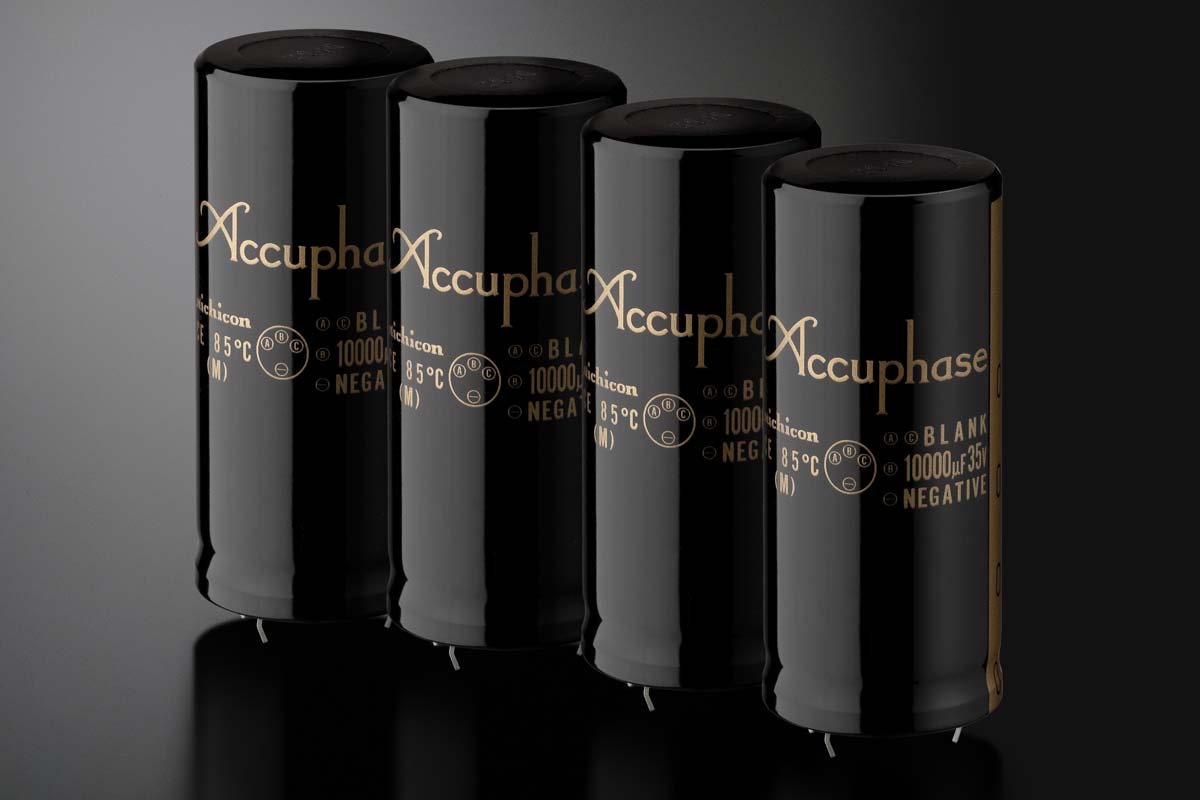
This concept has been employed before, but for the C-2300 it has been further developed into a symmetrical version that reduces distortion by another ten percent compared to the already sensationally low values of the predecessor. Incidentally, the volume control isn’t simply a component placed in front of the actual amplifier topology; rather, it essentially accesses it directly in order to control gain at its source. To make this possible, signal amplification is distributed across no fewer than five separate circuit boards per channel. And so that both channels can operate completely undisturbed from one another, they are, of course, built in strictly separate layouts – right down to the power supply, with each channel having its own encapsulated toroidal transformer and two 10,000-microfarad filter capacitors.
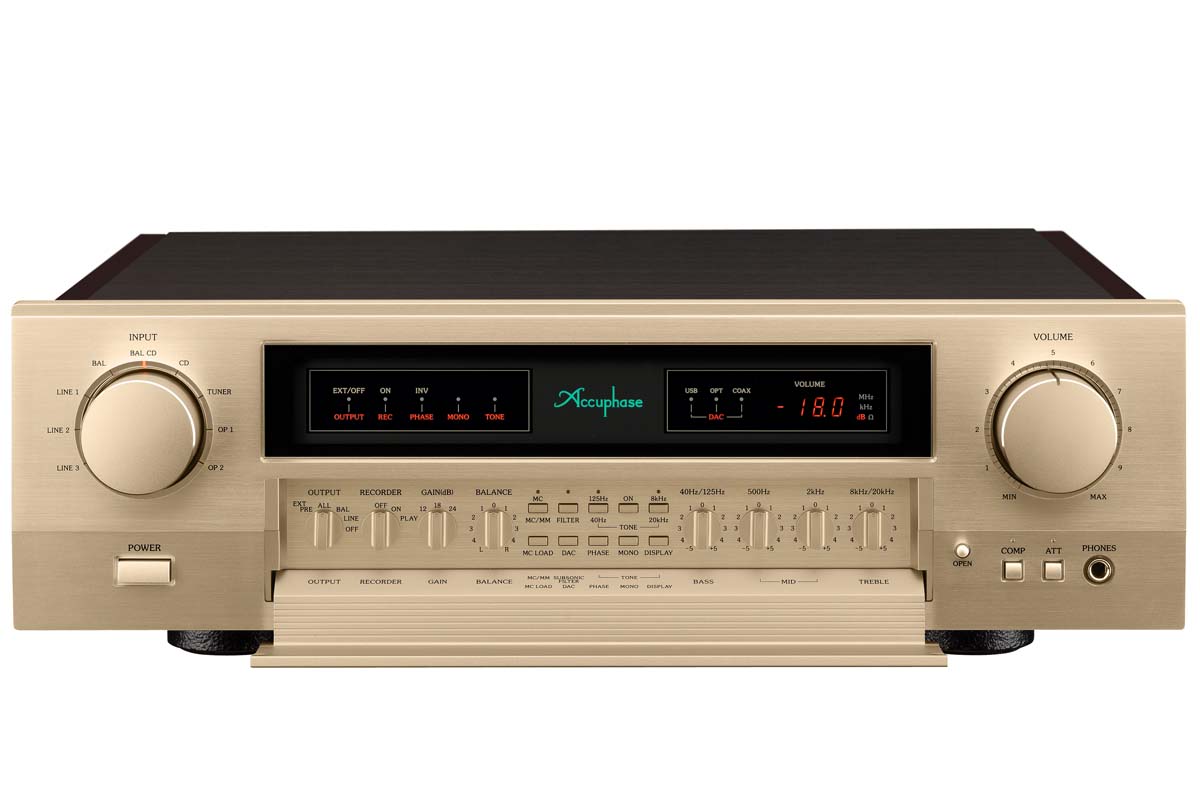
Officially, Accuphase doesn’t refer to the C-2300 as a preamplifier, but rather as a “precision stereo control center” – a reference to the extremely rich array of adjustment options hidden behind the flip-down front panel of this analog command center. A loudness function and a balance control that directly accesses the AAVA circuit are just as present as a three-step gain preset to facilitate operation within the optimal control range, a mono switch, and a phase inverter that can be switched separately for each input.
Last but not least, a four-band equalizer is integrated into the control center, with two selectable turnover frequencies each for the bass and treble bands. This particular detail once again exemplifies the brand’s development philosophy: While tone controls used to be taken for granted back in the day, they were later demonized and disappeared from the feature sets of most components, only to experience a small renaissance in recent times. With the Japanese, they were simply always there. The company never chased after trends; instead, they’ve always been driven by an uncompromising pursuit of technical and sonic perfection – and in the developers’ view, that includes the option of tonal adjustment. Accuphase doesn’t surf the wave – the wave inevitably finds its way back to Accuphase sooner or later.
Once music is playing and you attempt to get to the bottom of the C-2300’s sonic characteristics, it becomes clear within the first few bars that components from Yokohama neatly evade any trivial categorization into a supposed “sonic character.” If the reviewer wonders whether the component leans more towards the neutral-analytical or musically engaging side, the Accuphase exposes the absurdity of the question with a benevolent smile: Obviously, the latter follows as the logical consequence of the former.
In keeping with its provenance, I first choose “Akita-nikata-bushi” from the debut album Hello World by Chie Hanawa, one of the country’s best-known Tsugaru shamisen players. The recording features only this single instrument, and the Accuphase – no, Chie Hanawa and her shamisen – immediately fill the room with music. The sharp, sinewy attack of the strings is answered by the body with its distinctly woody voice, spreading freely throughout the space. Apart from the instrument, there is absolutely nothing in the room; between the notes, the preamp creates complete silence, from which the musical event emerges all the more sharply and three-dimensionally. The plucking of the strings with the fan-shaped bachi, the rhythmic striking of the leather skin, the sliding of fingers along the neck – everything arises on its own and immediately comes together in a completely natural way to form a cohesive whole. The C-2300 seems to “understand” the performance as it celebrates the complexity hidden inside outward simplicity that is so characteristic of this country.
The Japanese control unit is equally adept with complex Western fare: whether Holst’s The Planets, Night on Bald Mountain, or Wagner’s Parsifal. The tone of a solo violin unfolds brilliantly from the same nothingness that, even in the densest orchestral tuttis, opens up the space between the performers and allows the individual timbres to breathe and intertwine – free of any distracting grayness.
On “Curious Ruminant,” the first advance single from the announced Jethro Tull album of the same name, the Accuphase places the opening piano physically in the room, conveying the bite of the keystrokes completely effortlessly and yet without the slightest hint of restraint. It delivers the raw energy of the ensuing heavy guitar riffs and drum accompaniment straight to my core, only to caress me the very next moment with the soft warmth of the flute and draw me into the bizarre, dreamlike worlds of thought of a mature Ian Anderson with his reflective voice.
Through the Accuphase C-2300, music doesn’t simply play – the preamplifier lets it pass with a completely effortless naturalness. The path to this result: decades of consistently cultivated technical perfection. Measured performance above all reproach, with practically nonexistent distortion and noise, render all banal questions about “voicing” or “sound philosophy” moot before they’ve even been asked. Instead, uncompromising transparency gives the emotionality of the music free space to unfold.
Accompanying Equipment
CD players: Accuphase DP-570, Audio Note CD 3.1x, Esoteric K-05XD | Network player/streamer: Lumin P1, Linn Klimax DSM, Auralic Aries G2.2 | D/A converter: Benchmark DAC 3B | Preamplifiers: T+A PSD 3100 HV, Electrocompaniet EC 4.8 Mk II | Power amplifiers: Accuphase P-7500, Burmester 216, Air Tight ATM-1E | Loudspeakers: Audio Physic Avantera, Marten Parker Quintet, Wilson Audio WATT/Puppy | Cables: WestminsterLab, AudioQuest, Atlas Cables | Racks: Finite Elemente, Bassocontinuo
Preamplifier Accuphase C-2300
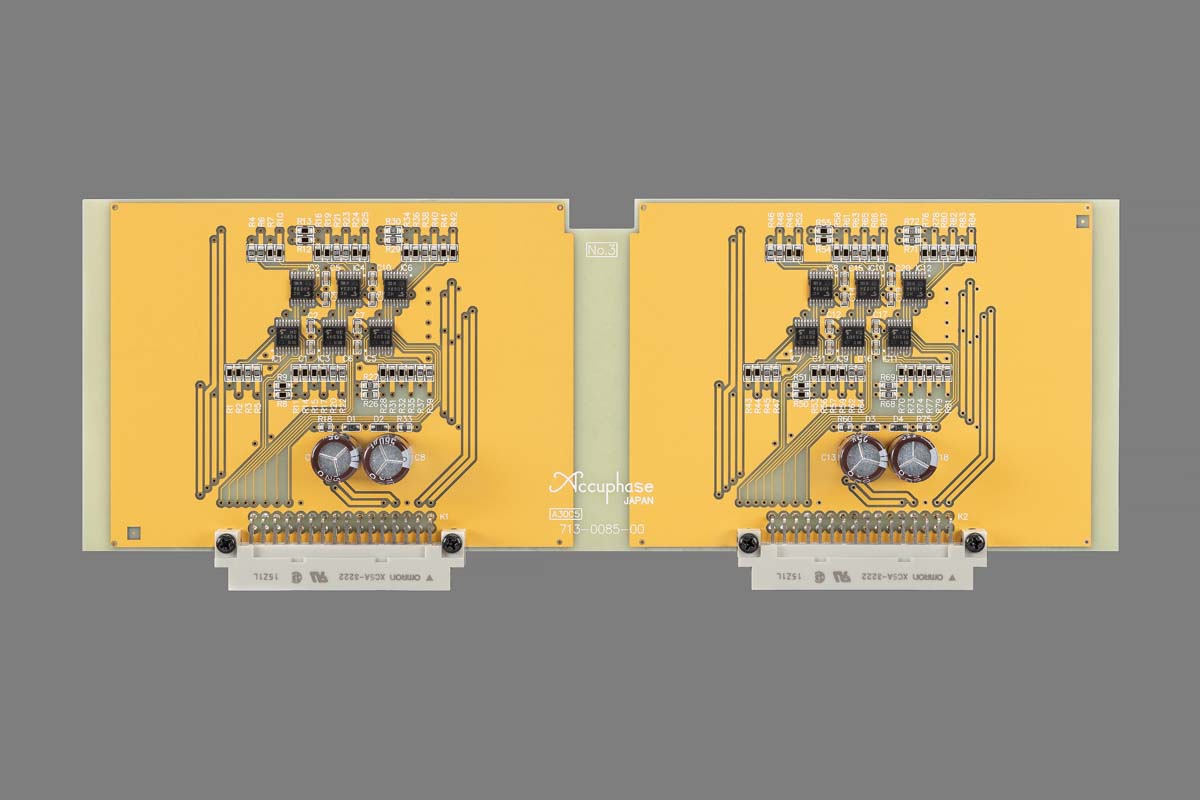
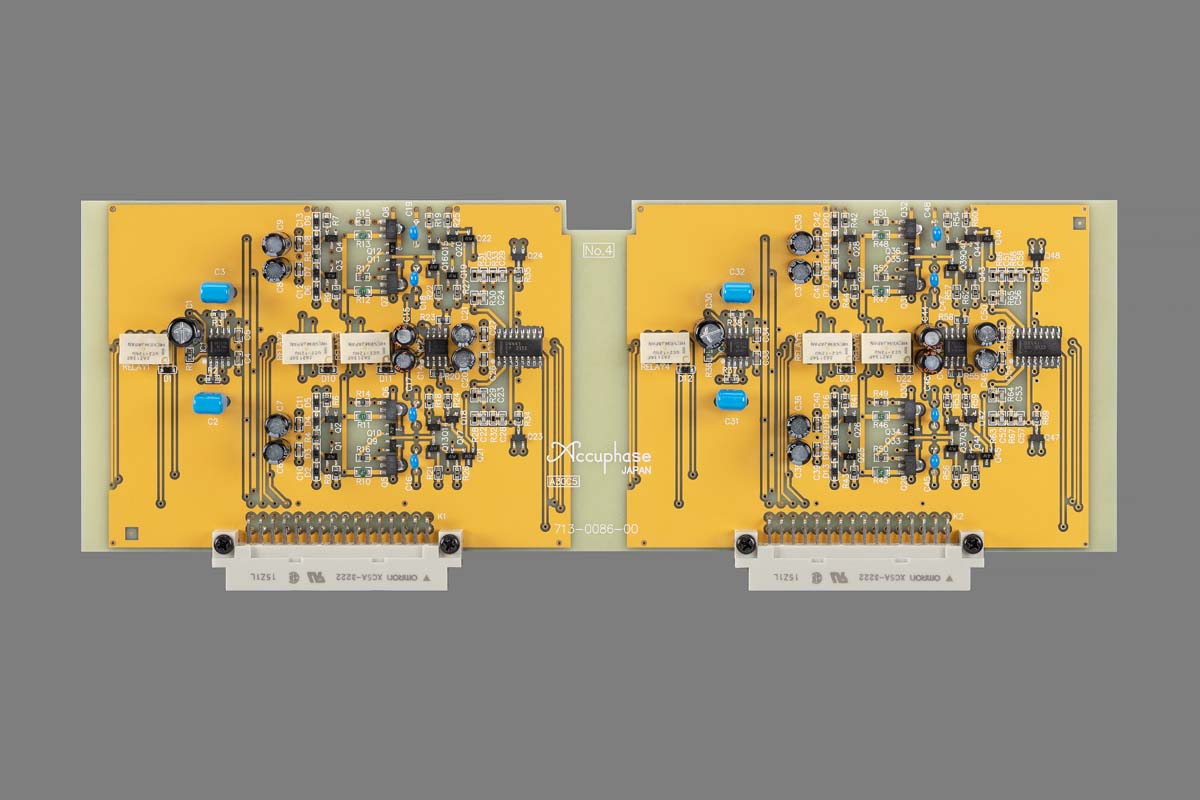
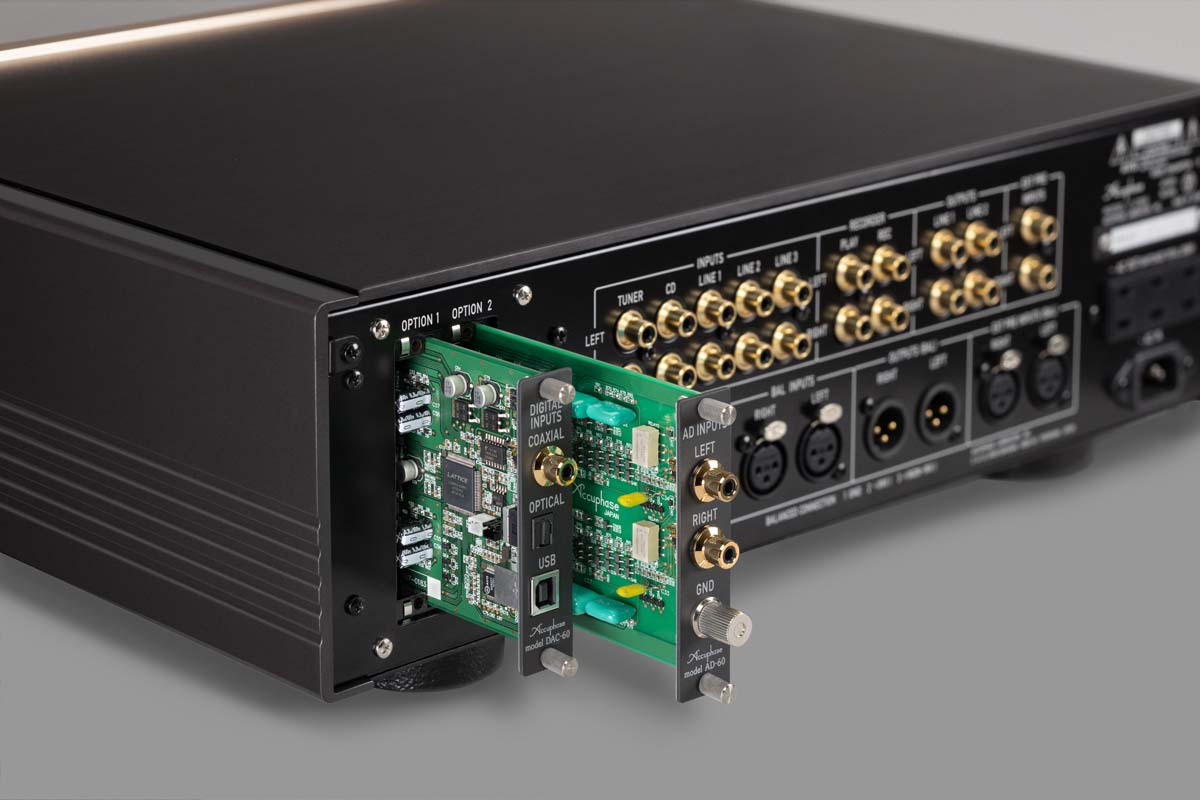
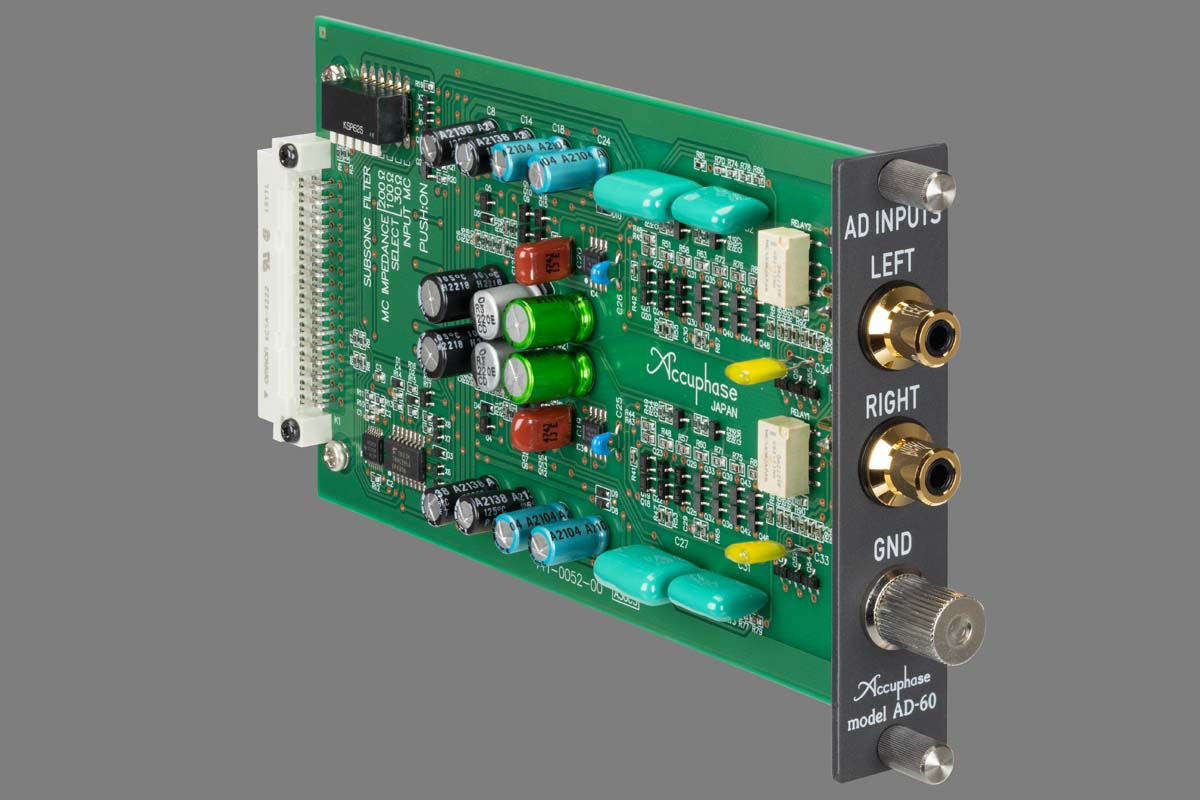
Concept: dual-mono preamplifier with integrated equalizer and slots for optional modules | Inputs: 5 x RCA, 2 x XLR, tape loop (recorder), 1 x ext. pre RCA, 1 x ext. pre XLR | Outputs: 1 x RCA, 1 x XLR | Total harmonic distortion (THD+N at rated output, all inputs): < 0.005 % | Signal-to-noise ratio: 111 dB (input shorted, rated output), 108 dB (EIA) | Crosstalk attenuation: −74 dB /10 kHz | Maximum output voltage: 7.0 V (line RCA/XLR); 6.0 V (recorder rec.) | Special features: symmetrical AAVA volume control, selectable overall gain 12/18/24 dB, four-band equalizer with switchable frequency points for bass and treble, two slots for optional modules, “Att” button for immediate 20 dB level reduction | Accessories: metal remote control | Dimensions (W/H/D): 46.5/15/40.5 cm | Weight: 19.3 kg | Warranty: 3 years | Price: approx. €11,000; DAC module DAC-60 approx. €1,350; phono module (MM/MC) AD-60 approx. €1,100
P.I.A. Hi-Fi Vertriebs GmbH
Rosenweg 6
64331 Weiterstadt
Phone +49 6150 50025
info@pia-hifi.de
ON THE TEST BENCH: ACCUPHASE C-2300
Low-Profile High Flyer
Anyone who shops in high-end circles regularly has to justify their spending to friends – does the purchase price really stand in a rational, comprehensible relationship to what’s being offered? Owners of the Accuphase C-2300 can lean back and relax when faced with such questions: “Considering the technical performance and outstanding build quality, it offers excellent value for money!” says the incorruptible measurement report – complete with an exclamation point! Such emotional outbursts are extremely rare among the species known as measurement engineers. And yet the exclamation point appears in several places throughout the commentary on the lab results …
General Measurement Conditions
- Line voltage: 230 V AC ±1%, held constant
- Maximum available power: 8 kVA
- Room: partially shielded
- Ambient temperature: 21 °C ±2 °C
- Relative humidity: 40% ±3%
- Cables shielded where required and kept as short as possible
Serial No.: K2N983
Input Impedance Measurement
Measurement equipment: HP 4194A Impedance Analyzer
Sweep: 100 Hz – 50 kHz
Output level: 114.5 mV
Balanced Input (XLR)
| Frequency | Input Impedance |
| 100 Hz | 41.2 kΩ |
| 1 kHz | 40.0 kΩ |
| 10 kHz | 38.7 kΩ |
| 20 kHz | 38.2 kΩ |
Unbalanced Input (RCA)
| Frequency | Input Impedance |
| 100 Hz | 20.2 kΩ |
| 1 kHz | 20.1 kΩ |
| 10 kHz | 19.8 kΩ |
| 20 kHz | 19.6 kΩ |
These values were determined dynamically using a signal and therefore represent real-world conditions more accurately than measurements made with an ohmmeter. The amplifier presents an exceptionally easy load for source components. Even sources with comparatively high output impedance should have no difficulty driving it. Manufacturer specifications are met.
Gain Measurement
Measurement equipment:
- Signal source: Audio Precision AP 2722
- Measurement: Rohde & Schwarz URE 3
Input/output: unbalanced
Gain Accuracy (Volume Control at Maximum)
| Nominal Gain Setting | Measured Gain |
| 12 dB | 11.97 dB |
| 18 dB | 17.99 dB |
| 24 dB | 23.99 dB |
Linearity Measurement
Input: Unbalanced (RCA)
| Volume Control Setting | Measured Level |
| 0 dB | 0.00 dB |
| −2 dB | −1.96 dB |
| −5 dB | −4.92 dB |
| −10 dB | −9.87 dB |
| −15 dB | −14.84 dB |
| −20 dB | −19.81 dB |
| −25 dB | −24.82 dB |
| −30 dB | −29.81 dB |
| −40 dB | −39.84 dB |
Measurements on balanced inputs and outputs are virtually identical.
Manufacturer specifications are met.
Output Impedance
Measurement equipment:
Audio Precision AP 2722, Rohde & Schwarz URE 3, GenRad 1433B
General Note on Output Impedance
For voltage sources such as a preamplifier, output impedance is defined as follows:
First, the output voltage is measured and recorded at the highest possible load impedance. A variable load resistor is then connected to the output and reduced until the output voltage drops to half of the initially measured value. The resistance at this point is defined as the output impedance.
This does not mean the device should be operated with such a load. It should be noted positively that the data sheet specifies a recommended minimum load impedance of 600 ohms.
In measurement technology, the term “output impedance” has a slightly different meaning: it indicates the load with which a source delivers optimal performance. In RF engineering, for example, 50 ohms is a common standard.
Harmonic Distortion Spectrum Measurements
Measurement equipment: Audio Precision AP 2722, GenRad 1433B
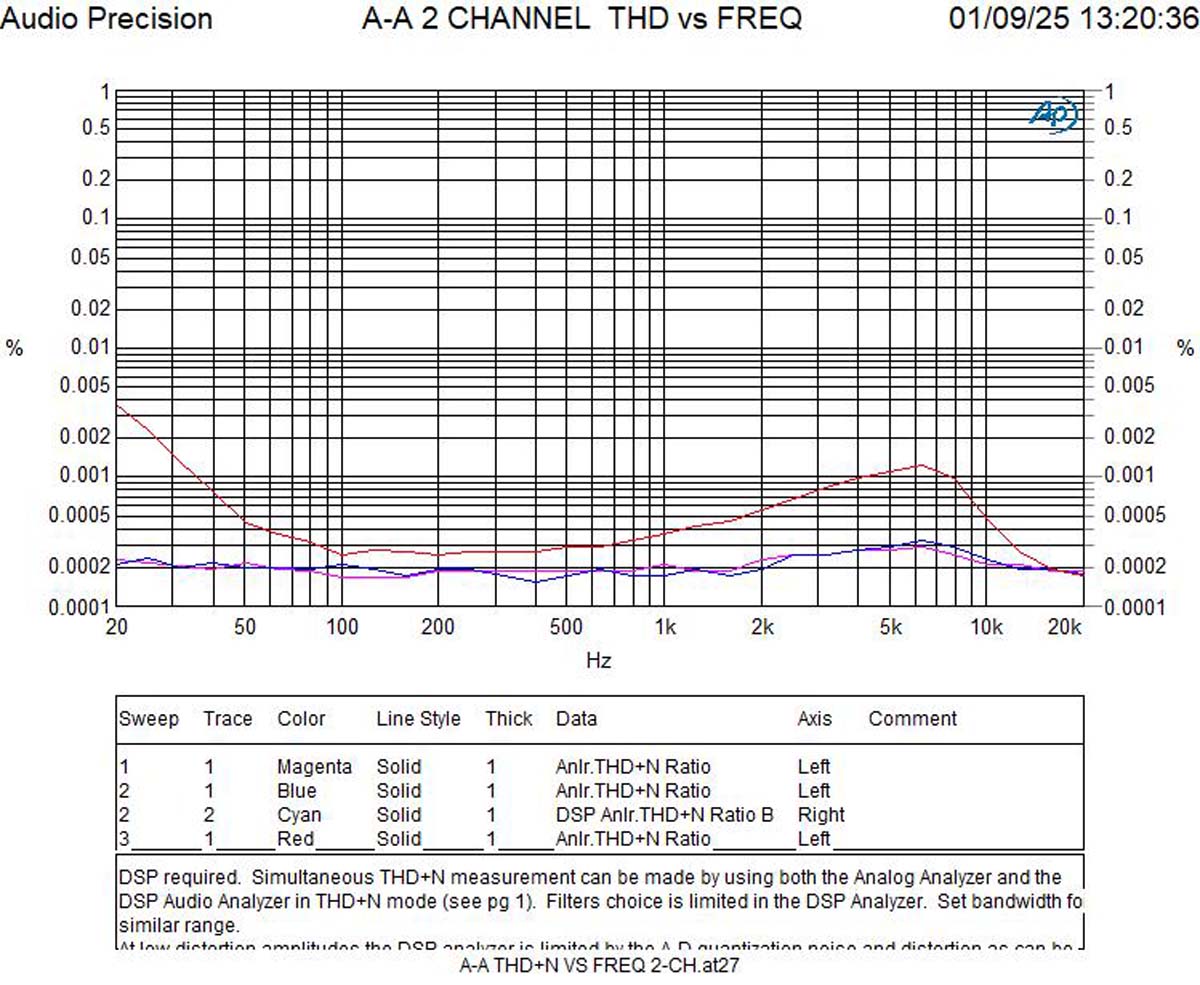
Shown are distortion spectra at various load resistances:
- Purple: 10 kΩ load
- Blue: 600 Ω load
- Red: 50 Ω load
Input voltage: 2 V
Gain: 18 dB
Volume control: −10 dB
Manufacturer specifications are exceeded by a wide margin. Even with a 50-ohm load, the values remain within the manufacturer’s specifications.
Additional Distortion Spectra
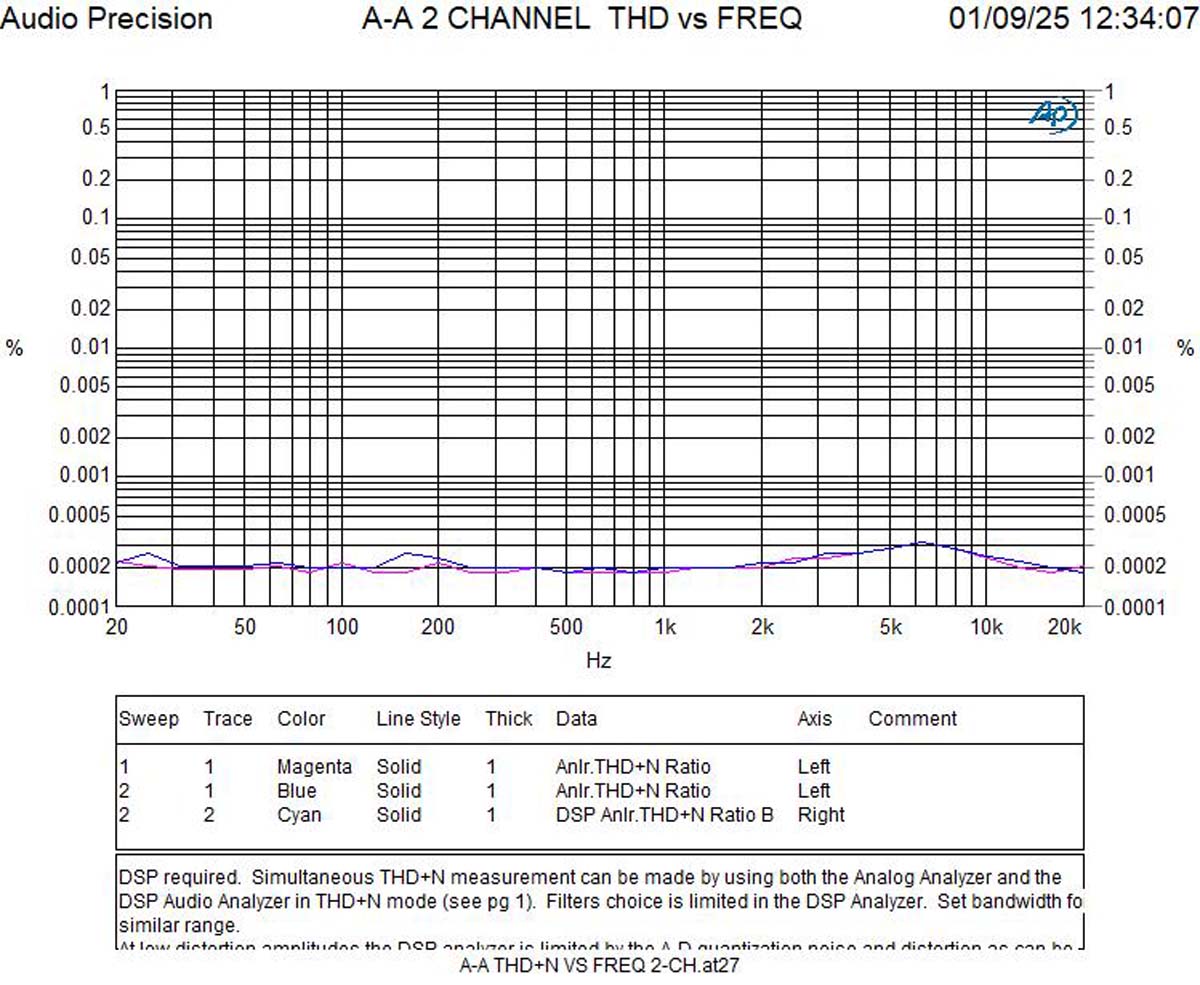
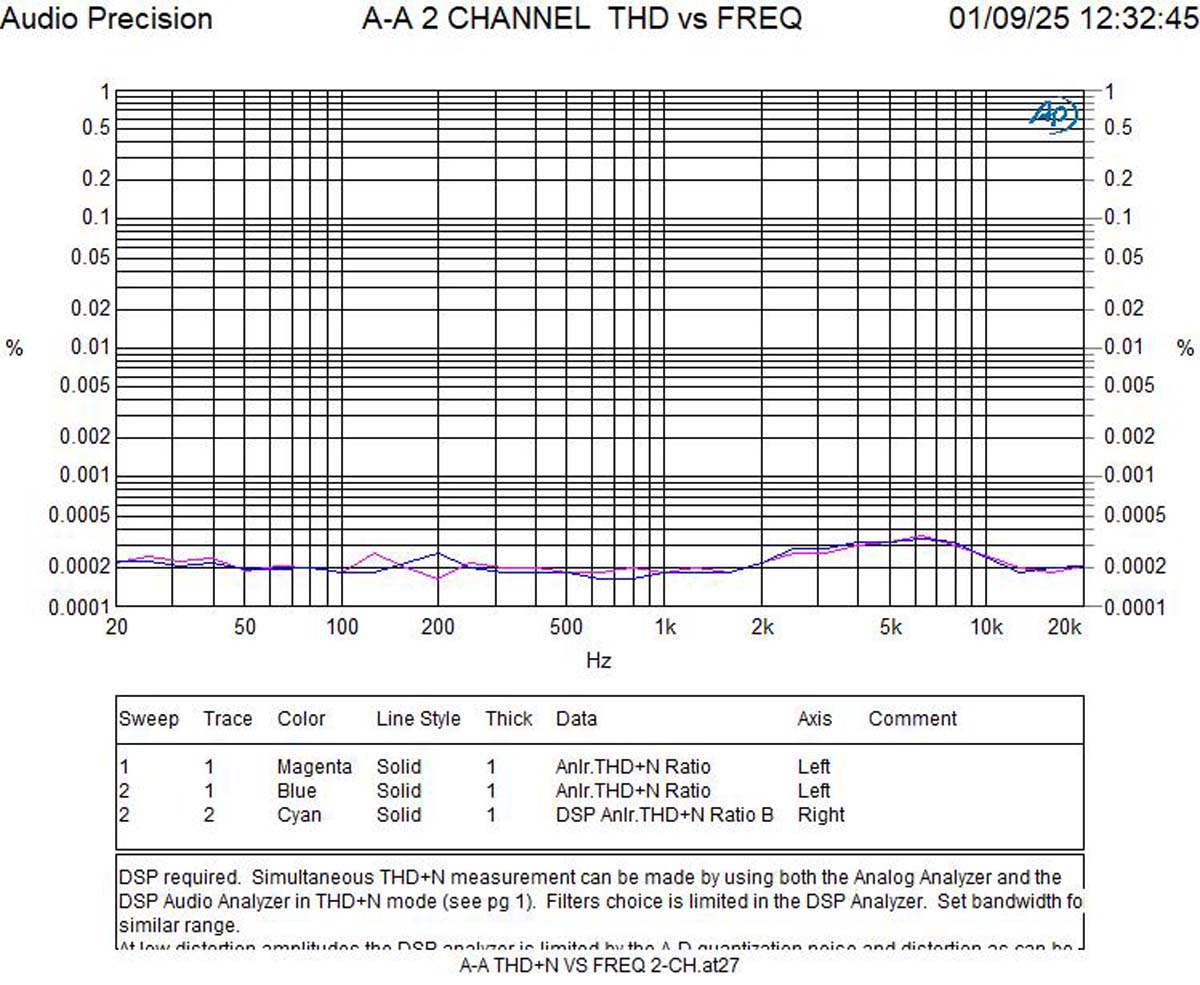
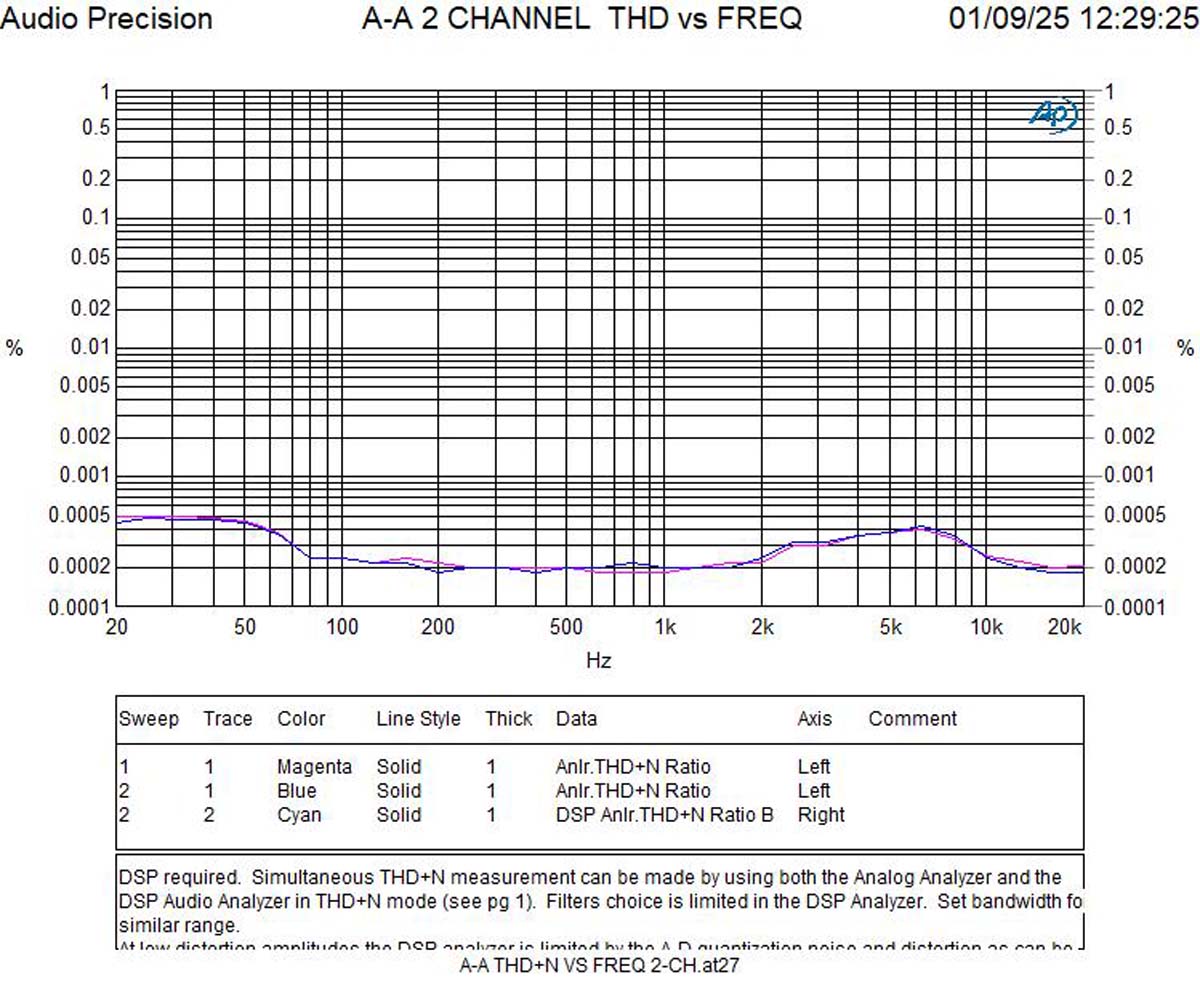
Under the same measurement conditions:
- 600 Ω load, gain 12 dB
- 600 Ω load, gain 18 dB
- 600 Ω load, gain 24 dB
Influence of Volume Control
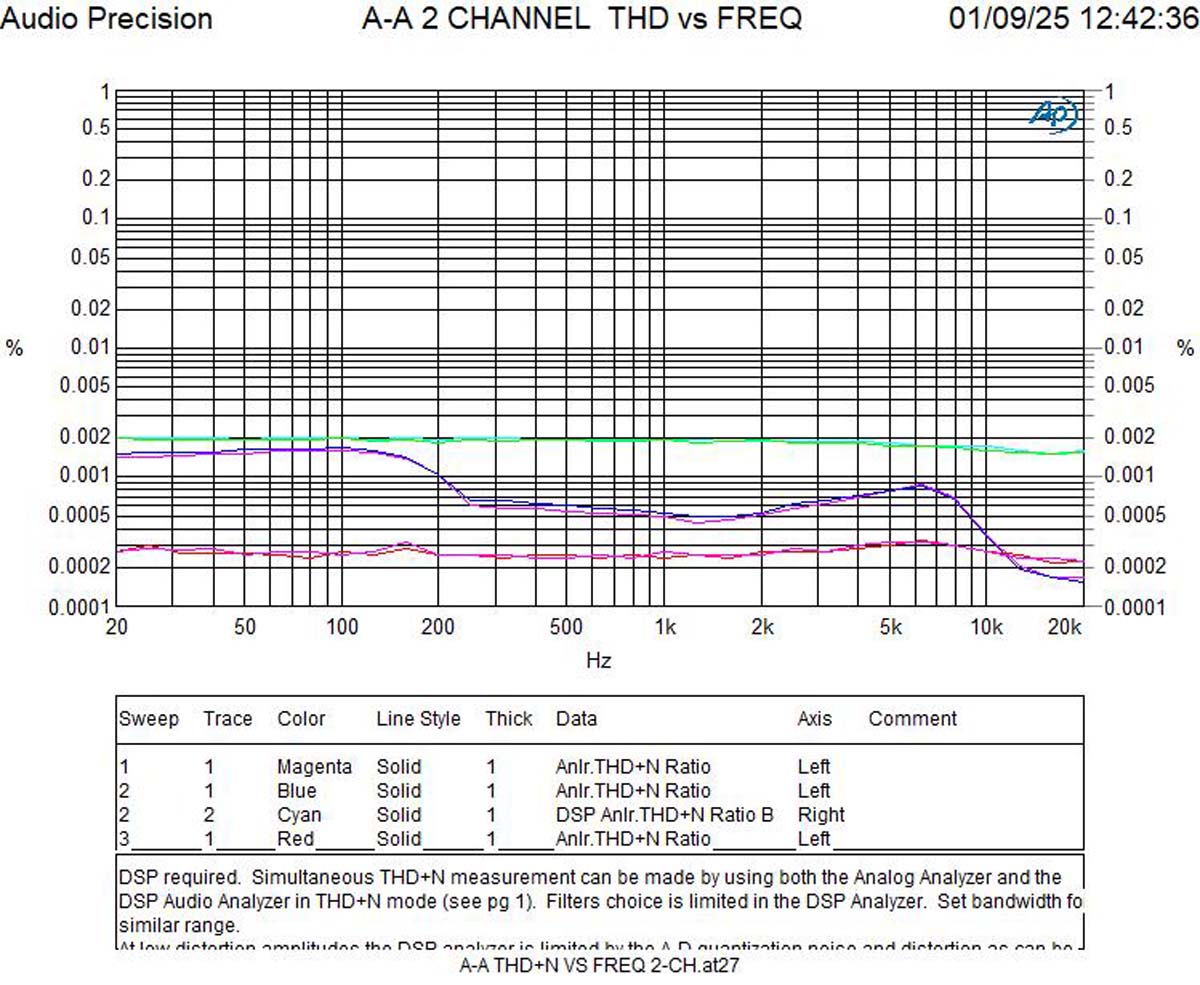
600 Ω load, gain 18 dB:
- Red: −20 dB
- Purple: 0 dB
- Green: −40 dB
Note: At 0 dB, the maximum output voltage of nearly 7 V was almost reached. At −40 dB, noise components dominate.
Influence of Input Voltage
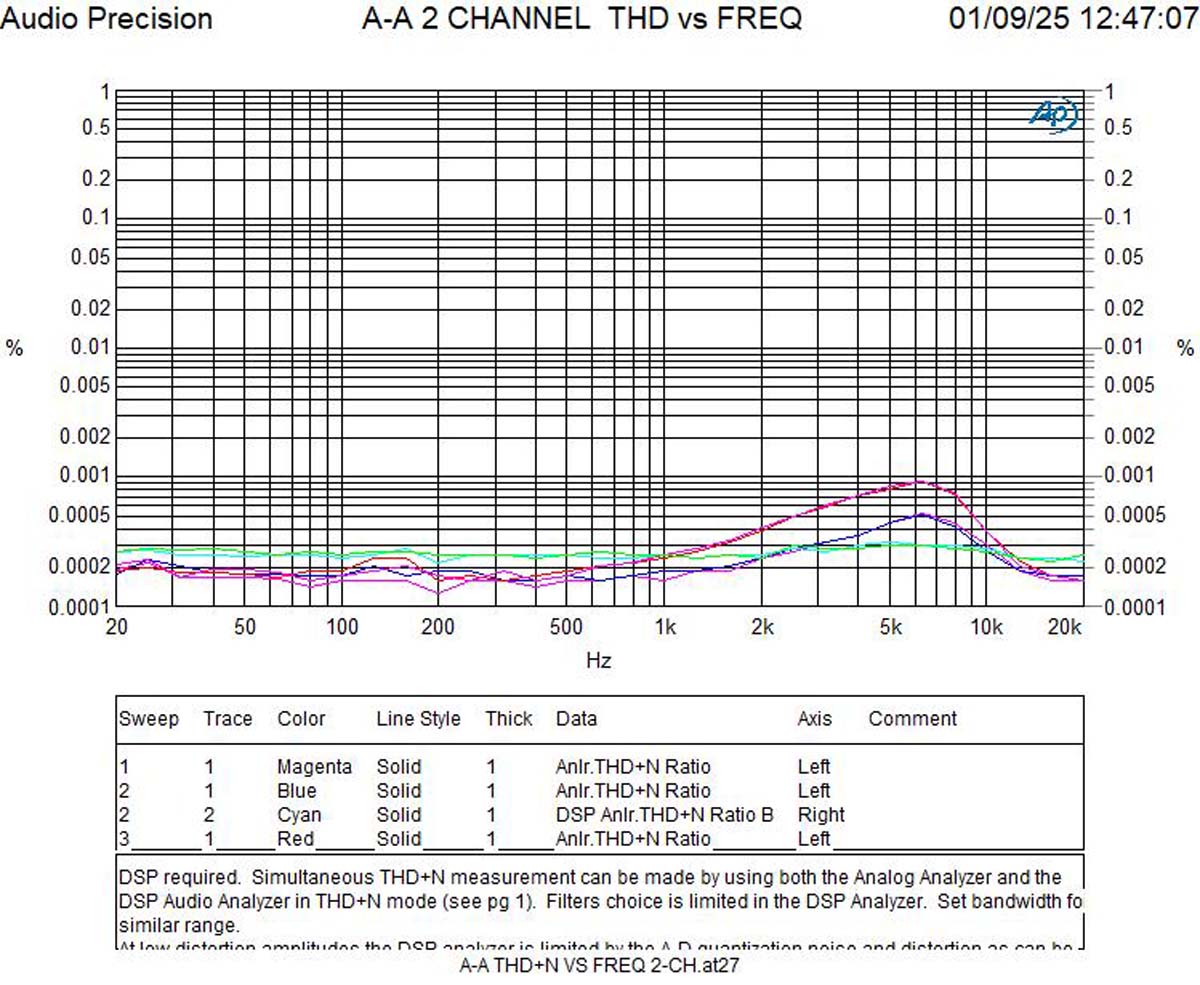
600 Ω load, gain 18 dB:
- Purple: 1 V
- Green: 2 V
- Red: 4 V
Manufacturer specifications are clearly exceeded regardless of operating conditions!
Frequency Response Measurement
Measurement equipment: Audio Precision AP 2722, Rohde & Schwarz UPD
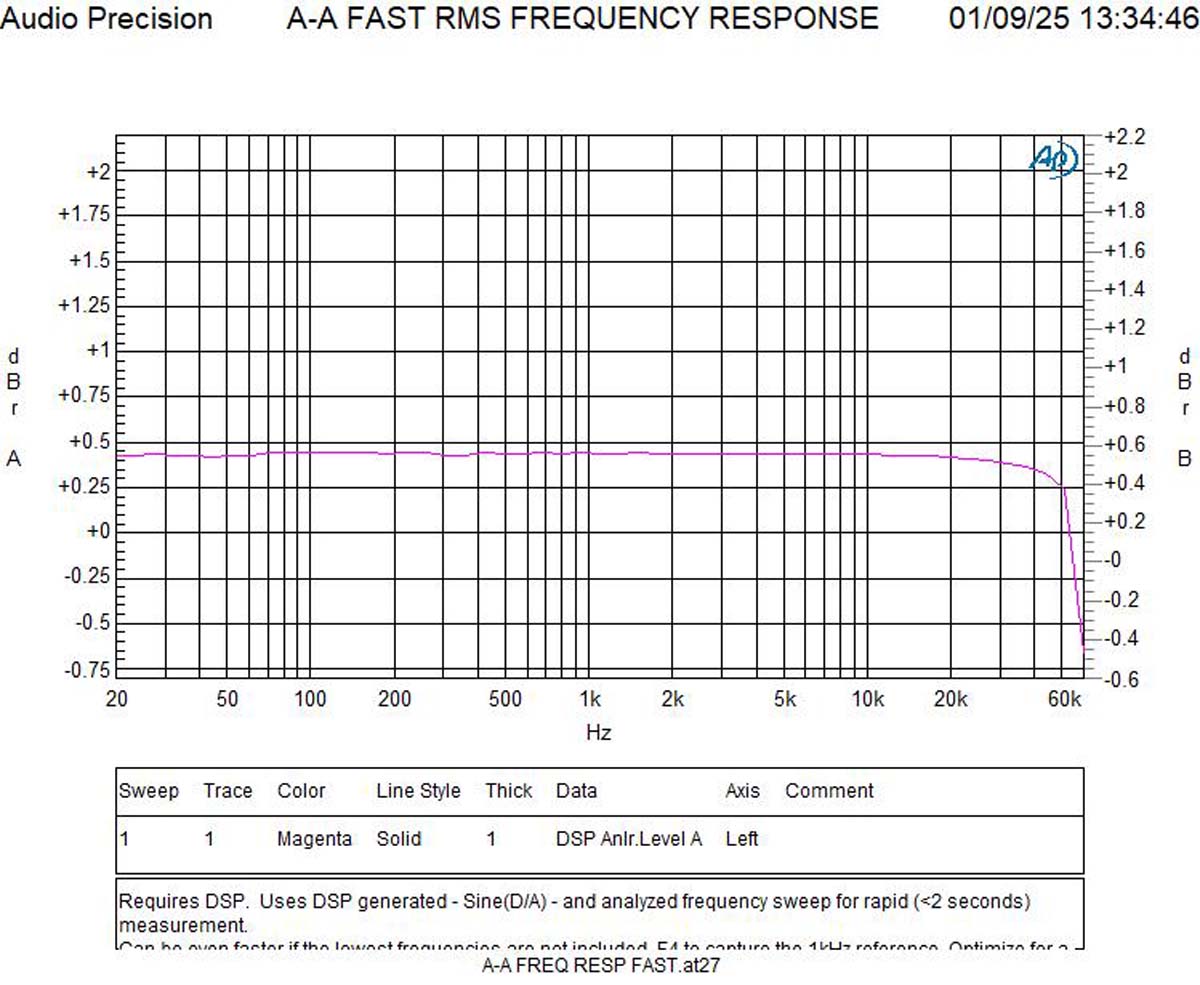
Unbalanced input/output
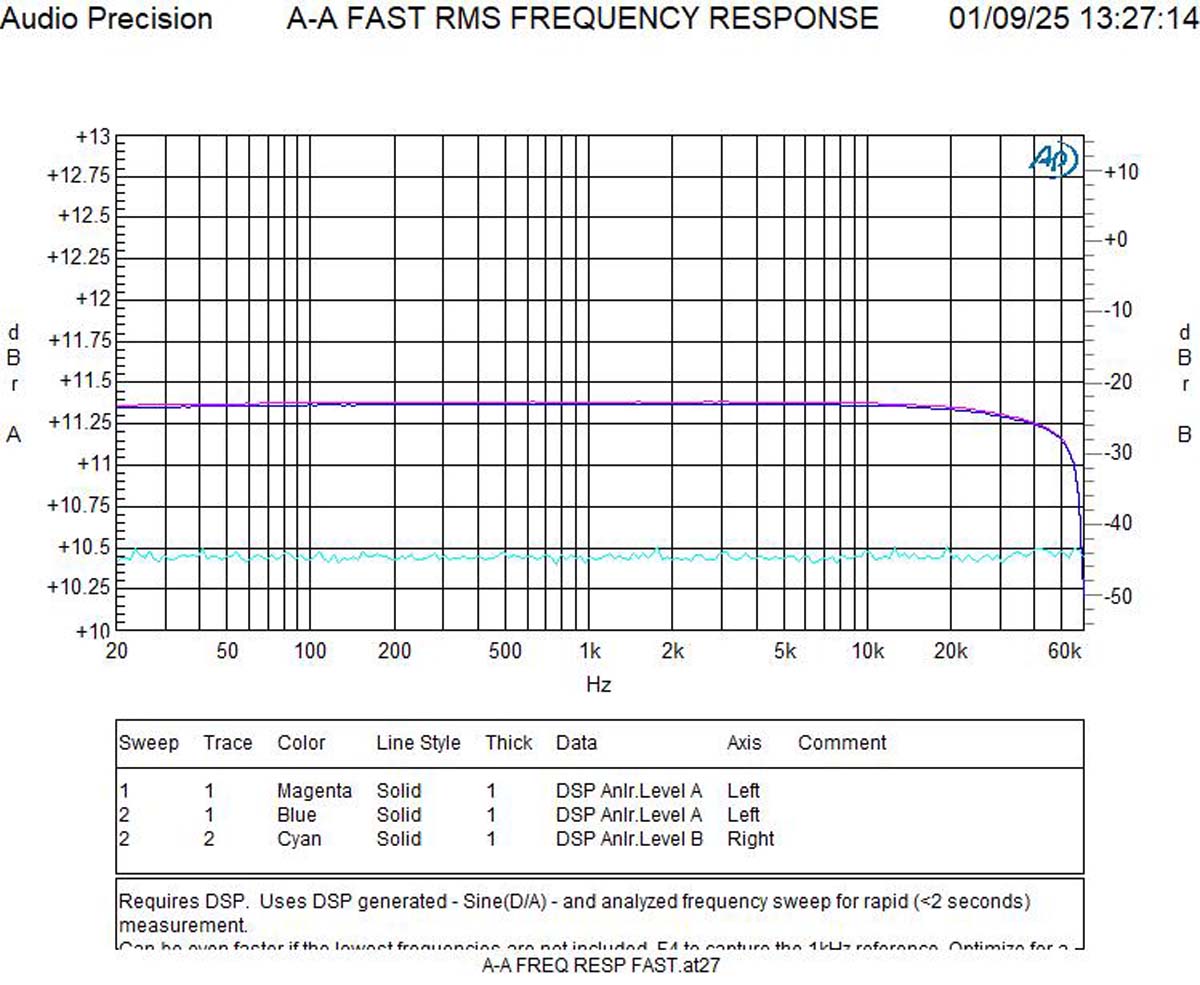
Balanced input/output
With an input voltage of 2 V, the frequency response is fully within manufacturer specifications.
Because the unit conveniently features switchable tone controls for bass, lower midrange, upper midrange, and treble, the frequency responses at maximum boost are shown below:
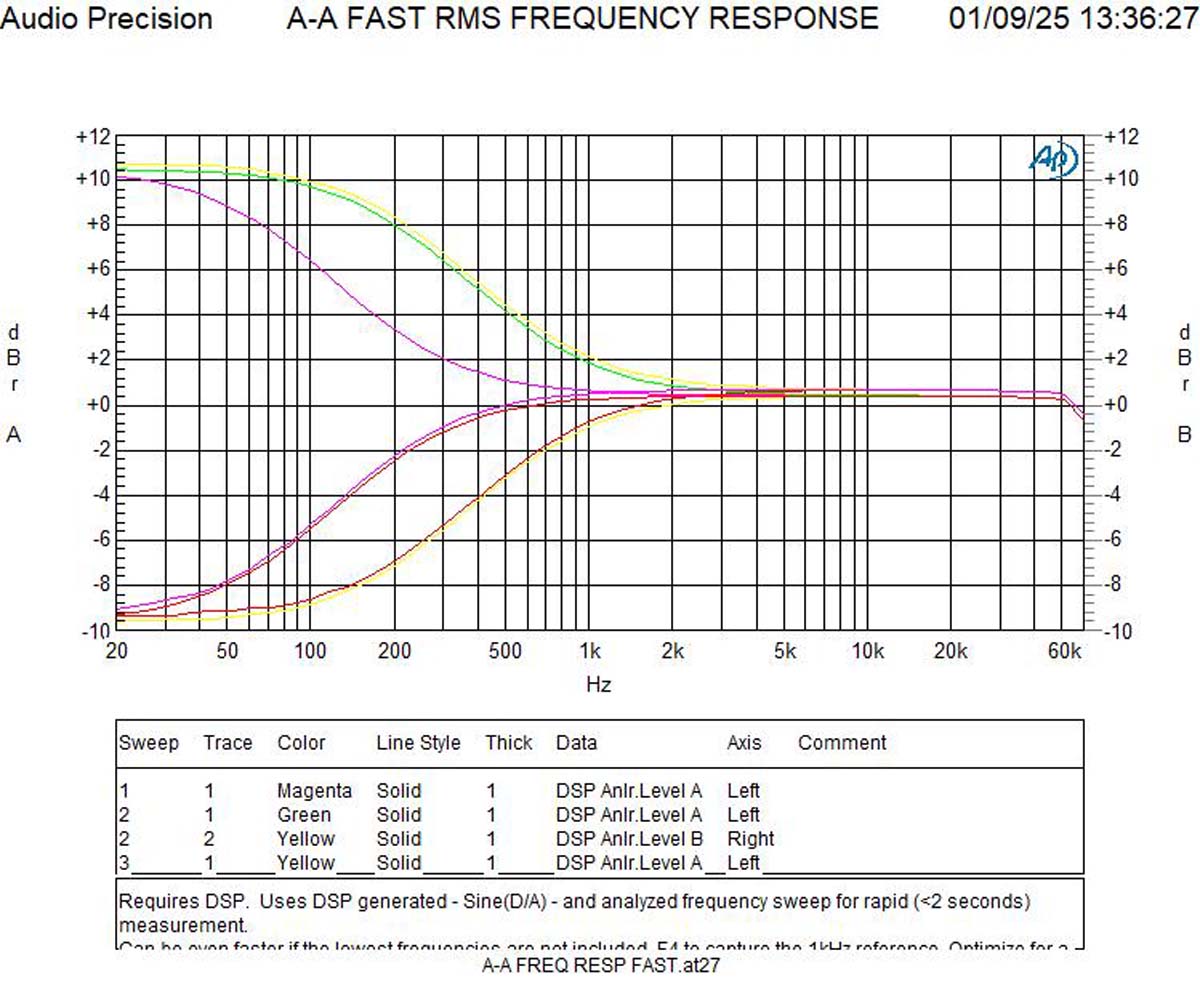
The bass control corner frequency is switchable.
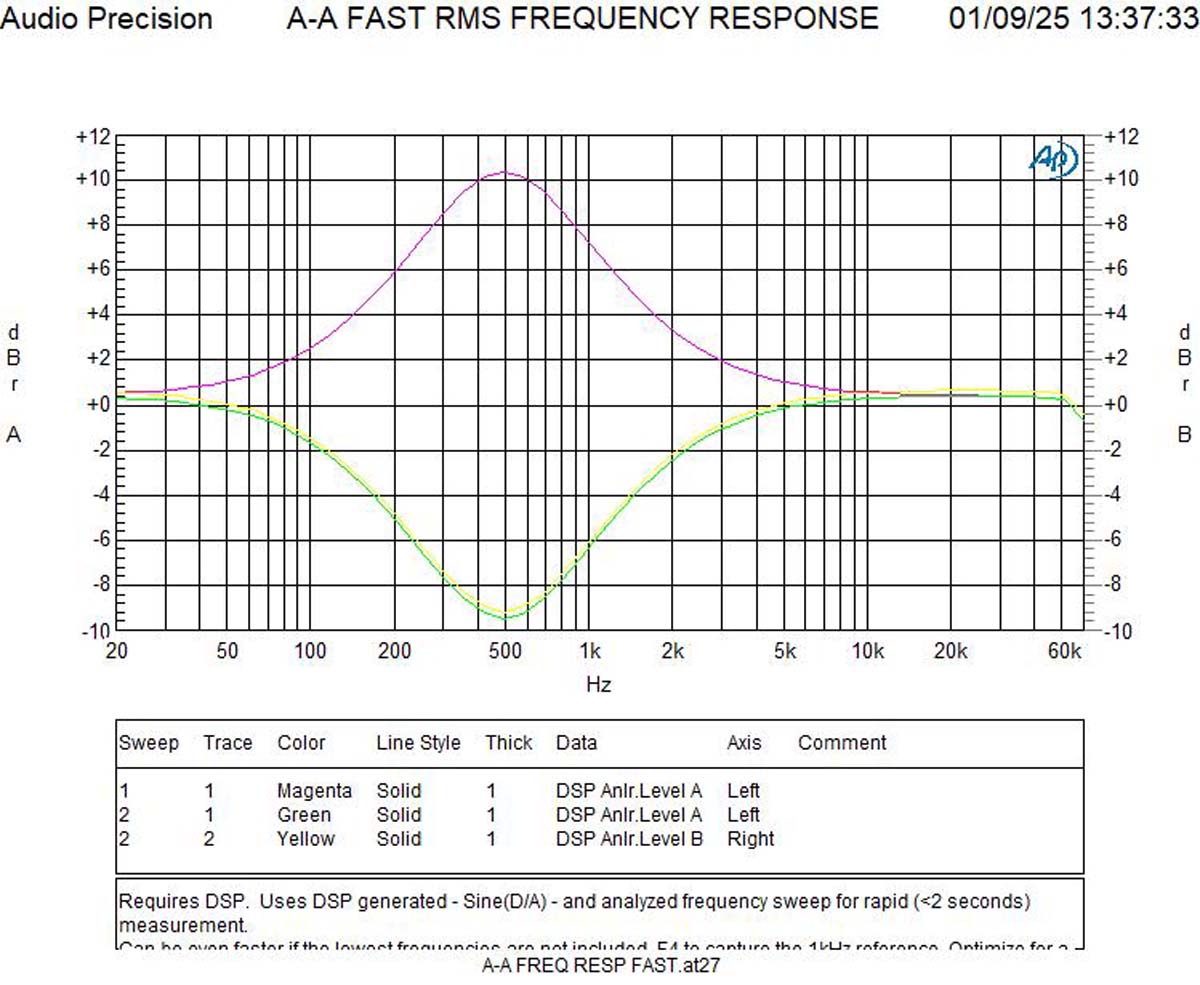
Frequency response for the lower midrange.
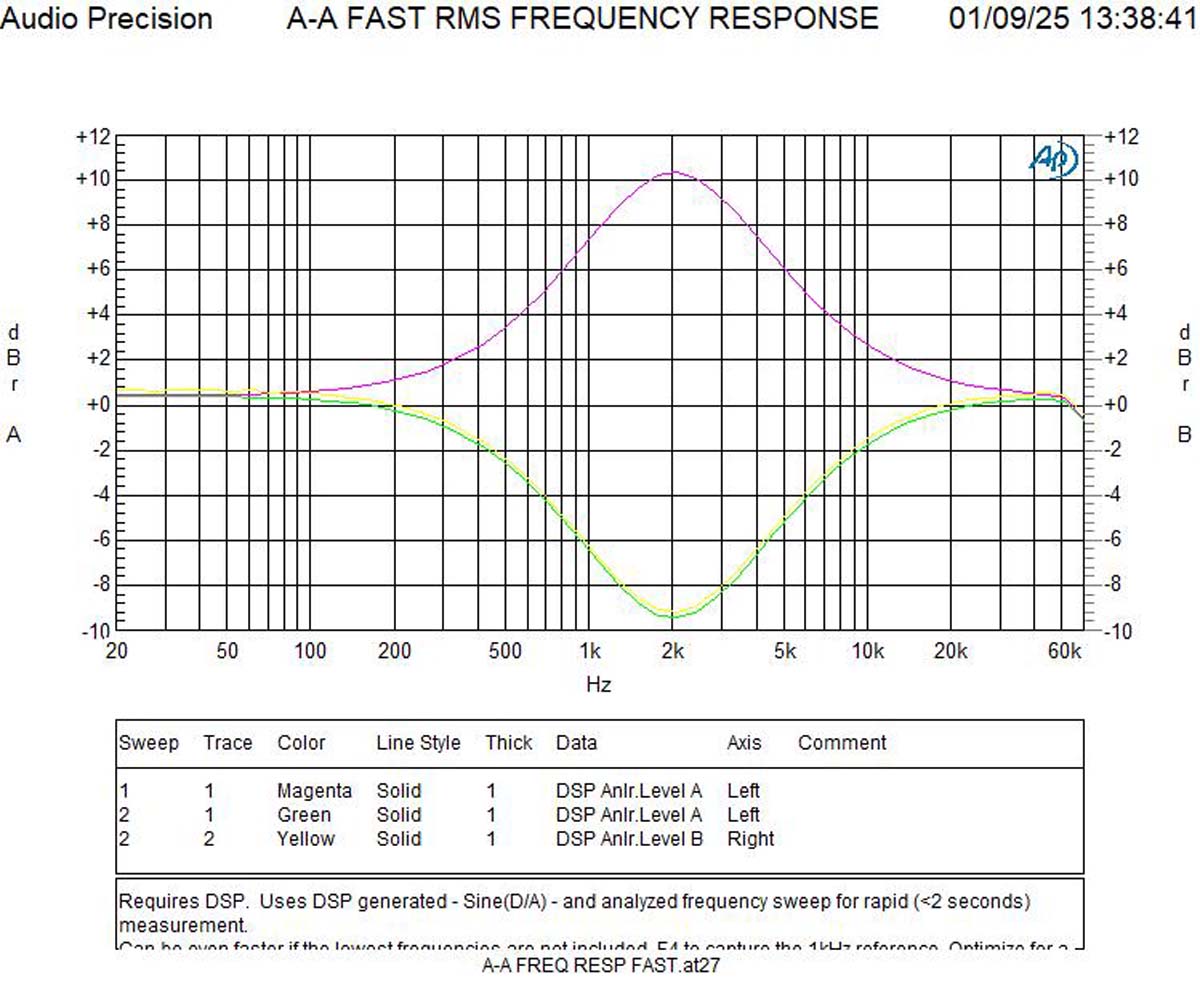
Frequency response for the high midrange.
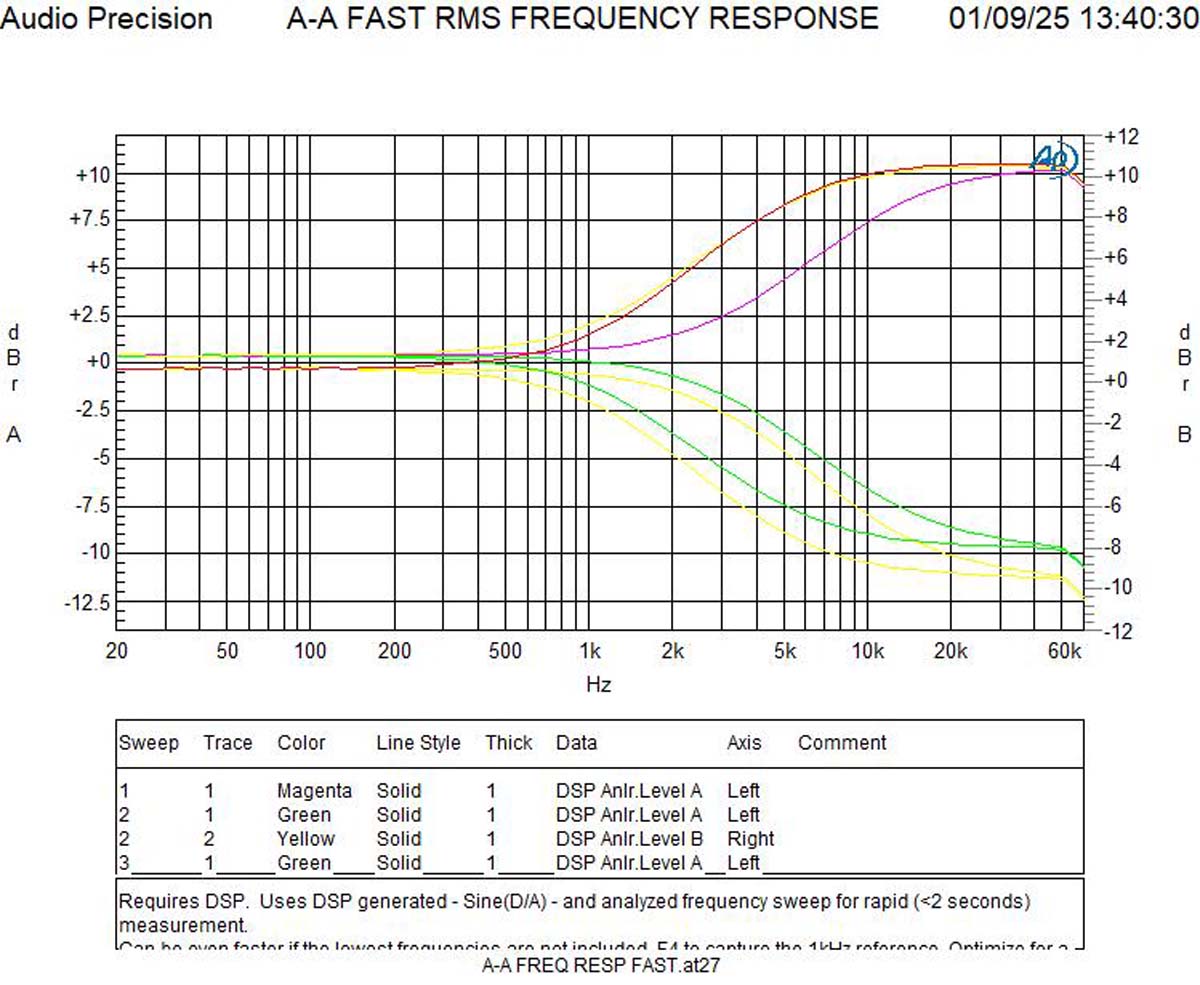
Finally, the two selectable treble frequency responses.
Square-Wave Reproduction
Measurement equipment:
Rohde & Schwarz RTO2024 oscilloscope, Audio Precision AP 2722
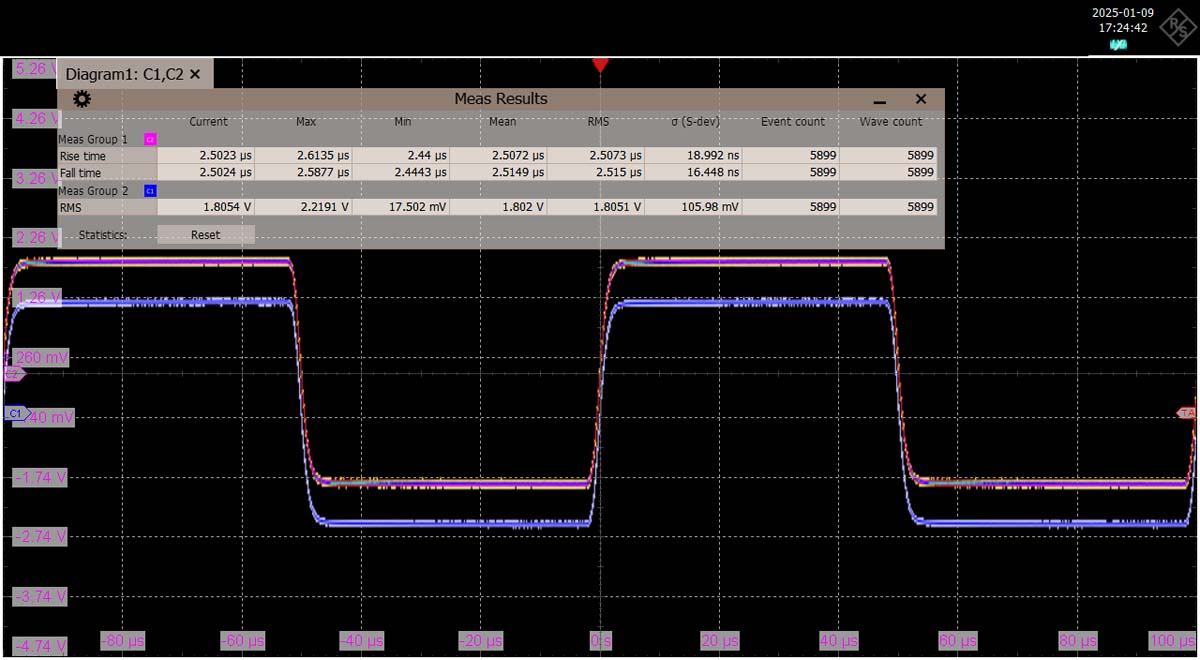
Perfect reproduction: no overshoot and identical rise times!
Power Consumption
Measurement equipment:
ZES Zimmer LMG 310 power analyzer, Rohde & Schwarz ESH3-Z5 line impedance stabilization network
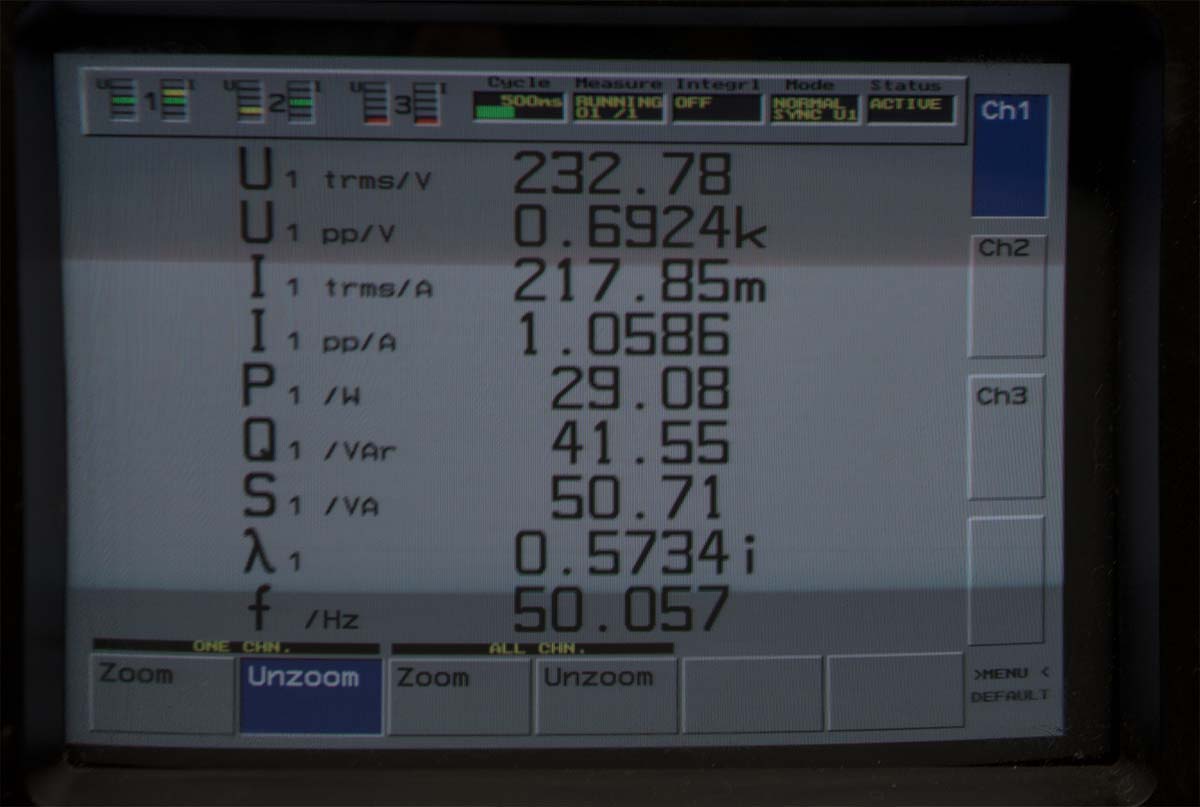
- Device powered on, no signal, with load: 29.08 VA
Conducted Emissions (Interference Fed Back Into the Mains)
Measurement equipment:
Rohde & Schwarz FSEB30 spectrum analyzer, Rohde & Schwarz ESH3-Z5 LISN
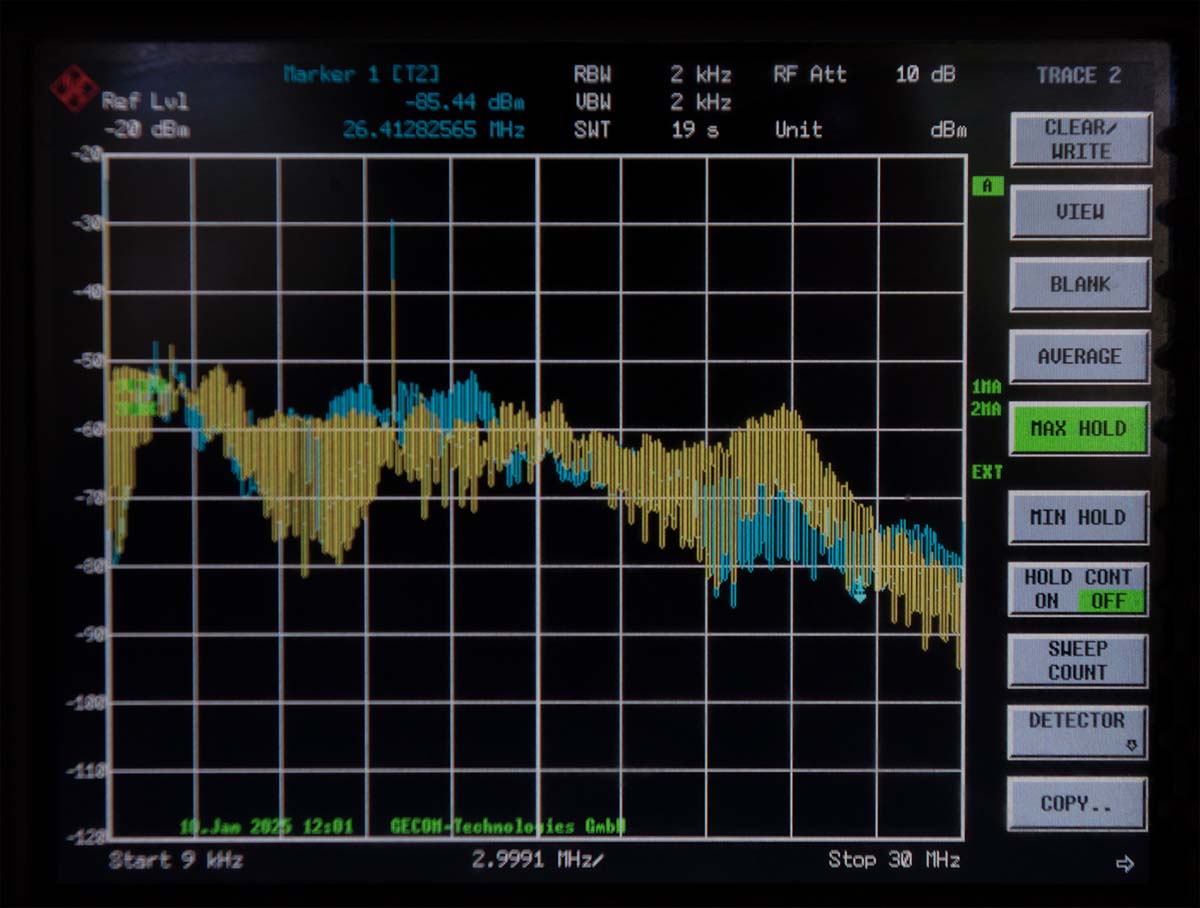
The interference spectrum was first measured with the device connected but switched off in the range 9 kHz – 30 MHz (yellow). The device was then switched on and the spectrum measured again (blue). The device feeds no problematic interference back into the power line.
Signal-to-Noise Measurements
Measurement equipment:
Audio Precision AP 2722, Rohde & Schwarz UPD, Datron 4920 AC standard
With inputs shorted, the noise voltage is:
| Channel | Noise Level |
| Left | −119.33 dB |
| Right | −118.13 dB |
These values are excellent and exceed manufacturer specifications.
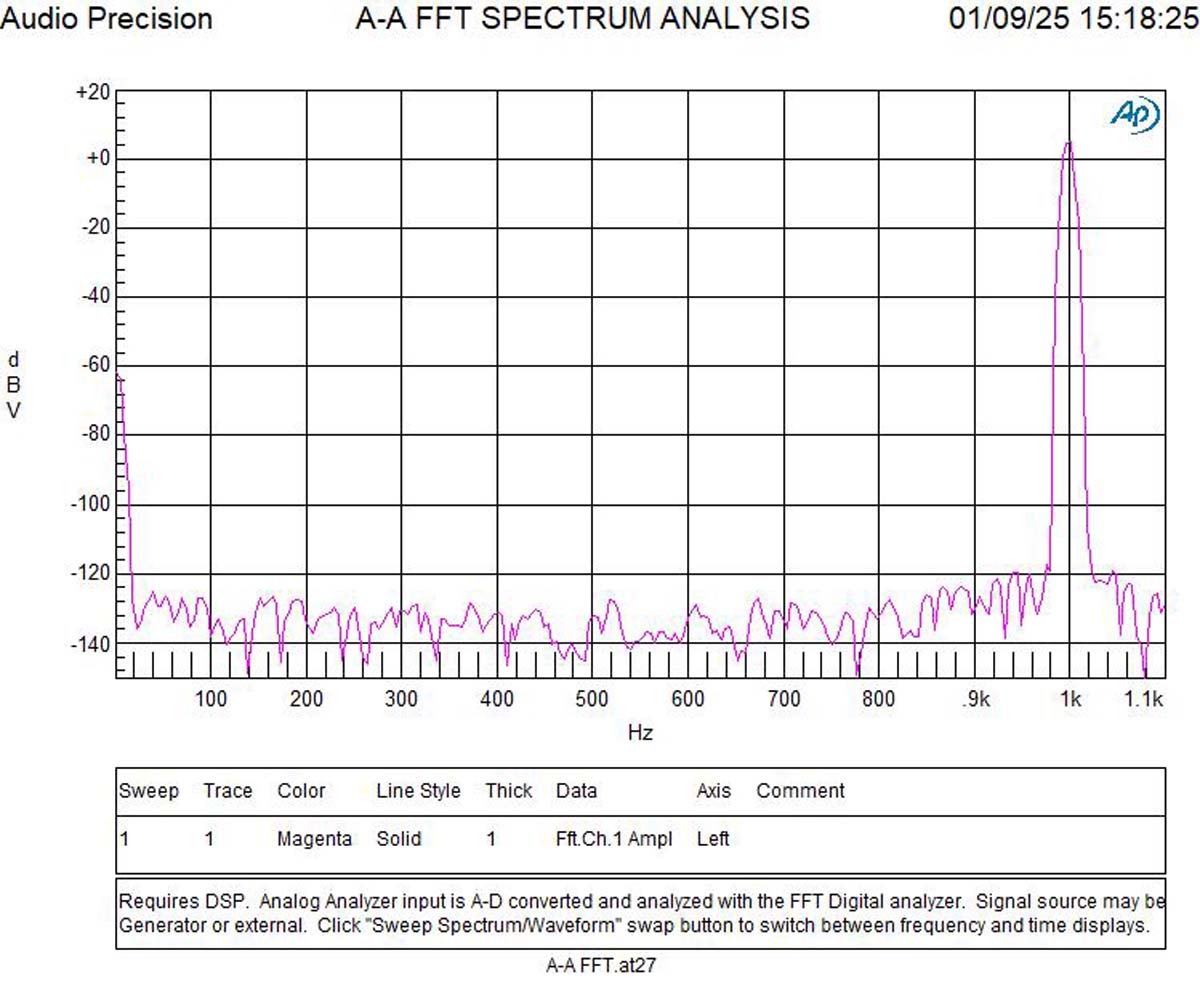
Another way of determining noise voltage is via an FFT spectrum:
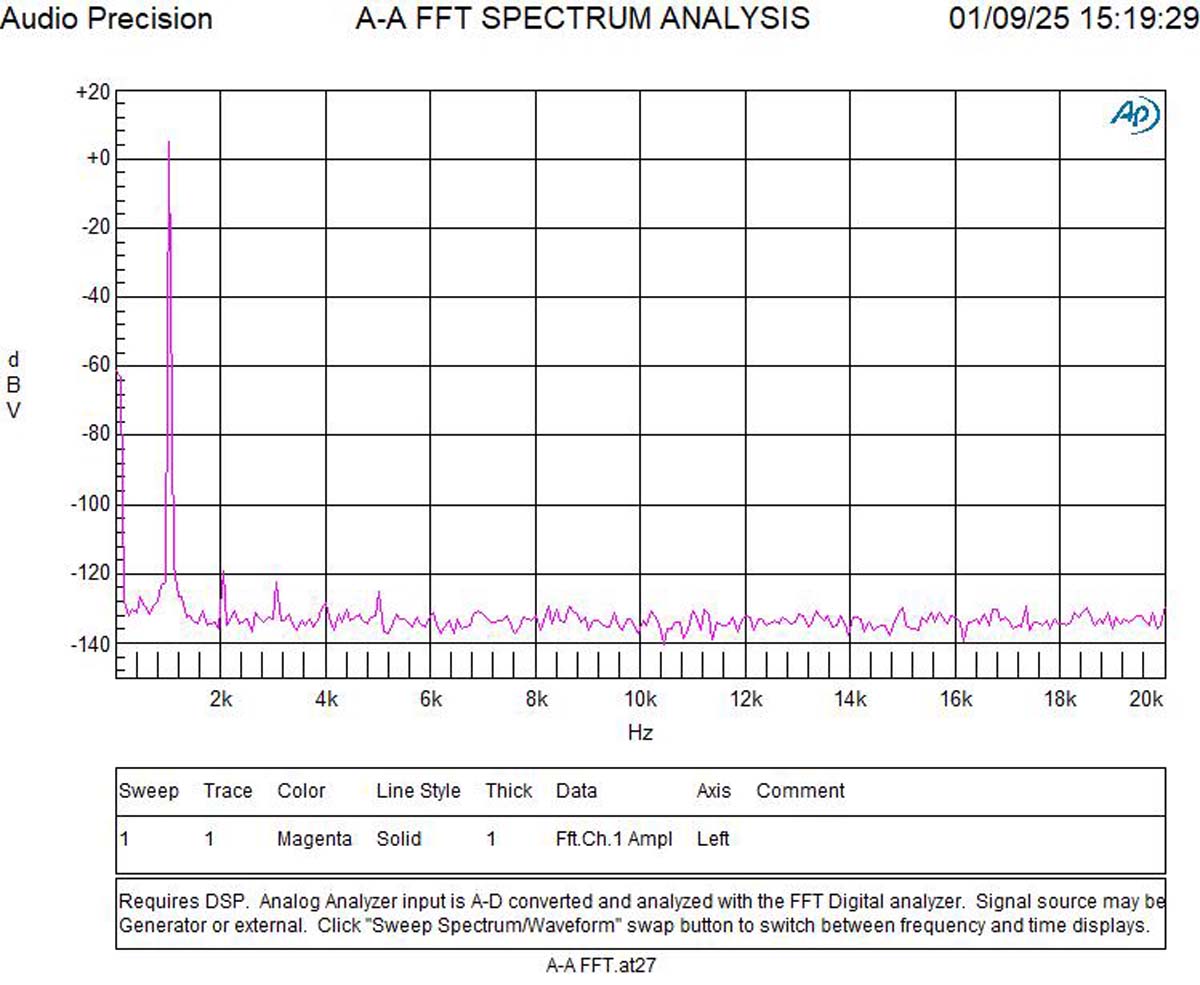
- The wavy baseline corresponds to the noise spectrum.
- The signal appears as the peak at 4 V.
- The noise level matches manufacturer specifications.
- Very low distortion components are visible, primarily second and third harmonics.
An equally positive picture emerges when examining interference below the signal: no interference from power-supply components whatsoever! Measured at 4 V output voltage, both channels:
Intermodulation Distortion
Measurement equipment:
Audio Precision AP 2722, Rohde & Schwarz UPD
Intermodulation distortion refers to mixing products that can occur when an amplifier reproduces two or more frequencies simultaneously.
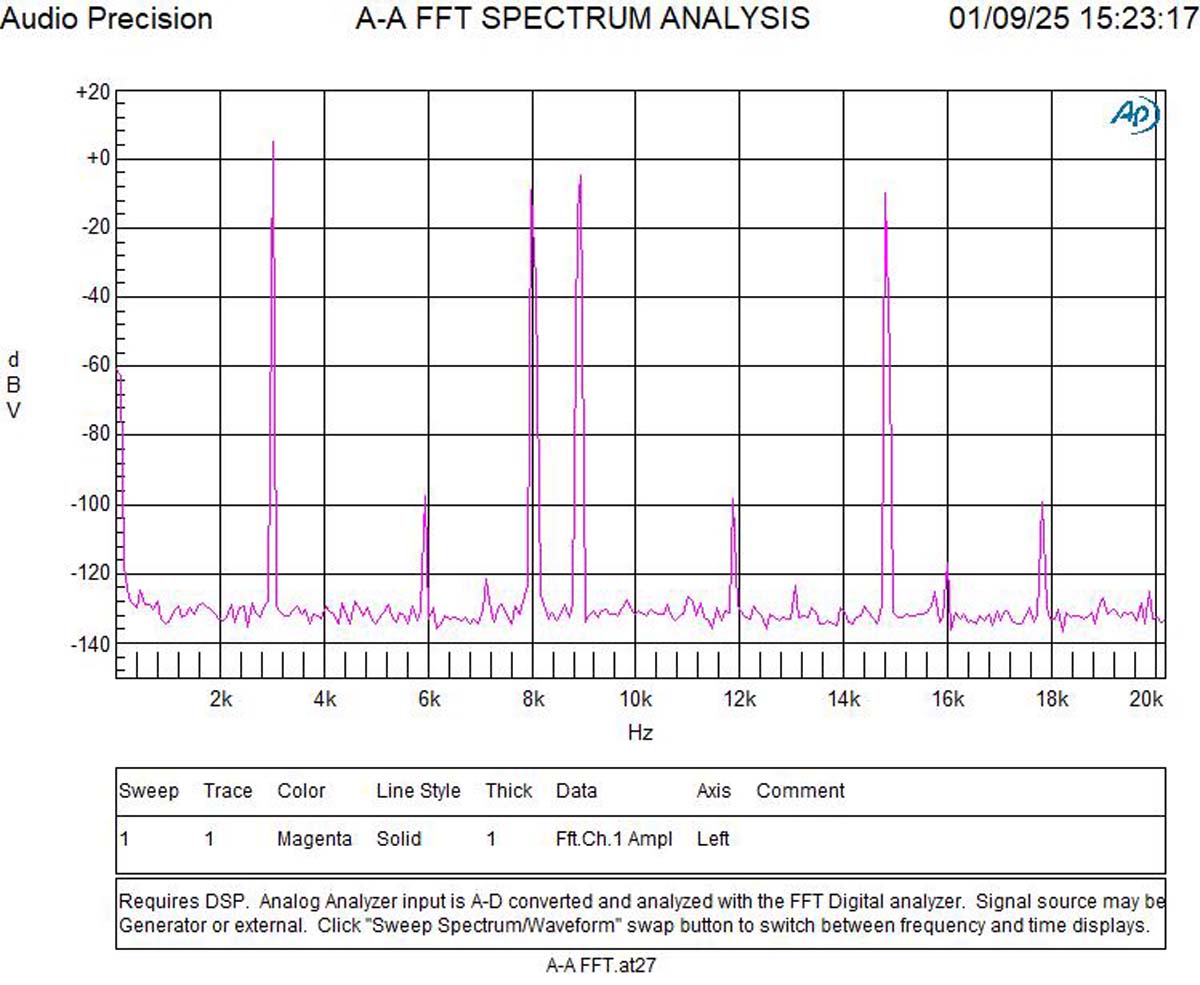
The results are very good: all interference components are approximately 100 dB below the useful signals.
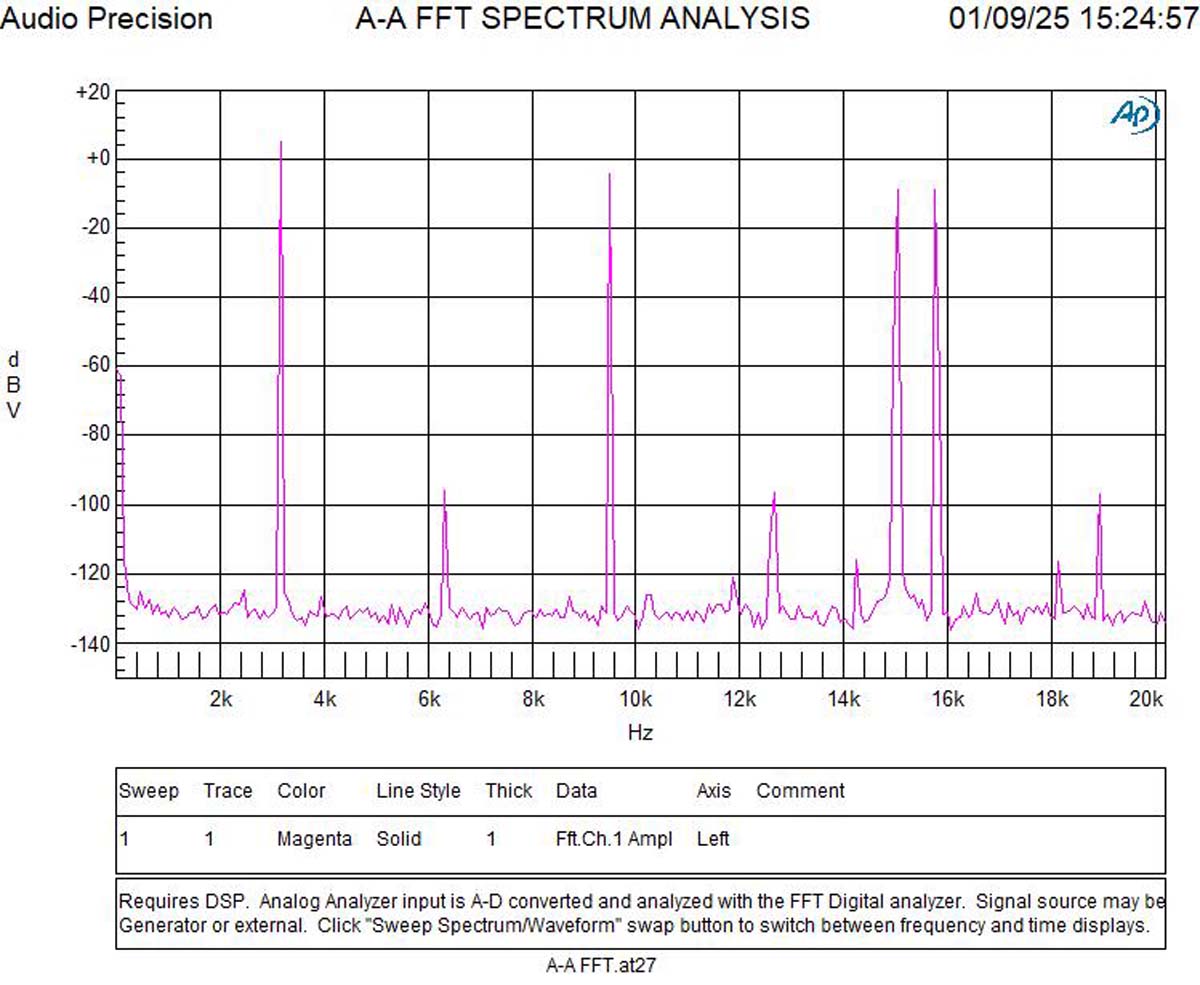
The same excellent results are obtained with other carrier frequencies:
Assessment
A mechanically and visually high-quality amplifier with excellent measured performance. Manufacturer specifications are met or exceeded throughout. Considering the technical performance and outstanding build quality, it offers very good value for money!