
Queen were broke – despite an album that reached number two in the UK (Sheer Heart Attack) and despite sold-out concerts across Europe and Japan. Clearly, their management had failed spectacularly.
So they found a new manager (John Reid, who also managed Elton John) and practically started over. Their next album – the fourth – had to turn things around. “If the album hadn’t been a huge success, we probably would have disappeared,” Brian May says in essence. “We made the album knowing: live or die.” Even so, rather than playing it safe, they decided on a bold move: “Opera” was the motto for the fourth album. They borrowed the album title A Night At The Opera from the Marx Brothers. They used to watch the film of the same name a lot in the recording studio.
The album’s worldwide success was driven by the advance single: “Bohemian Rhapsody”, a six-minute piece that begins as a ballad and turns into a hard rock song after an operatic interlude. Apart from the first guitar solo (2:37 to 3:02), the entire song comes from Freddie Mercury – the band referred to it as “Fred’s thing.” The idea of releasing this monster song with its unwieldy title as a single was met with plenty of skepticism from management. But a radio DJ played the yet to be released “Bohemian Rhapsody” unauthorized 14 times over two days – and listeners flooded the station. This led to the single releasing on October 31, 1975, one month before the album – and both became Queen’s biggest successes. Naturally, the 2018 feature film about Freddie Mercury bears the title Bohemian Rhapsody.
Another operatic variant on the album – perhaps also inspired by the Marx Brothers film – is the nostalgic, almost parodic music hall sound. In no fewer than three (albeit short) songs, the listener is transported back to the interwar period, to the era of the Charleston and early jazz. In “Lazing On A Sunday Afternoon,” Mercury’s voice is distorted to sound like it’s coming through a megaphone (supposedly with the help of a tin mug), recalling early record recordings. In “Seaside Rendezvous,” the voices imitate brass instruments, underpinned by a tack piano reminiscent of honky-tonk bars. At the end of “Good Company,” which is accompanied by ukulele, the electric guitars even imitate a Dixieland band.
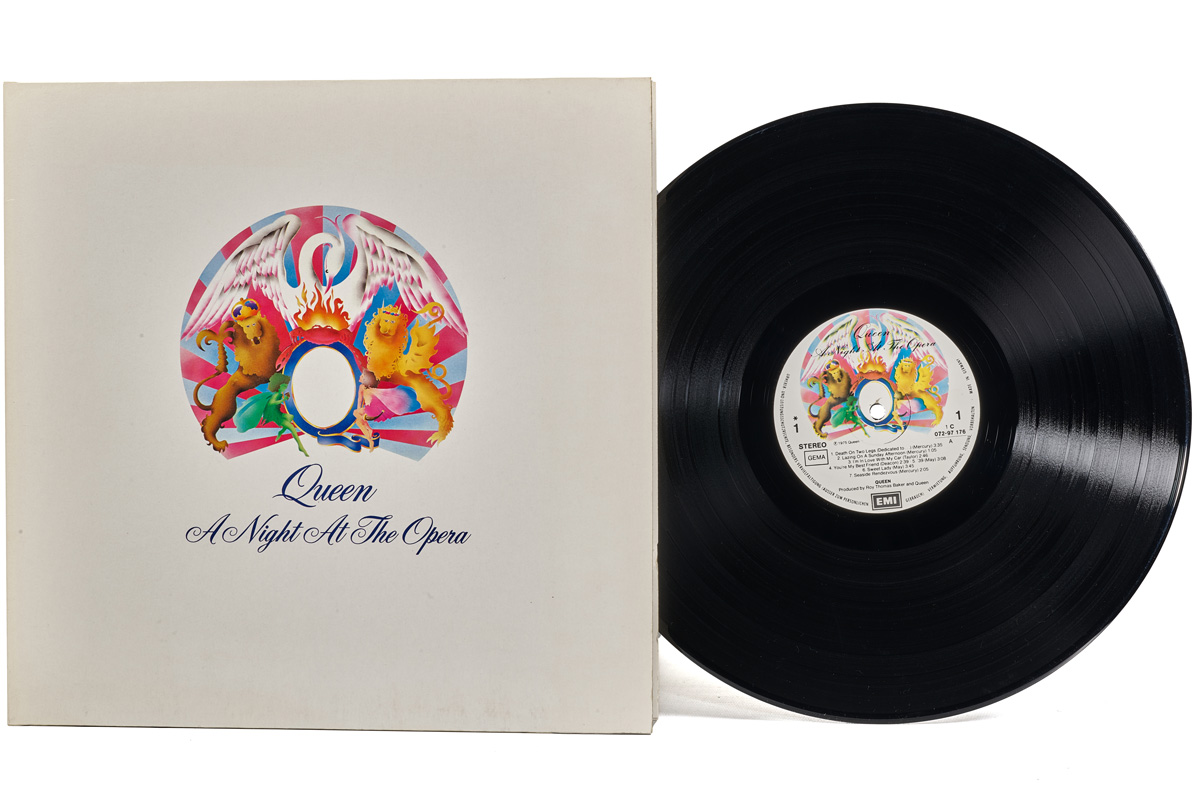
Queen – A Night At The Opera
Recording: 1974–1975
Release: November 1975
Label: EMI
Production: Roy Thomas Baker & Queen
Tracklisting
Side A
- Death On Two Legs 3:43
- Lazing On A Sunday Afternoon 1:08
- I’m In Love With My Car 3:05
- You’re My Best Friend 2:50
- 39 3:30
- Sweet Lady 4:01
- Seaside Rendezvous 2:13
Side B
- The Prophet’s Song 8:21
- Love Of My Life 3:38
- Good Company 3:26
- Bohemian Rhapsody 5:55
- God Save The Queen 1:11
Musicians
Freddie Mercury – vocals, piano
Brian May – guitars, vocals, ukulele, harp, etc.
John Deacon – bass, electric piano (Wurlitzer)
Roger Taylor – drums, vocals, etc.
Commentary and Trivia
- The album is a multitrack work of art with numerous vocal and guitar choirs (some used as brief inserts). Sometimes Freddie Mercury handles all the choir vocals himself; at other times Roger Taylor takes the highest notes (and Brian May the lowest).
- It was probably the most expensive album production in the UK up to that point. It cost 40,000 pounds – roughly half a million euros in today’s money.
- The album opens with a settling of scores with the previous manager: “Death On Two Legs.” Although the person in question is not named, he sues the band and the record label. A hit dog will holler, as the saying goes.
- All four musicians contribute at least one song to the album. The most controversial within the band is Roger Taylor’s “I’m In Love With My Car,” inspired by a roadie for whom his car (a Triumph) was the most important thing in life. At the end of the song, Taylor’s Alfa Romeo can be heard. Taylor insists that the song be the B-side of the “Bohemian Rhapsody” single.
- Brian May’s “39” is a kind of space pirate song – John Deacon plays acoustic bass here. George Michael would later call it his favorite Queen song.
- Even more expansive than “Bohemian Rhapsody” is Brian May’s “The Prophet’s Song.” In the more than two-minute a cappella section, Mercury effectively sings as a trio with himself. Rolling Stone calls “The Prophet’s Song” the best song on the album.
- Mercury’s “Love Of My Life” becomes one of Queen’s greatest ballads. At live concerts, the audience soon takes over the singing entirely.
- Even before the album’s release, the promotional video for “Bohemian Rhapsody” appears, visually inspired by the cover of Queen II. This short film marks the beginning of the international boom in music videos.
- The album closes with the British national anthem as a guitar choir – after all, the anthem is called “God Save The Queen.” The idea was inspired by Jimi Hendrix’s cheeky interpretation of the US national anthem.
- The press praises A Night At The Opera as “progressive rock with a sense of humor” (AllMusic). This album masterpiece contains everything: opera and jazz, nostalgia and hard rock. “Some of the strongest songs we’ve ever written” (Freddie Mercury).