
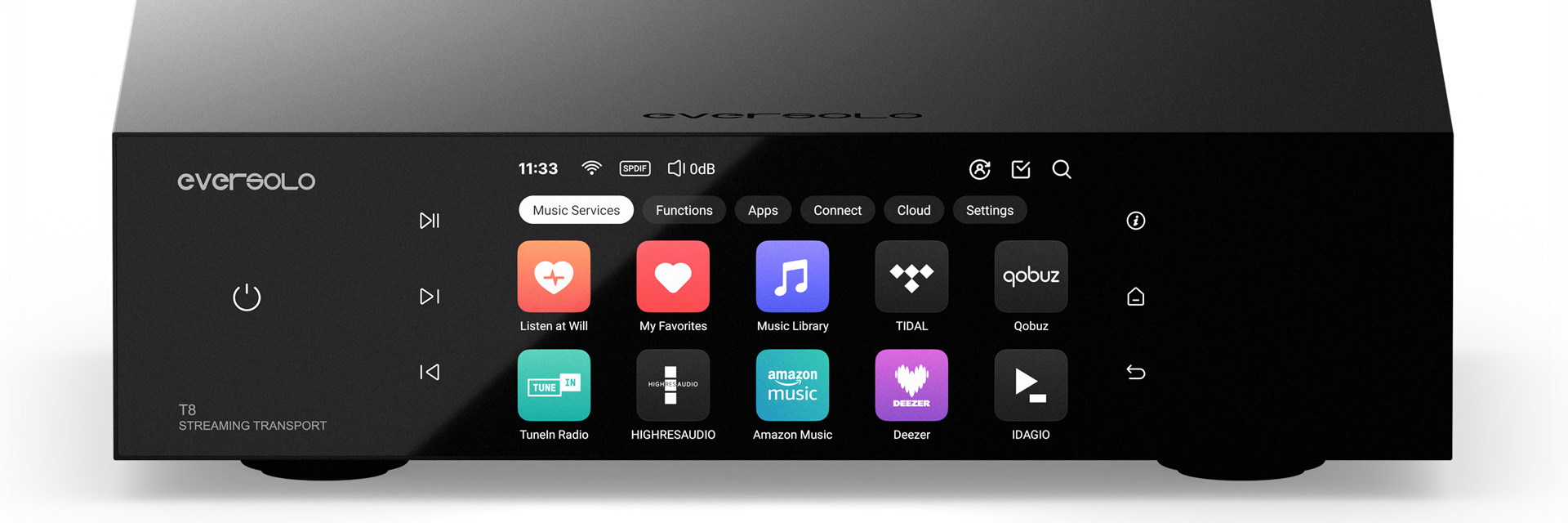
It took roughly 60 seconds before the first sounds from the Eversolo T8 filled my my listening room. No manual, no network issues. For a digital audio product with such a rich feature set, that’s a good start … and certainly just the beginning of a journey through my music library.
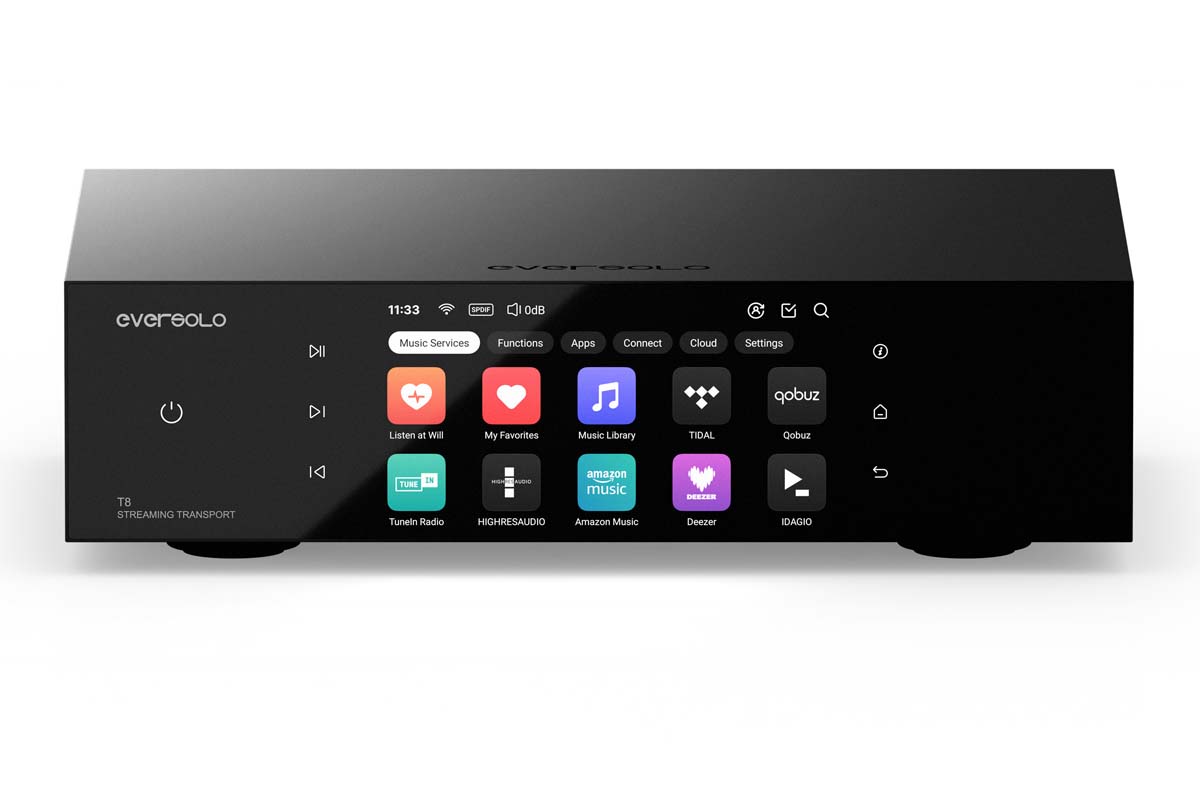
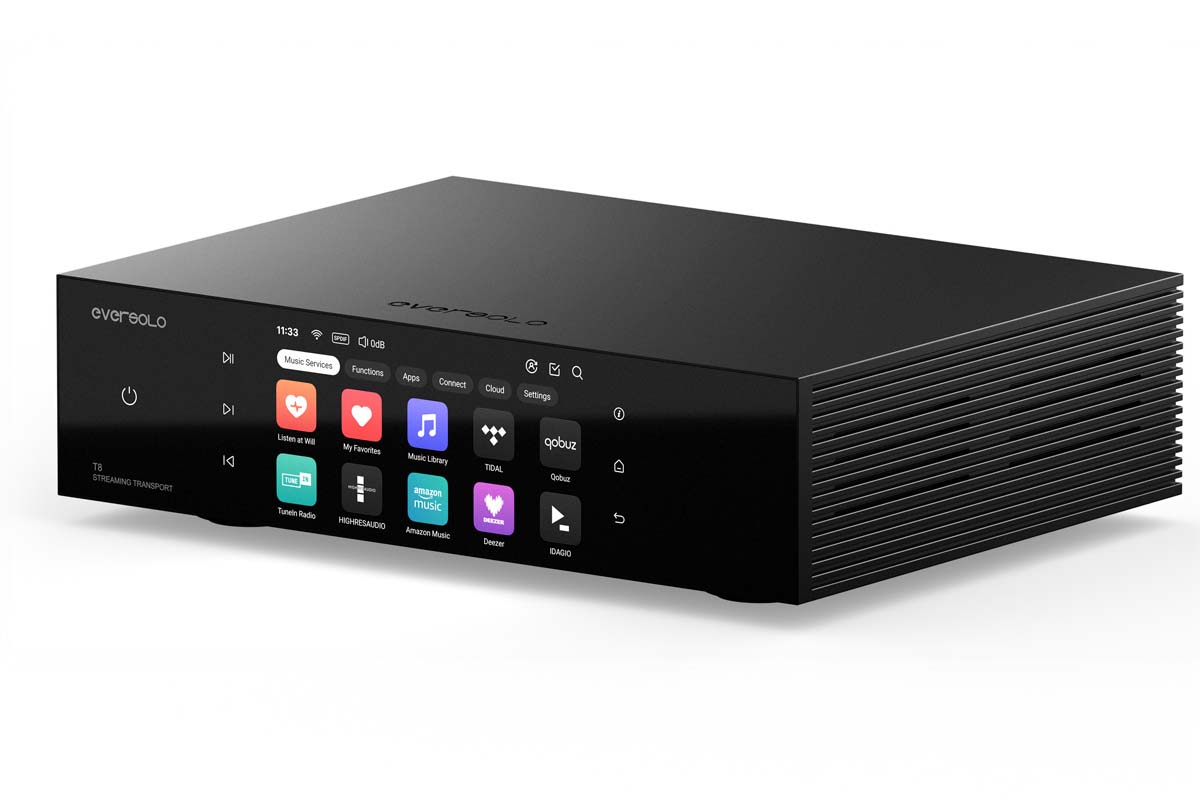
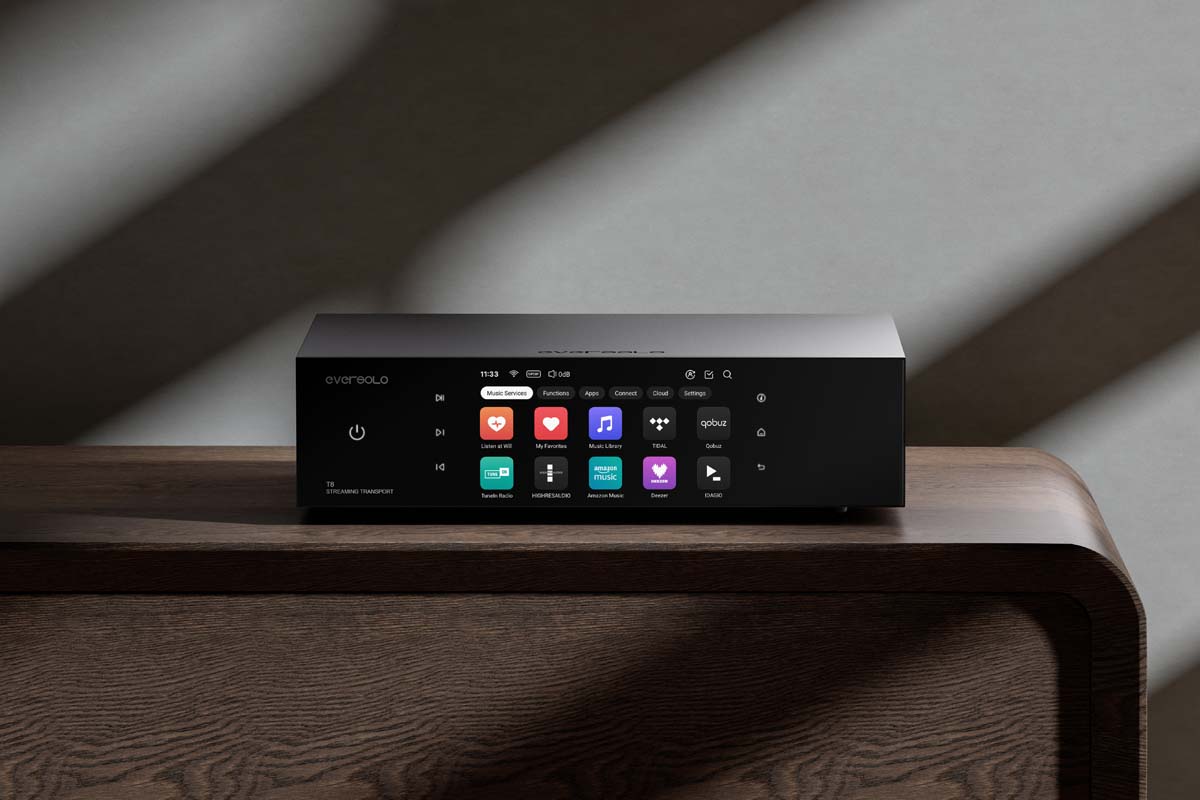
The Eversolo T8 is, first and foremost, a streaming player, but it’s also a music hub and a room calibration system. Let’s start at the beginning. I intuitively connected to my streaming service without having to enter long passwords or anything like that. The short version: connect the cables, plug in the network cable, select the streaming service on the touchscreen interface, scan the QR code with your smartphone, press “Play.” That’s all it takes to get music out of the T8. Of course, you can make plenty of additional settings afterward, but fundamentally, that’s it. The very well-built chassis is completely free of buttons, aside from the hard power switch on the back. The entire front panel is an intuitive control surface with an easy-to-read color display in the center. The form factor, at 32 centimeters wide, is unique, but the aluminum enclosure design is appealing and well balanced. In fact, the purely digital T8 is the manufacturer’s flagship. Accordingly, it’s priced slightly above Eversolo’s also compact all-in-one devices.
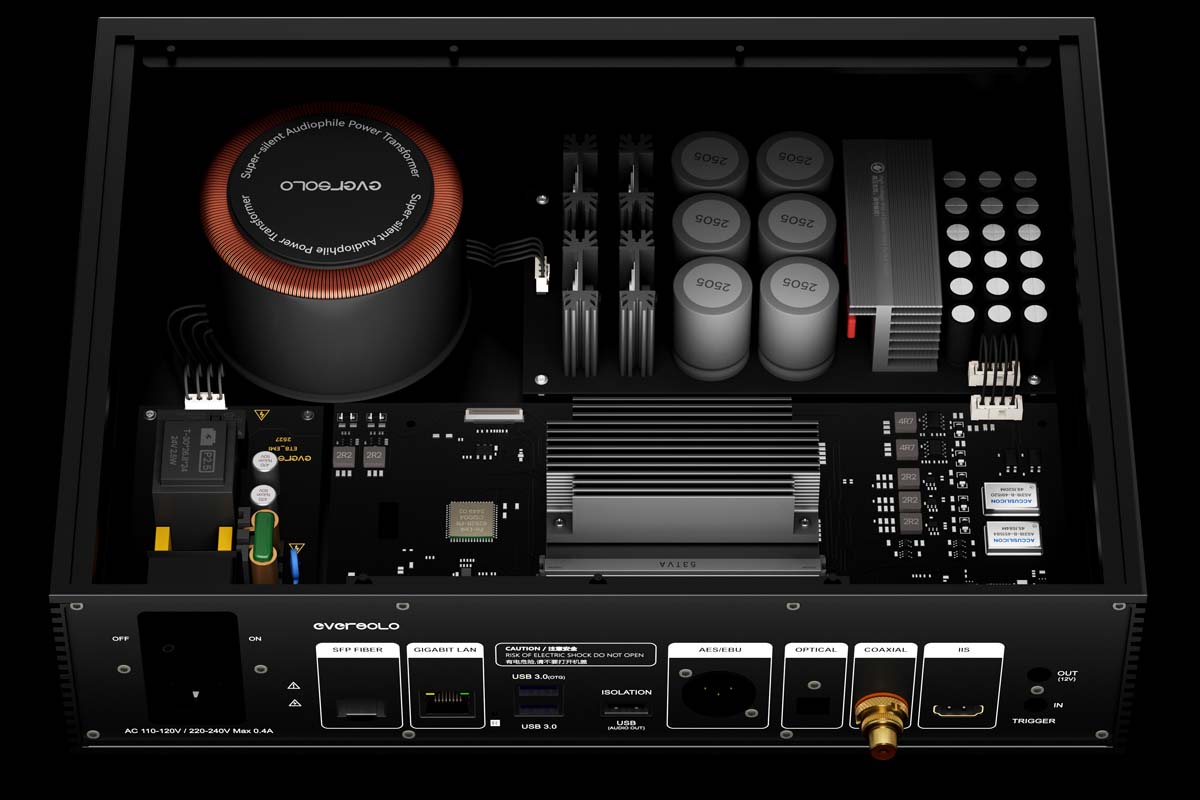
Let’s begin with the high-quality linear power supply with toroidal transformer. It delivers its voltages via Teflon-insulated cables to an expansive power conditioning section that occupies more than a third of the chassis. From the developers’ perspective, a power supply with the lowest possible noise is crucial, because the T8 houses numerous sensitive circuits. First and foremost is the extremely precise femto clock, which times the digital audio signal with high precision, largely eliminating issues such as jitter. Two clock references are used here, each based on the mathematical multiples of the standard sampling rates of 44.1 kilohertz or 48 kilohertz – this prevents rounding errors for either base frequency, and no sonically detrimental sample rate conversion occurs at any time. The developers call this the “Eversolo Original Sampling Rate Audio Engine.”
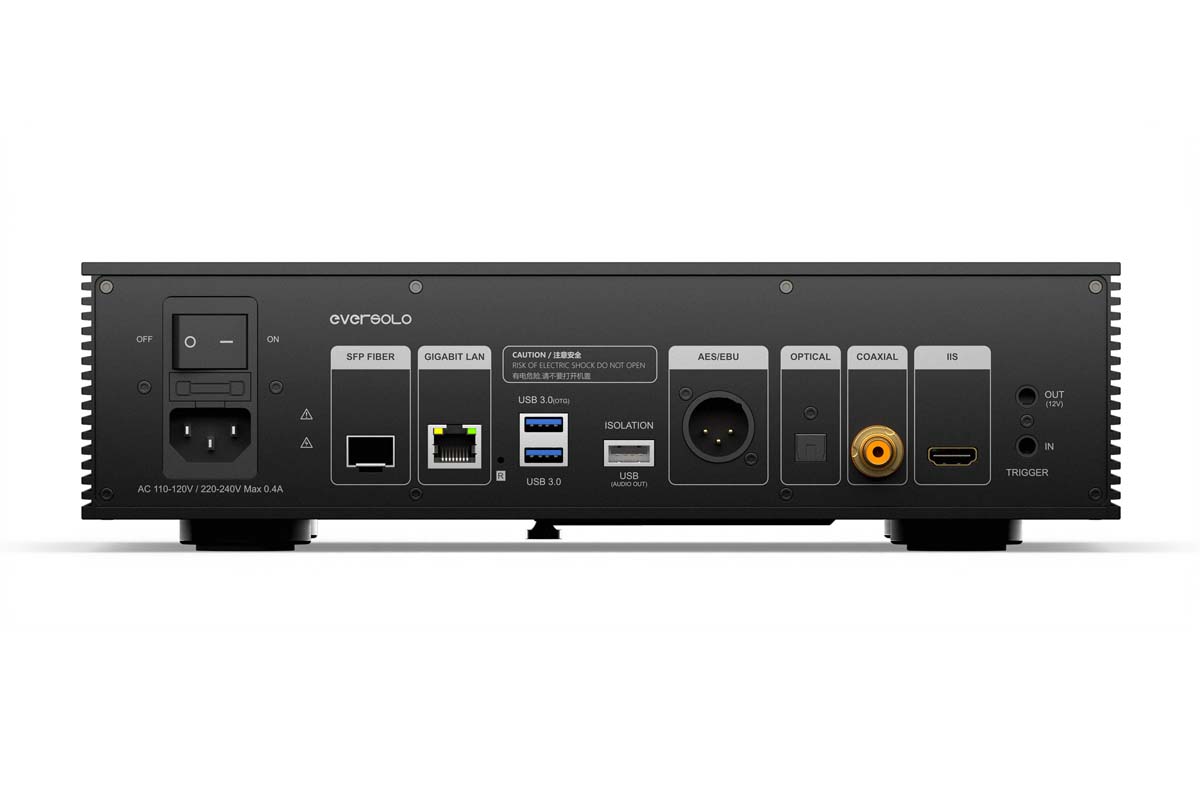
The music is passed on to a DAC of my choice via electrically isolated digital outputs. In addition to standard connections such as S/PDIF, USB, or AES/EBU, there’s also an I2S output (HDMI connector). The network can be connected via Gigabit LAN or directly via fiber optic cable, as there is a professional SFP port (fiber optic), which is inherently electrically isolated, though very few of us will likely actually use it. I’m familiar with these ultra-fast connections from the studio world, and perhaps they will eventually become standard in private homes as well.
Those who prefer not to stream but instead want to play their carefully ripped collection locally can do so with the Eversolo as well. Either via USB 3.0 and an external hard drive or with installable high-speed SSDs, for which two slots with a maximum of 16 terabytes are provided. Wirelessly, the T8 already supports the current Wi-Fi 6 standard. One thing I like: once set up, I can forget where my music is stored. The Eversolo operating system can, for example, create its own playlists from local and streamed music, which are then played back seamlessly – much like the Roon system, with which the T8 is, of course, compatible.
The ever-growing album Gentō by the supergroup Bioscope (Steve Rothery and Thorsten Quaeschning) plays via Qobuz. The T8 is connected to my Luxman DAC, as it only has digital outputs. Apparently, the careful handling of digital music data pays off, because from the very first moment, the soundstage feels expansive, well organized, and highly resolved across the entire listening range. Both the deep bass from Quaeschning’s synthesizers and the Marillion guitarist’s tones, amplified through a Roland Jazz Chorus, impress me with good spatial separation, but also musical cohesion. Because the T8 delivers a clean signal to the DAC, the music detaches from the speakers in a very tangible way. This pays dividends for the tuning of my setup, as the high-quality source allows the rest of the components to show what they can do. While Eversolo itself says that the sound is mainly determined by the choice of DAC, from experience I know that a good transport (whether a CD drive or streamer) can provide that crucial extra bit of quality. In the past, a good power supply often played a role – and that is certainly the case with the T8, whose unit is of exceptionally high quality.
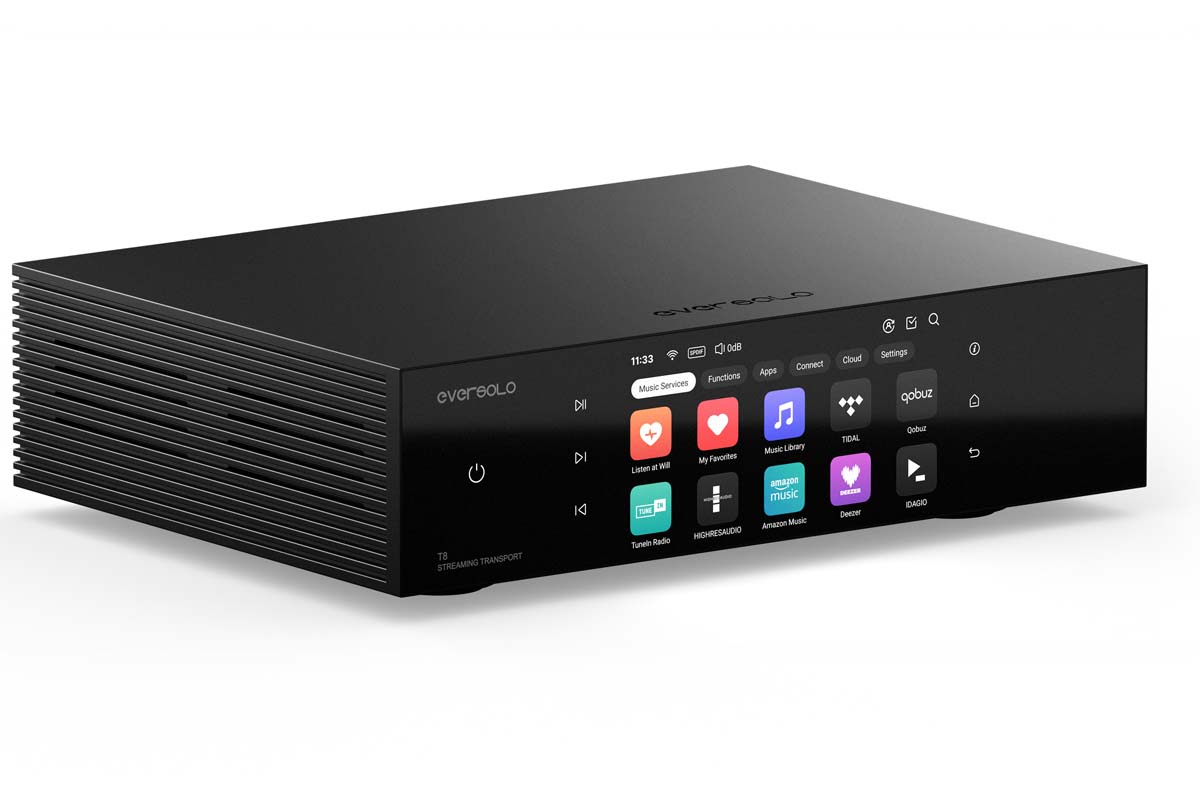
Operation is handled either via the clear device display or via the corresponding apps, though many of us will use the Connect function of our respective streaming providers. The T8 simply does whatever I ask of it. And I like the clearly readable display of album covers and track information on the screen. Others can do this too, but Eversolo gets everything right here, and if I don’t want to see the cover, I can deactivate the display or replace it with various VU meter graphics. A remote control with basic playback functions is also included.
The Welsh band Cardinal Black has recorded an accessible, large-scale album with Midnight At The Valencia, full of soul and a solid dose of British guitar DNA. The bass drum actually sits below the rest of the drum kit even in stereo playback; the kick pedal hits the drumhead with force, while guitarist Chris Buck lets his guitar sing above it like no one else can at the moment. Always melodic, yet at the same time virtuosic. And I receive this emotional information through the T8 in optimal quality into my familiar playback chain.
The Chinese manufacturer calls its integrated room correction system “evotune.” It analyzes the room with the help of a measurement microphone – or even more simply, the microphone of my smartphone. I A/B test the feature using the Cardinal Black album just mentioned for the sake of this review. The only drawback: this function currently seems to be available only in English – but so be it. After a burst of noise and two sine sweeps, the corresponding curve is generated. I can switch it on and off on the fly. The result is somewhat different; initially, the app lowers the level of the newly generated filter. After matching the volume, there’s actually only a slight difference in the high-frequency range in my room: the cymbals move slightly backward, while Tom Hollister’s voice comes slightly forward. A matter of taste. Eversolo recommends a professional measurement microphone for this purpose – and I can confirm that a smartphone microphone is not a measurement microphone! But there’s another thing the T8 can do: room calibration. Whether you ultimately want to use it is entirely up to you. If desired, you can also adjust your EQ curve yourself using the built-in 10-band EQ. Easy setup, flexible operation, and professional connectivity are clear strengths of the Eversolo T8. From my perspective, however, the optimal processing of digital data with the dual femto clock and the classic linear power supply is the strongest argument for the Eversolo T8. Stylish looks included.
EVERSOLO ROOM CALIBRATION
Room calibration can be done in just a few minutes with the Eversolo T8 and a smartphone. A corresponding dialog in the associated app gives access to the feature. After selecting the microphone (an optional measurement microphone delivers significantly better results than a smartphone), a noise signal is sent into the room via both speakers. This is followed by a sine sweep from each speaker. After a short calculation period, the corresponding equalization curve is sent to the T8, where it can be activated or deactivated as desired.
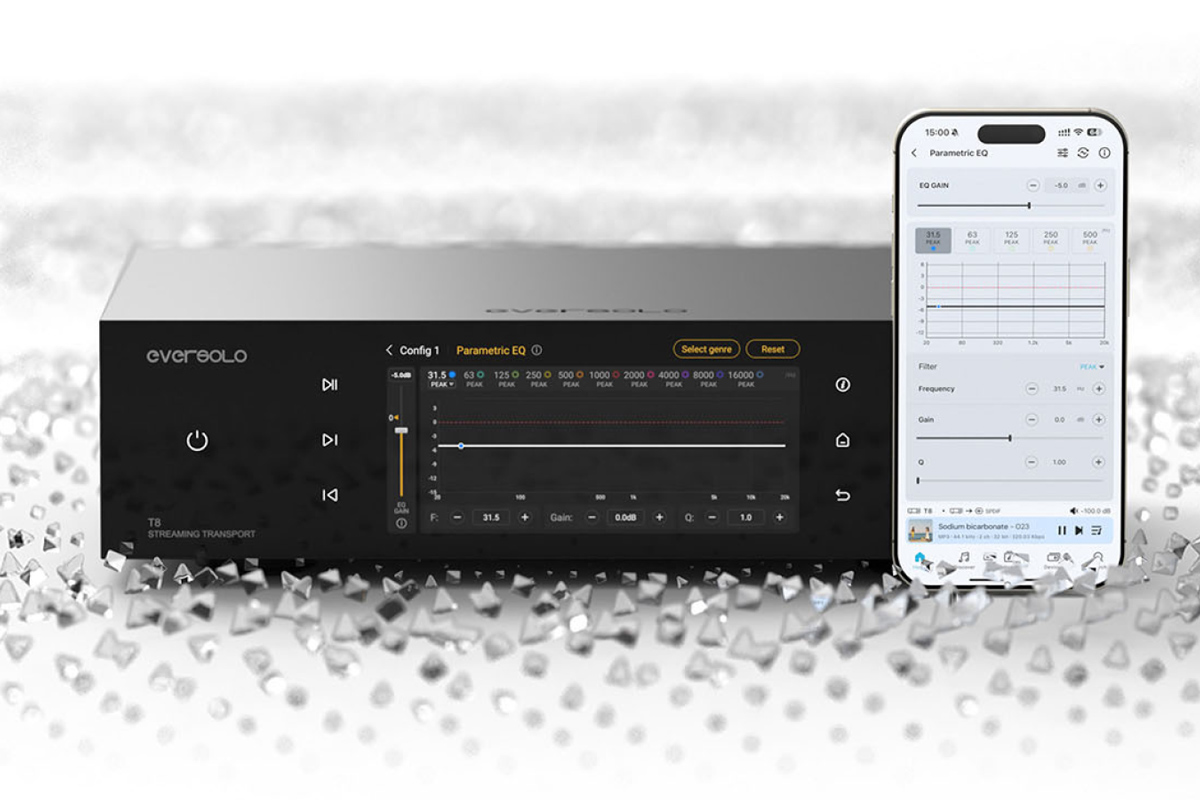
Streaming Bridge Eversolo T8
Concept: digital music player for streaming locally or network-stored music, optionally with room correction | Inputs: 1 x network RJ45, 1 x SFP (fiber optic) | Outputs (digital): 1 x USB, 1 x I2S (HDMI), 1 x S/PDIF optical, 1 x S/PDIF coaxial, 1 x AES/EBU (XLR) | Internal storage: 64 GB; slots for NVMe SSD (max. 16 TB); USB port for external storage media | Formats: up to DSD512 and PCM 32 bit/768 kHz | Streaming services: compatible with all audio streaming and internet services; compatible with Connect services; Roon-ready | Features: high-quality linear power supply, dual femto clock, isolated digital outputs, WiFi 6; quad-core ARM processor, 6-inch touchscreen | Finish: black | Dimensions (W/H/D): 32/9/23 cm | Weight: 5 kg | Warranty: 2 years | Price: around €1380
audioNEXT
Isenbergstraße 20
45130 Essen
info@audiodomain.de