
Around the year 2000, Dave Douglas was widely regarded as jazz’s greatest “hope for the future,” as jazz historian Dan Morgenstern put it.
He was celebrated as the consummate trumpeter, seemingly capable of mastering every style and approach in jazz with effortless ease. Dave Douglas had studied at Berklee, worked as a street musician, served his apprenticeship in hard bop with Jack McDuff and Horace Silver, and also established himself in avant-garde and free jazz circles. More than that, he looked well beyond the American horizon, viewing his country—and its politics—with the critical perspective of an outsider. It was not in his native New York but as an exchange student in Barcelona that he decided to devote himself to jazz.
Douglas had a keen ear for European concert music, adapting works by Schumann, Weill, and Stravinsky, performing in Uri Caine’s Mahler Project, and recording primarily for European labels. He also embraced the musical traditions of Eastern Europe and the Middle East, becoming a member of John Zorn’s Masada Quartet, contributing to Don Byron’s klezmer projects, and exploring Balkan music with his own Tiny Bell Trio. In just the first ten years of his career as a bandleader (1993–2003), Dave Douglas recorded 20 albums under his own name with ten different ensembles.
The first—and oldest—of those ensembles on record was what he called his “String Group.” Instead of the usual piano and second horn, the lineup features three string instruments—violin, cello, and bass—along with drums. The overall sound recalls European chamber music, except that the musicians are American jazz artists who are constantly inventing, improvising, weaving in and out of one another’s lines, and, above all, swinging with tremendous force. Alongside Douglas, the principal soloist is violinist Mark Feldman, who moves seamlessly between jazz swing, Tchaikovsky parody, avant-garde techniques, and klezmer inflections. The String Group is the ideal vehicle for Douglas’s transatlantic musical vision, in which jazz, classical music, and folk traditions all converge. As Douglas himself put it, his goal was “to absorb all these influences so we can make our own statements.”
The album Five commands attention from its very first moments. Its “overture,” “Invasive Procedure,” is a through-composed forty-second miniature whose direction changes almost continuously—an explosive chamber work propelled by jazz-rock energy, like a red-alert siren.
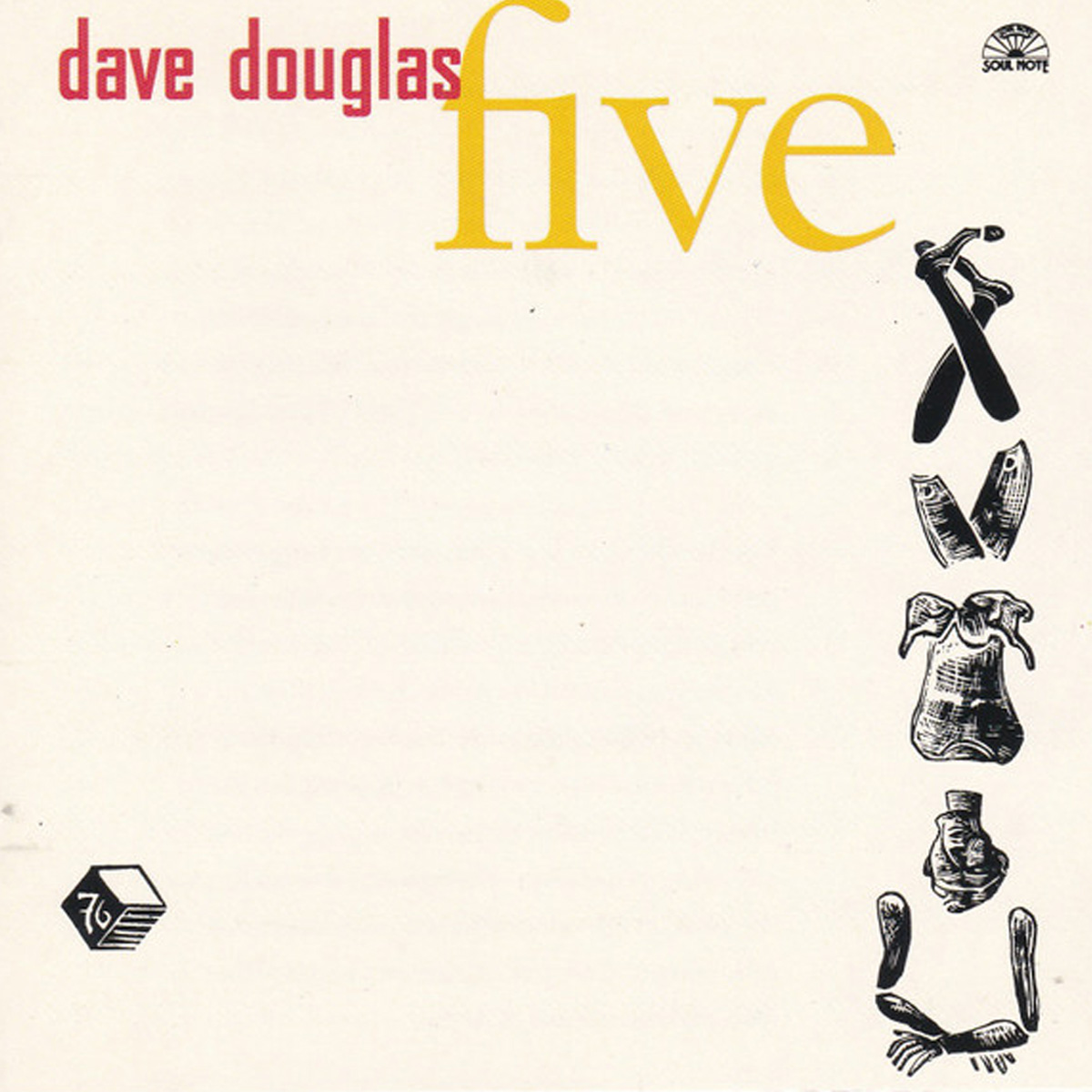
It is immediately followed by “Mirrors,” whose central section has the entire band improvising and swinging somewhere between a Dixieland ensemble and rhythmic free jazz. This tribute to soprano saxophonist Steve Lacy is the first of six dedication pieces Douglas composed for the album. The other honorees are Wayne Shorter, Mark Dresser, Woody Shaw, John Cage, and John Zorn—a revealing blend of jazz legends and avant-garde innovators. Douglas opens the ballad “Going, Going” (for Shorter) with a solo that is as close to Mahler as it is to the blues. “Mogador” (for Zorn) evokes a Middle Eastern lament—a nod to Zorn’s Masada band—set against a tango- or march-like rhythm and repeatedly interrupted by a forceful, signal-like countermotif.
The program also includes two standards—not familiar warhorses, but compositions by two brilliant musical iconoclasts: Thelonious Monk and Rahsaan Roland Kirk, both imaginatively reworked. Indeed, every track on Five possesses a sense of finality in both conception and execution, in its wealth of motivic invention, rhythmic drive, and stylistic range, stretching from brush-driven swing to explosive freedom. “It rarely gets any better than this,” John Zorn writes in the album’s liner notes. “Adventurous music, touched by genius.”
Every track on jazz trumpeter Dave Douglas’s album Five has an unmistakable sense of finality in both its conception and its execution.
Find Dave Douglas – Five on discogs.com.