

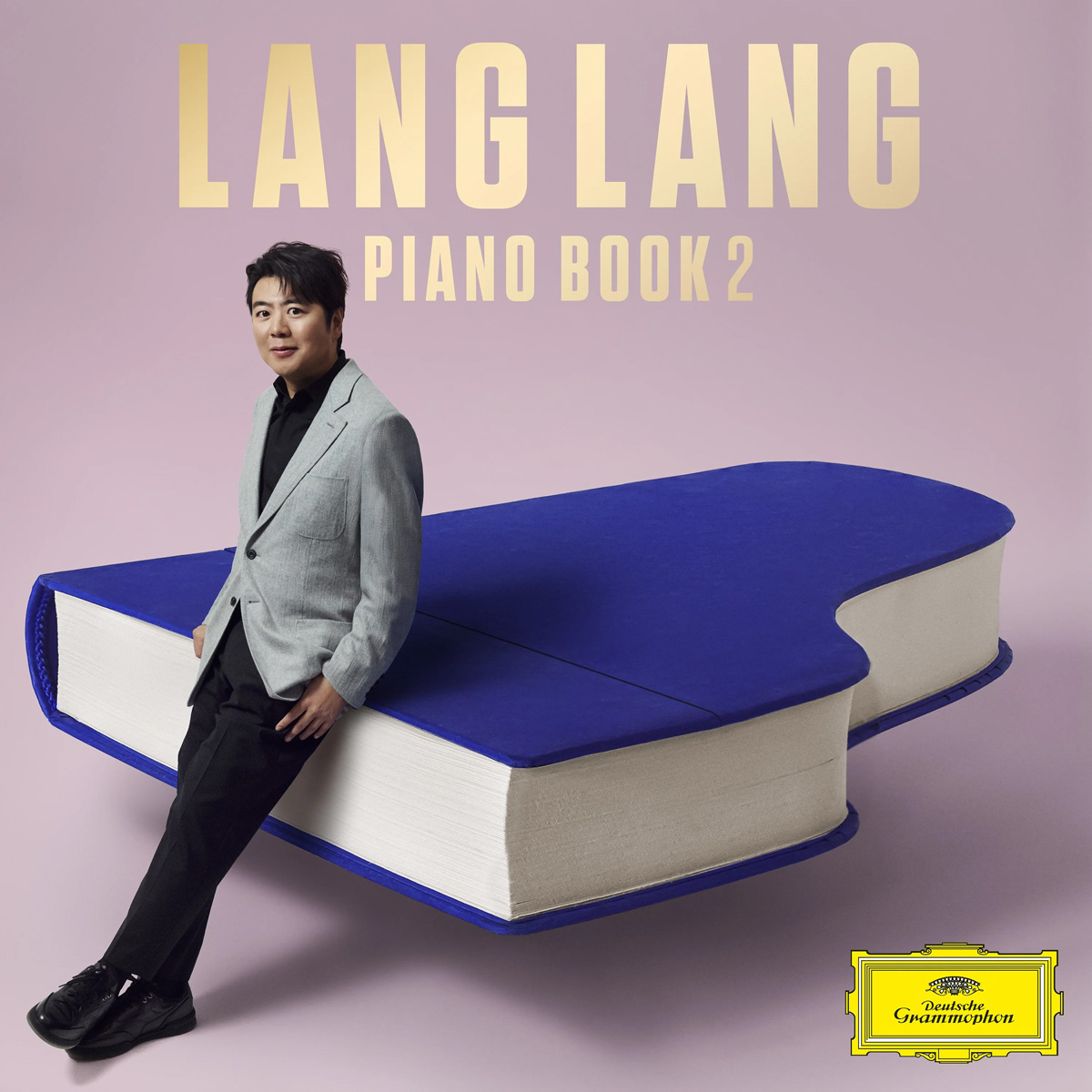
With Piano Book 2, Lang Lang effortlessly removes many of the barriers that people often associate with classical music.
Over the past two decades, Lang Lang has evolved into an artist who brings classical music into the public sphere in a way that remains out of reach for many of his colleagues. He possesses that rare combination of effortless virtuosity and media presence that inevitably draws audiences in. Born in 1982 in Shenyang, northeastern China, Lang Lang received rigorous training from an early age that systematically nurtured his extraordinary talent. As a teenager, he moved to Philadelphia, where he studied with Gary Graffman at the Curtis Institute and laid the foundation for his international career. His breakthrough came before he turned twenty, and since then he has become one of the most recognizable pianists of his generation, commanding both the concert stage and the media spotlight. While he performs with a natural ease that can seem almost weightless – as though his energy flows directly through the keyboard into the hall – he has also cultivated a carefully managed public visibility that has made him a familiar face on the international music scene, recalling the strategy of violinist David Garrett, who likewise has successfully bridged the worlds of tradition and popular culture.

Critics, however, often approach him with a certain reserve that can only partly be explained by aesthetic considerations, since his technical mastery is rarely questioned. The debate centers instead on whether his interpretive approach truly adds new layers of meaning to the repertoire or remains suspended in an ambiguity that some listeners find difficult to define. The fact that Lang Lang tends to remain within the established core of the classical canon and rarely ventures beyond familiar territory has fueled the suspicion that he cultivates a polished surface. Even collaborations with major musical authorities such as Nikolaus Harnoncourt, which might theoretically have opened new artistic horizons, have left only limited traces in his style. His recording of Bach’s Goldberg Variations, for example, sometimes felt like an attempt to construct an intellectual architecture whose supporting pillars did not always hold, because the desire for individuality occasionally seemed stronger than the work’s own inner logic.
At the same time, it would be a mistake to underestimate Lang Lang’s importance to contemporary classical music. In an era when the traditional classical audience is shrinking and economic structures are becoming increasingly fragile, an artist who not only performs but also communicates becomes especially valuable. His appeal reaches people who might otherwise never engage with classical music, and his openness acts as a gateway, lowering barriers without creating the impression that he is compromising his artistic integrity. It is precisely this ability to spark curiosity and reduce apprehension that makes him an important figure in a field that urgently needs new impulses if it is to remain visible within the broader public consciousness.
The new Deutsche Grammophon sampler presents a panorama of piano literature that is clearly aimed at listeners seeking an accessible first encounter with classical music. The selection resembles a carefully arranged mosaic of familiar works and more recent compositions, inviting curiosity without overwhelming the listener. This approach is particularly effective from the outset with Chopin’s Prelude in E minor, whose concise form and concentrated melancholy acquire an immediate emotional clarity under Lang Lang’s hands. It is a piece that establishes the tone of the entire album: approachable, focused, and free of academic heaviness.
Another highlight is Mendelssohn’s Spring Song, performed here with the lightness and transparency that allow the miniature’s lyrical character to shine without drifting into sentimentality or triviality. The melody unfolds freely and effortlessly, almost like an open invitation to those who may be intimidated by the perceived strictness of classical music. Equally effective is Liszt’s Consolation No. 2, a work that combines Romantic warmth with virtuosic fluency and remains remarkably understated in this performance. Lang Lang finds a tone that unites elegance and technical brilliance while avoiding any trace of showmanship. As a result, the piece serves as an ideal introduction to the piano repertoire, presenting both beauty and complexity in an exceptionally accessible form.
Particularly noteworthy is the inclusion of more contemporary musical landscapes – though without venturing into avant-garde territory – such as Joe Hisaishi’s Spring, whose melodic clarity and cinematic breadth are likely to resonate immediately with younger listeners. Here, Lang Lang demonstrates how naturally he can connect classical and popular aesthetics. The piece feels neither out of place nor like a concession to younger audiences, but rather as a gentle extension beyond tradition that broadens the sampler’s appeal. The remaining works, ranging from Mozart, Beethoven, and Satie to Einaudi, fit seamlessly into this concept, creating a journey through miniature compositions that repeatedly open inviting windows into the repertoire.
Overall, this is an album crafted with great care for listeners who wish to explore classical music without immediately plunging into the depths of the major cycles and large-scale works. The recording quality is excellent, and the playing remains consistently clear and inspiring throughout. As such, the sampler is an ideal release for beginners and casual listeners alike – an album that encourages further exploration while standing confidently on its own: an open gateway into the world of piano music.
Lang Lang – Piano Book 2
Various artists
Label: Deutsche Grammophon
Format: 2 CDs, 2 LPs, DL 24/48