

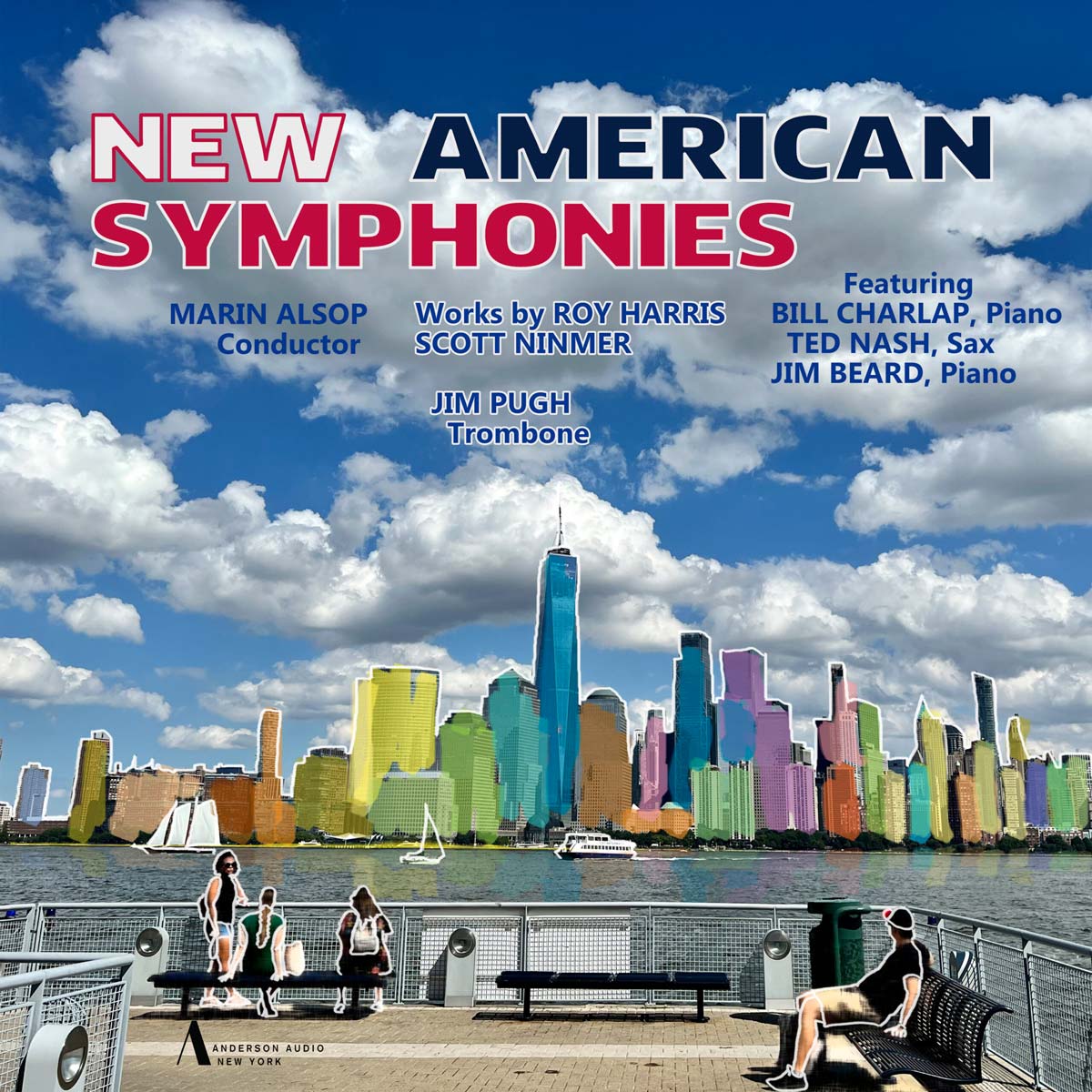
The upcoming album New American Symphonies features an undiscovered gem. Or more accurately, a rediscovered gem.
This article was originally published in Copper Magazine issue 233
FIDELITY cooperation with Copper Magazine
Read this article also on Copper
Trombone Symphony was written by composer Roy Harris for Tommy Dorsey in 1938, but never recorded until now. Upon listening to this wonderful piece, which has influences in jazz, classical, and one could say show music and popular song, it makes me wonder why it took so long to see the light of day. It will be available August 14 in stereo and immersive audio in various formats.
On this album Trombone Symphony is paired with Night Suite, a modern work by composer Scott Ninmer. The recording, which features trombonist Jim Pugh, is superb both musically and sonically, the latter being no surprise as it was done by Jim Anderson and Ulrike Schwarz in Digital eXtreme Definition (DXD). New American Symphonies has a large-ensemble band, with half a dozen reed players, four trumpets, three trombones, piano, bass, drums, guitar, and percussion. The musicians are top-notch New York players like Bill Charlap and Jim Beard on piano, and Ted Nash playing sax. The ensemble for Trombone Symphony was conducted by Marin Alsop.
New American Symphonies will be available as a download from Native DSD and HD Tracks, on all streaming services, and on LP from Citizen Vinyl.
According to a news release, it took years of research by Jim Pugh to bring Trombone Symphony to light. He ultimately discovered Roy Harris’s original manuscripts at the Library of Congress. Pugh found out that Tommy Dorsey’s orchestra had tried rehearsing part of the Symphony once before giving up, and it was never performed in public. It’s hard for me to believe. As Pugh notes, “if you close your eyes and listen to the first movement, you can hear where jazz would eventually arrive some 35 or 40 years later…it’s this remarkable little time capsule that slipped through the cracks of history.”
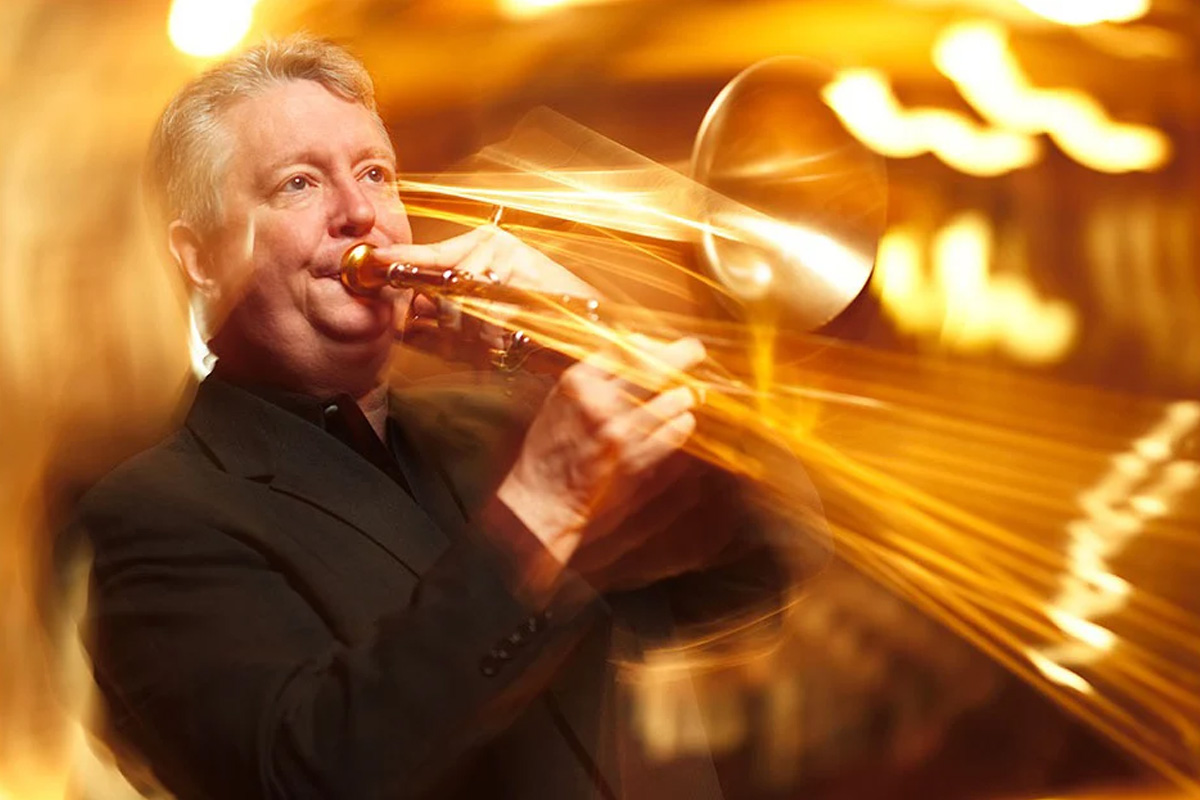
Indeed, the first movement sounds contemporary and not at all dated. I could hear this as an overture to a Bernstein Broadway musical, or a piece by a composer of today. The tempo is brisk (no wonder Dorsey’s orchestra might have had trouble playing it), and the tonal colors are richly varied, with superb ensemble playing, and soloing and interplay between the piano, woodwinds, and brass. In fact, the album’s publicist sent me the full scores to the music, and it’s fascinating to see the orchestration on paper and then hear it come to life.
1930s pop music audiences might have been scratching their heads, while classical music aficionados would have, I think, appreciated the music as sitting right alongside American composers like Gershwin and Copland.
The second movement is more subdued, languid in tempo and enveloping the listener with rich, lower-register sonorities. Jim Pugh’s beautiful burnished tone complements the music perfectly. The music unfolds in a stately manner and as you would imagine, the trombone carries much of the melody. Gorgeous.
Scott Ninmer’s Night Suite is more “modern” sounding in its big-band jazz feel, chord voicings, and harmonic palette. It sounds freer, less “composed” with more room for improvisation and solo spotlights. In the first movement, “Eventide,” Pugh gets plenty of room to solo, and the band is adept in their call and response. The music would be at home on a playlist of Don Sebesky, Maynard Ferguson, the Jazz at Lincoln Center Orchestra, Christian McBride, and other large group brass and woodwind ensembles.
The second movement, “Gliding Through the Darkness,” begins with an arpeggiated electric guitar figure doubled by various instruments, and then the brass and winds join the proceedings with lush background punctuations. “Too Late,” the mid-tempo third movement, is airier and breezier, with weaving melodies and jazz chops. As soon as I heard the guitarist, I knew I had heard him before but couldn’t place him. I checked the liner notes and, ah, Jon Herington of Steely Dan fame. I’m thinking Donald Fagen would dig this. I certainly do.
The sound is ravishing. The soundspace is enveloping, wide, and deep, and this is in stereo – believe me, I’ll be auditioning the immersive mix at the earliest opportunity. The tonal balance is to my ears impeccable. Instrumental textures are easy to discern, and stand out even when the orchestrations get complex. There’s weight and presence and superb dynamic range. You never get the sense of “listening to a recording,” but rather of merging with the music. On a high-end system, this recording is really wonderful, a reminder of why we all do this audiophile thing.
Interview
Naturally I needed to ask Jim Anderson and Ulrike Schwarz how New American Symphonies came about.
Frank Doris: How did the Trombone Symphony, such a great piece of work, go unnoticed for decades?
Jim Anderson: It was buried in the Library of Congress in a box. In fact, the story begins with Jim Pugh. [He] was reading a biography of Leonard Bernstein, [where] he was talking about how all the composers of the 1930s were writing for Benny Goodman and Artie Shaw and people like that. And there’s a sentence [in the book] that said, “And Roy Harris wrote a trombone concerto for Tommy Dorsey.” And Jim said, “What?”
And so he snooped around for a while and finally got permission to go to the Library of Congress and look in Roy Harris’s papers. They went through box after box after box. First he found a score, and then some parts. Eventually he [found] the score for one movement and the parts for a second movement. And so what he then did was to recreate both parts.
Then he spoke with Harris’s widow and got permission to go into the studio and see what it sounded like. If you notice, the first movement is really almost a piano concerto for Bill Charlap. That was sort of written for Harris’s wife to play. Then the second movement is really Tommy Dorsey’s solo. And then you notice it doesn’t go anywhere. There’s no third movement. That’s because the Dorsey band tried to play it after a gig at the Rainbow Room (in New York) and they just called this thing unplayable and it was shelved. In fact, I think on one of the scores it says “abandoned” or something like that.
Ulrike Schwarz: And they were some very unkind notes [written on] the trumpet part. The players didn’t like it.
JA: Jim [Pugh] never told me what it was that was written, but some trumpet player wrote something disgusting about the piece and [said] it was just impossible. It wasn’t your typical bebop from the ’30s. I mean, it was definitely years ahead of itself. But we went into the studio with some of the best players in the city, which means some of the best players in the world. And we knocked it out in about six hours.
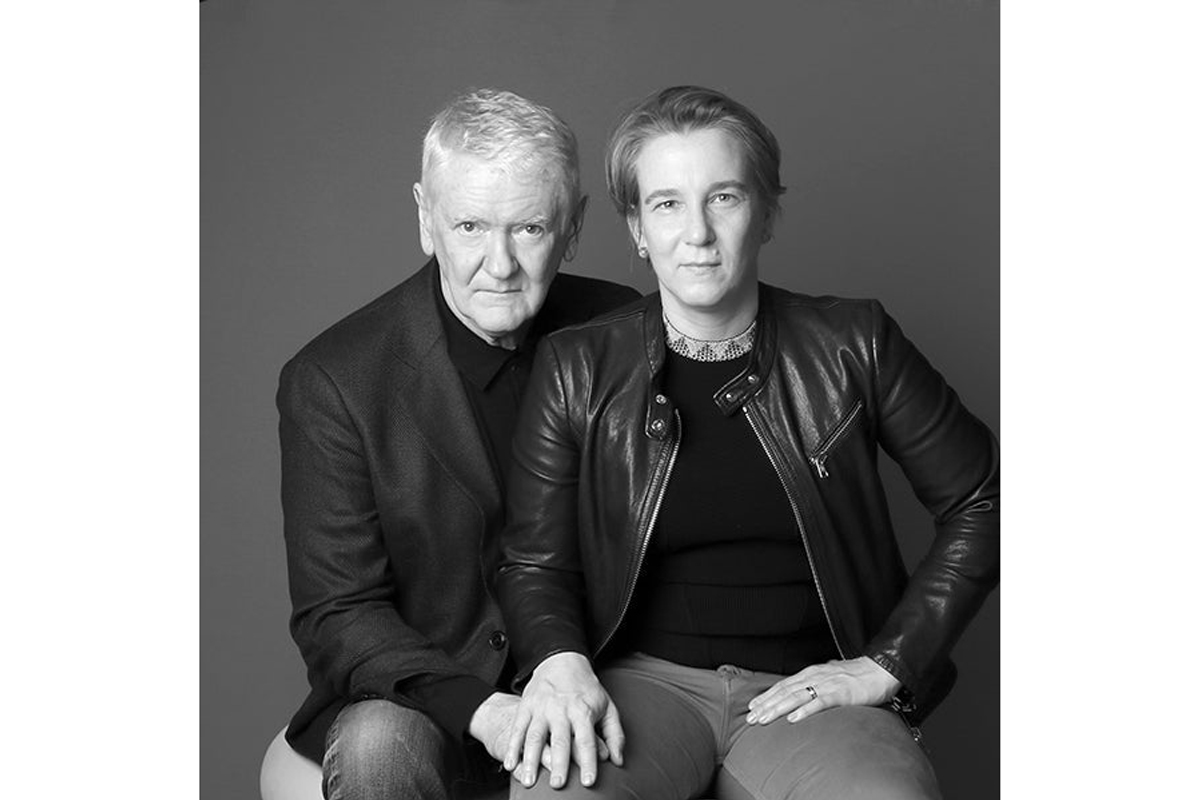
About the Ninmer piece: he’s a former student of Jim’s who’s gone on to have a pretty good career as a composer and arranger. And right now he’s with the [United States] Marine Band. He wrote [Night Suite] in honor of Jim as one of his former professors. When we were in the middle of recording the Ninmer piece, I said, “Jim, whatever happened to that Trombone Concerto we recorded?” He said, “It’s just hanging around there.” And I said, “With those two pieces we’d have an album.” So that’s how we got these two pieces combined.
FD: For me, it’s a combination that works, because it shows an evolution of music over the decades, and how the Trombone Symphony was ahead of its time and then Night Suite sort of looks back a little bit.
It sounds like there’s a lot of improvisation in Night Suite, and they wrote in spaces for Jim Pugh to improvise.
JA: Very much so. It’s very much like a jazz thing. You hear Jim state the melody and then there are huge sections of improvisation.
FD: I love Jim Pugh’s sound, his tone. The tone of the trombone and the way he played it was the perfect instrument to fit with the music. If somebody would’ve played, say, a harmonica, it would’ve been jarring or irritating. But the trombone was just…you can see why the piece was called Trombone Symphony and written for that instrument in mind and it’s just perfect.
JA: Well, Frank, what’s really interesting about Jim is that he and I go back to seventh and eighth grade, back to junior high school in Butler, Pennsylvania. I heard him play 60 years ago. He was a true prodigy back then. He was a student of Matty Shiner who was the preeminent trombone teacher in Pittsburgh. Then he went on to Eastman School of Music and was with Emory Remington. So he studied with the best really. But at the same time, he was just a phenomenon. I mean, you might even call him a freak. He was born to play that instrument.
FD: The sound of the recording is wonderful. Copper readers are going to want to know the tech details.
Ulrike Schwarz: The recording system was 32 channels of DXD [using the Merging Technologies] Pyramix. I think we [also] had an extra eight channels. Everything was mixed with the Merging Technologies SuperClock. Both recordings used ribbon microphones on Jim’s [trombone], an RCA and an AEA KU4.
JA: Jim plays with Steely Dan. [He told me], “When we’re on the road, we have an AEA KU4 for the horn section.” And so we brought that into the studio.
FD: Was it all recorded live?
JA: Yeah, it was all live. I mean, there’s a bit of editing. Jim didn’t have to do any corrections. And we had Marin [Alsop] conducting on Trombone Symphony.
[Editor’s Note: some of the mics had to be repositioned when the sax players changed instruments, and some flutes had to be overdubbed.]
And then the first piece, the Harris, we had Marin also conducting on that too. Both pieces were done in two three-hour sessions.
FD: You didn’t break everything down and set everything back up for the two pieces? It was the same setup?
JA: They were done in separate sessions. One was done in Studio A at Power Station. The other one was done in Studio C at the Power Station.
US: You should [mention that] one was done in 1995 and the other one was done in 2023.
FD: So much for my acute ears!
JA: Well, frankly, I think it says a lot for our mixing in that the two pieces just blend together and you’d never know that there’s a…
FD: Gap between them? Oh, I would never guess. I’m making fun of myself saying that I have bad ears and should be able to hear the differences. But no, it’s seamless.
US: My job was to put them sonically together so that you wouldn’t actually think there is a 30-year gap. When I heard the Trombone Symphony for the first time, I kind of couldn’t really believe what was going on. I think the Harris [Night Suite] is such a standout performance and standout piece.
JA: It also adds a lot to the history of American music, frankly.
FD: I wonder how much other undiscovered stuff out there.
JA: Oh gosh, there must be. I was with [Andrés] Segovia in the 1980s in his studio and there was a pile, just a pile about maybe two feet high of manuscripts that had been sent to him for him to correct and make [arrangements for] guitar that various major composers had sent him, and he said, “I’m just going through these one at a time.” We looked at them and they were just fantastic pieces. Now that’s just Segovia and the guitar. So who knows what else is out there as people go through these boxes in the Library of Congress?
FD: There could be a whole world of undiscovered music waiting to be found and heard.
JA: That’s why we started New American Symphonies. Because [both pieces] feel very American and they really kind of show their roots. I think these two pieces really add a lot to the literature of the trombone.
FD: It’s not an instrument that’s heard as much as it used to be, which is kind of a shame because it’s just such a beautiful-sounding instrument.
JA: He’s got very much almost like a Tommy Dorsey tone on that second movement with the Harris.
FD: People are going to have newfound respect or knowledge or curiosity about the trombone just from listening to this.
JA: I totally agree with you. I remember one of my teachers saying, “If you have a good trombone section, you’ve got a big band. If you have that trombone section, everything will be fine from then on.”
Special thanks to Copper Magazine