
Progressive rock entails tempo changes, classical and jazz reminiscences, extensive instrumental parts and surprising instruments. But all of this is hard to fit into a three-minute song – which is why epics exist.
This is a special piece in several respects. Dream Theater had already been working on it in 1989, just as their debut album was being released. Three years later – on their second album – “A Change of Seasons” was actually supposed to have found its place. But the length of the epic – about 17 minutes at the time – forced the band to postpone it once more as it would have pushed the album beyond the available running time. The track was being played in concerts, however, and fans were asking for a recording. In 1995, Dream Theater therefore decided to finally record the piece – but they didn’t have enough material for a full album at the time. Their solution was to add some live recordings – covers of songs by their progressive-rock influences Pink Floyd, Genesis, Led Zeppelin, Deep Purple, and others – and declared the whole thing an EP. Despite its very respectable total running time of 57 minutes.
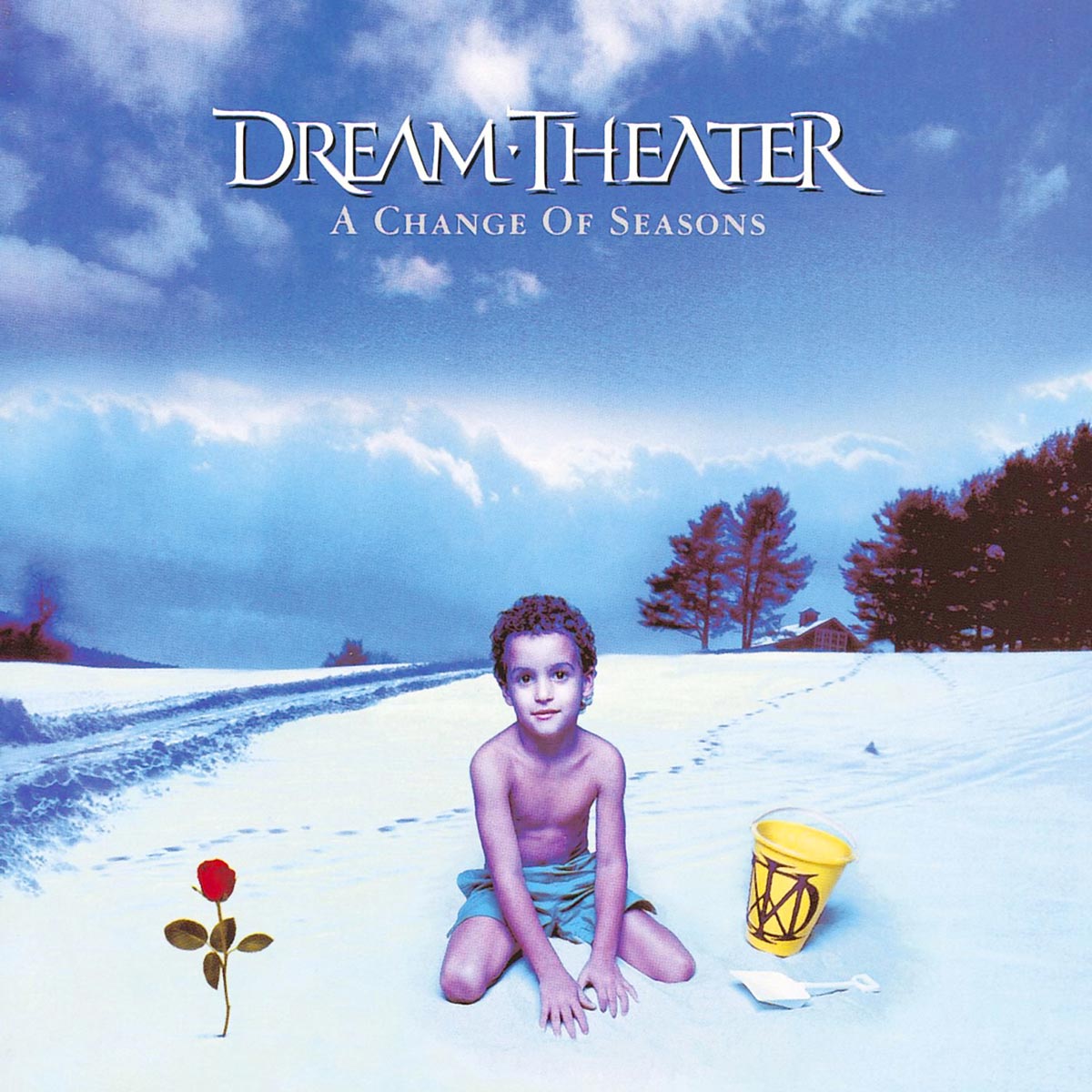
The prog-metal style that Dream Theater had essentially invented single-handedly was still quite new at the time. In other words: progressive rock – with lots of breaks, shifts, contrasts, and changes of direction – spiced up by heavy-metal passages. Dream Theater established asymmetrical riffs and odd seven-quarter time signatures as hallmarks of the style. John Petrucci (guitar) and Mike Portnoy (drums) became virtuoso idols throughout the prog scene. At 23 minutes, “A Change of Seasons” was their longest piece to date. To this day, it is regarded as a showcase work, a milestone, and a classic of the band. “One of the most impressive pieces of music ever written in the prog-metal field” (Phil Carter). The band would go on to produce more epics: “Octavarium” (2005), “In the Presence of Enemies” (2007), and “Illumination Theory” (2013).
The band divides its mammoth piece into seven sections, each with its own title. Four of them are actual songs with vocals – usually gentle, melancholic, and highly melodic, sometimes solemn and grandiose, and occasionally somewhat dramatic. The other three sections – Parts 1, 4, and 6 – remain purely instrumental. They feature the heavy metal guitar riffs, a rapid-fire flood of variations on musical motifs, a powerful organ, a synthesizer solo, numerous sophisticated rhythm changes, and virtuoso flourishes – as well as purely acoustic passages. At the end of Part Four (10:10 to 13:03), we hear Petrucci’s notorious turbo-charged staccato playing (from around 12:20), along with some crazy breaks. Toward the end of the somewhat bombastic Part Five (13:03 to 17:21), the structure begins to disintegrate a little (around 17:00) – which is fascinating in its own right. The transitions between the sections are particularly sophisticated. Often, a musical element from the preceding section returns, creating continuity and flow.
Incidentally, all the lyrics were written by drummer Mike Portnoy. In them, he processed personal experiences and tells a kind of “life cycle” story. At the center is Part Three (“Carpe Diem,” 6:56 to 10:10), in which Portnoy also draws inspiration from two films starring Robin Williams. The dramatic climax of the section (around 8:47) is the memory of his final encounter with his mother: “She walked into the night / She turned for one last look / She looked me in the eye / I said: I love you … good-bye.” Portnoy’s mother died in the crash of a private plane in 1984. He was 17 at the time. What followed for him was “The Darkest of Winters” – the title of Part Four of the piece. Portnoy founded Dream Theater shortly after his mother’s death.