

Why does a sound pressure level of 120 decibels (dB) threaten permanent hearing damage when an ordinary conversation already registers 60dB? And why do some of us need amplifiers capable of delivering several hundred watts when we spend most of our listening time using less than one watt per channel? The math behind these apparent contradictions isn’t all that complicated – once you understand how it works.
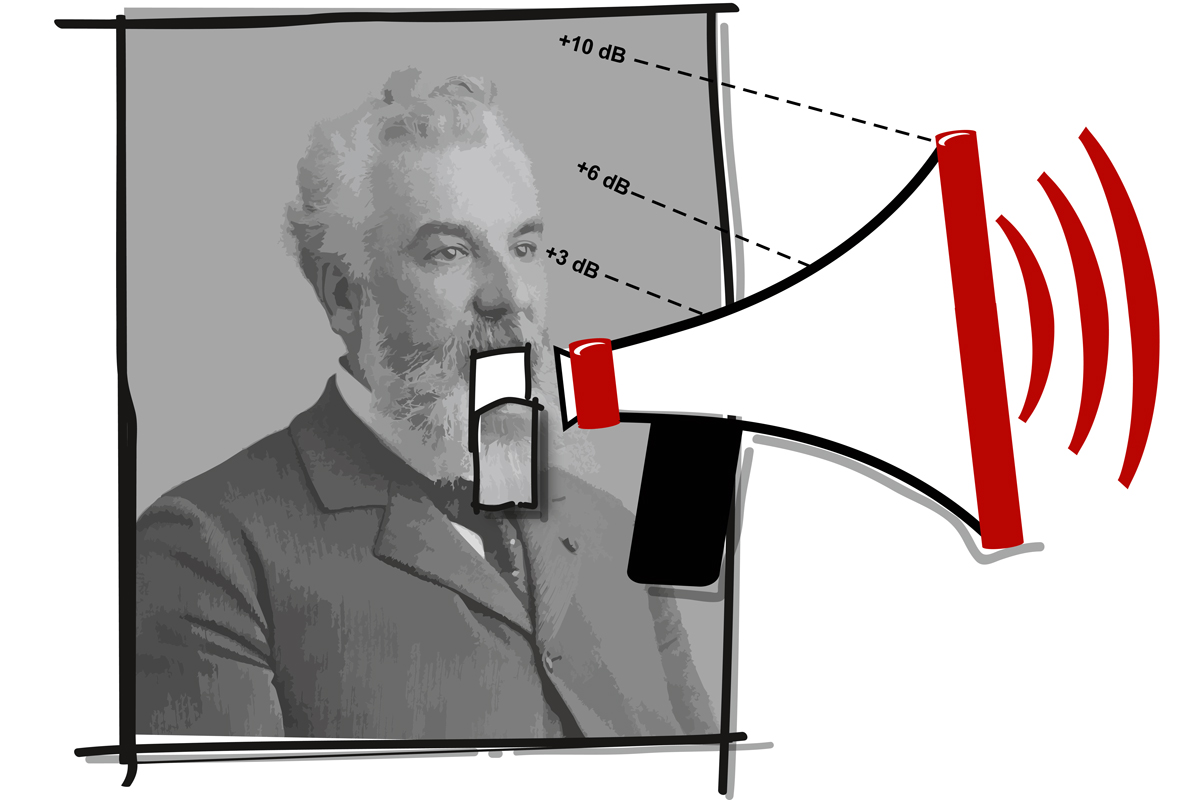
We’ve all seen those charts that place various sounds – conversation, traffic noise, jackhammers, departing aircraft, and shotgun blasts – along a decibel scale. The casual observer might conclude from such a chart that last night’s 120dB rock concert was roughly twice as loud as the 60dB roommate snoring away in the next room. Of course, that’s not true. Decibels are not a linear measure but a logarithmic one, much like the Richter scale for earthquakes. In fact, the concert was 1,000 times as loud, and its acoustic power was a million times greater. But how do we arrive at those numbers?
Logarithmic means that, rather than representing a linear increase, a measurement expresses a multiplication of the measured quantity by a specified factor. In our case, an increase of 10dB (one Bel*) represents a tenfold increase in acoustic power – and this holds regardless of the starting value: 70dB represents ten times the power of 60dB; 80dB represents another tenfold increase, or 100 times the power of 60dB. The unit therefore measures not absolute values but ratios:
| Change in dB | Sound pressure level | Acoustic power |
| ±0 | ×1 | ×1 |
| +3 | ×1.413 (approximately ×√2) | ×1.995 (approximately ×2) |
| +6 | ×1.995 (approximately ×2) | ×3.981 (approximately ×4) |
| +10 | ×√10 (approximately ×3.16) | ×10 |
| +20 | ×10 | ×100 |
| +40 | ×100 | ×10,000 |
| +60 | ×1,000 | ×1,000,000 |
As we can see, the logarithm does us two big favors: an increase of 3dB corresponds almost exactly to a doubling of power (×1.995), while an increase of 6dB corresponds to a quadrupling (×3.981). Both approximations are sufficiently accurate that for all practical intents and purposes, there’s no need to worry about rounding errors.
The introductory example and the table also tell us that the increase in sound pressure level is proportional to the square root of the increase in power. The physical explanation is straightforward: Sound is a periodic fluctuation in air pressure, produced as air molecules move back and forth in response to the frequency of the sound wave. Doubling the sound pressure level means doubling the amplitude of the pressure variation. In simplified terms, you can think of it as the air molecules being pushed twice as far apart and compressed twice as much within the same amount of time, which, broadly speaking, corresponds with the physical requirements to reproduce that sound pressure level. Moving an object – say, a loudspeaker diaphragm – twice as far in the same amount of time requires twice the force over twice the distance, and therefore four times the power.
Electrically, this relationship manifests itself in the interplay between voltage and current. To play 6dB louder, a loudspeaker must move its diaphragms twice as far. The voice coil follows the voltage waveform supplied by the amplifier: The greater the voltage swing, the greater the excursion. In terms of physical movement, voltage swing corresponds to distance traveled. Current (which, in practical terms, determines the force available and is measured in amperes) is, according to Ohm’s law, voltage divided by impedance. A 4-ohm loudspeaker driven by a 2V signal will therefore draw half an ampere from the amplifier (2V/4Ω); with a 4V signal, it will draw twice as much – one full ampere. The power drawn rises accordingly from one watt to four watts, increasing with the square of the signal level.
Now that was a bunch of theory …
But what does all this mean in everyday listening? In all our examples so far, we’ve assumed that we’re sitting exactly one meter from the loudspeaker. In reality, the typical listening distance is more likely to be two or three times that. In free-field conditions, sound intensity at the listening position falls to one-quarter with every doubling of distance. This is because sound waves ideally radiate spherically from their source, while the surface area of that sphere increases with the square of its radius. Fortunately, the fact that a change in sound pressure level is proportional only to the square root of the change in power works in our favor here: Sound pressure doesn’t fall quadratically but decreases by just 6dB each time the distance doubles.
There’s another consideration: We don’t listen in a free field but in a living room, an enclosed space where reflections from the walls partially replenish the sound pressure lost with distance. How much of that loss is recovered depends heavily on the room’s size and acoustic characteristics, but as a rule of thumb, we can assume that each doubling of listening distance costs us not 6dB but only about 3dB.
We also have another ace up our sleeve: a second loudspeaker, complete with its own stereo channel. In an ideal electroacoustic scenario, this would give us an additional 6dB. If we combined both loudspeakers into a single unit with twice the diaphragm area, its sensitivity would increase by 3dB. On top of that, the second stereo watt would have to deliver exactly the same signal, in exactly the same phase (i.e. a mono signal), to the loudspeaker to give us another +3 dB as per the table above. Since the two loudspeakers are physically separated, however their sound waves don’t neatly add together; they also partially cancel one another. And because the signals in the left and right stereo channels aren’t identical, the practical gain from two loudspeakers, each receiving one watt, is generally assumed to be only about 3dB.
Even so, this means that in a typical two-channel home system, with a listening distance of two meters, we receive roughly the same number of decibels per watt at the listening position as the loudspeaker’s published sensitivity rating would suggest. A reasonably typical loudspeaker rated at 84dB/1W (or 87dB/2.83V into 4Ω), for example, would therefore deliver around 84dB at the listening position with one watt per channel – a perfectly respectable listening level.
Things get interesting when we ask for more. Since every additional 6dB requires four times the power, we’ll need 4W to reach 90dB, 16W for 96dB, and a hefty 250W per channel to achieve concert levels of 108dB. By contrast, someone listening at 80dB through a highly efficient 90dB loudspeaker and wanting 20dB of headroom for dynamic peaks will get along just fine with a 10W tube amplifier.
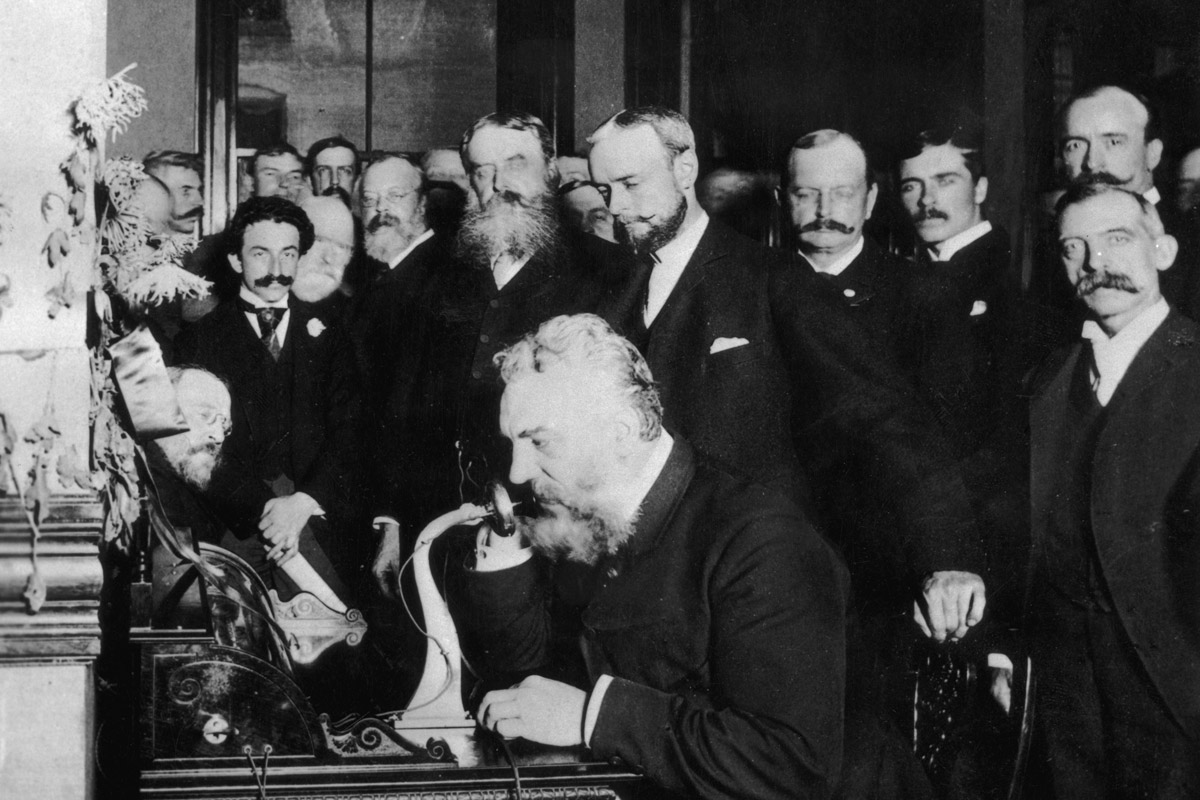
*Alexander Graham Bell (1847–1922) didn’t live to see the introduction of the unit named in his honor. In 1924, Bell Telephone Laboratories – whose name can be traced back to Bell by way of a rather convoluted institutional history – introduced the Transmission Unit (TU) to quantify signal-power loss in telephone transmission cables. In 1928, the unit was renamed the Bel in Bell’s honor, although its tenth, the decibel, had been intended from the outset as the unit for practical use.