
Richard Branson had a clear career ambition: he wanted to become an entrepreneur.
At 18, he launched a magazine; at 20, a mail-order record business, followed by a record store and then an entire chain of shops. At 22, in 1972, he founded Virgin Records, his own record label, along with a recording studio. The newly minted record mogul displayed an astonishing instinct for emerging musical trends – and the courage to put his money behind them. He signed some of the most adventurous exponents of the Canterbury scene, including Mike Oldfield and Gong; ventured into German Krautrock with Tangerine Dream and Faust; and was among the first to respond to the arrival of punk in Britain, followed by reggae. But Branson’s ambitions extended far beyond record production. He invested in music videos and video games, founded airlines and radio stations, set up a travel agency, and put money into banks, motor racing teams, and space ventures. The man who had discovered Mike Oldfield became a billionaire in 1992.
One of the Canterbury bands signed to Branson’s Virgin label in 1973 was Henry Cow. The group had been around since 1968, when it was founded by Fred Frith and Tim Hodgkinson. Frith played guitar, Hodgkinson keyboards, but both were accomplished multi-instrumentalists. By the summer of 1973, when they entered Branson’s Manor studio to record their debut album, the band had grown into a five-piece. Virgin Records welcomed them warmly into its expanding family of artists. Four of Henry Cow’s five musicians, along with all three backing vocalists, were immediately recruited to take part in Mike Oldfield’s live presentation of Tubular Bells at London’s Queen Elizabeth Hall that June. Later that year, when Oldfield performed the work again at a BBC studio, Henry Cow’s musicians were on hand once more.
Henry Cow were widely regarded as the ultimate expression of the progressive and intellectually adventurous Canterbury sound. Their largely instrumental debut, Legend, bristles with atonal motifs, jittery jazz rhythms, and intricate time signatures. At times, Henry Cow sound like an experimental jazz ensemble somewhere between free jazz and fusion; at others, like an avant-garde chamber group or a noisy rock band. Rhythms, styles, and sonic textures can change every few bars. Particularly striking are Fred Frith’s inspired, often dazzling guitar solos and Chris Cutler’s restless jazz-rock drumming. At the heart of the album is the Teenbeat suite, comprising “Teenbeat Introduction,” “Teenbeat,” and “Teenbeat Reprise.” The band had spent at least two years developing this ambitious sequence, weaving together a wealth of musical motifs and ideas. The intervening track, “Extract From: With The Yellow Half-Moon And Blue Star” – an excerpt from a piece Frith had composed for dance theater – also originated in the band’s Teenbeat experiments.
Ray Smith (1949–2018), who would later achieve renown as a sculptor and receive numerous art awards, was something of an all-purpose presence in Henry Cow’s inner circle at the time. Naturally, he took it upon himself to create the artwork for the band’s debut album, using acrylic paint applied with a piping bag.
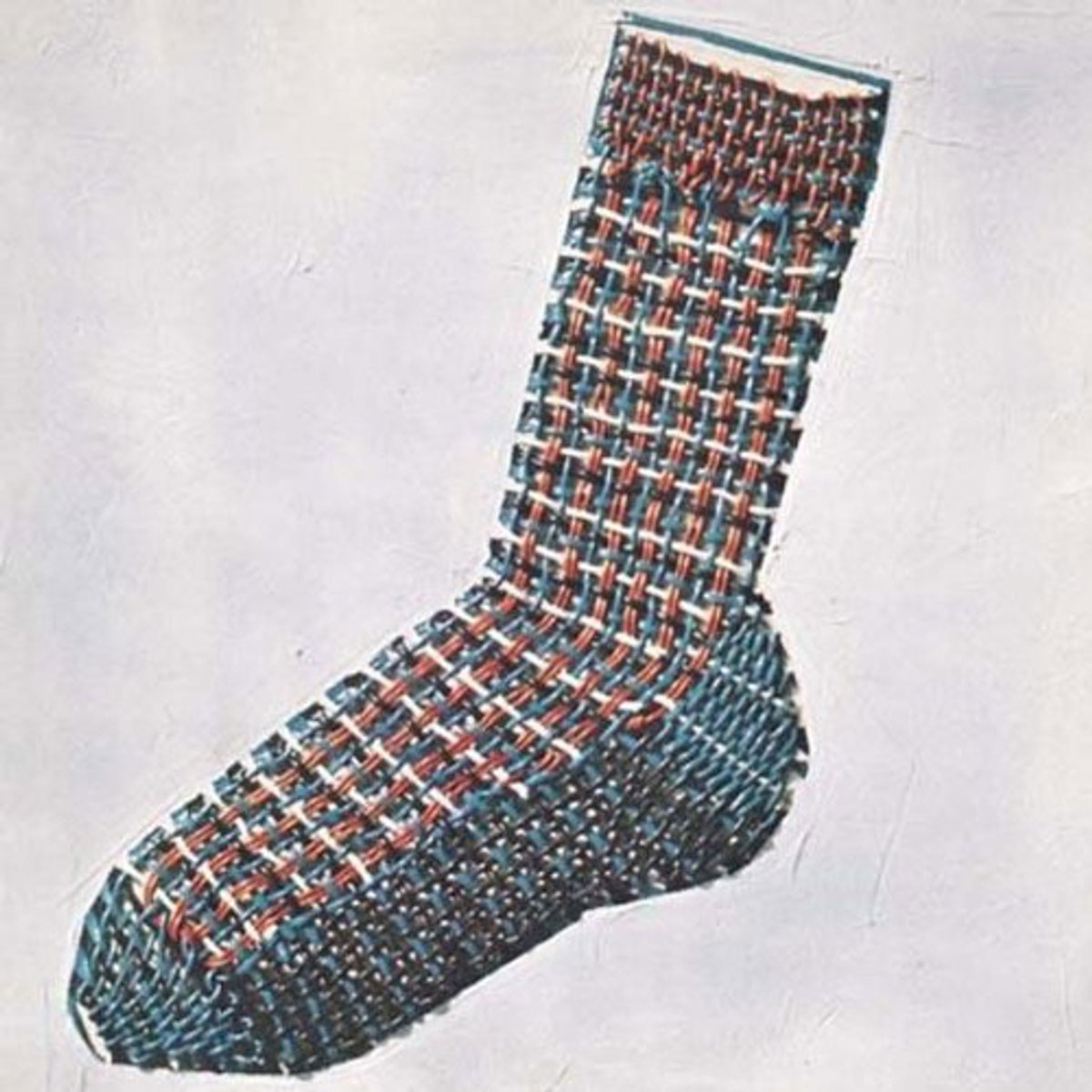
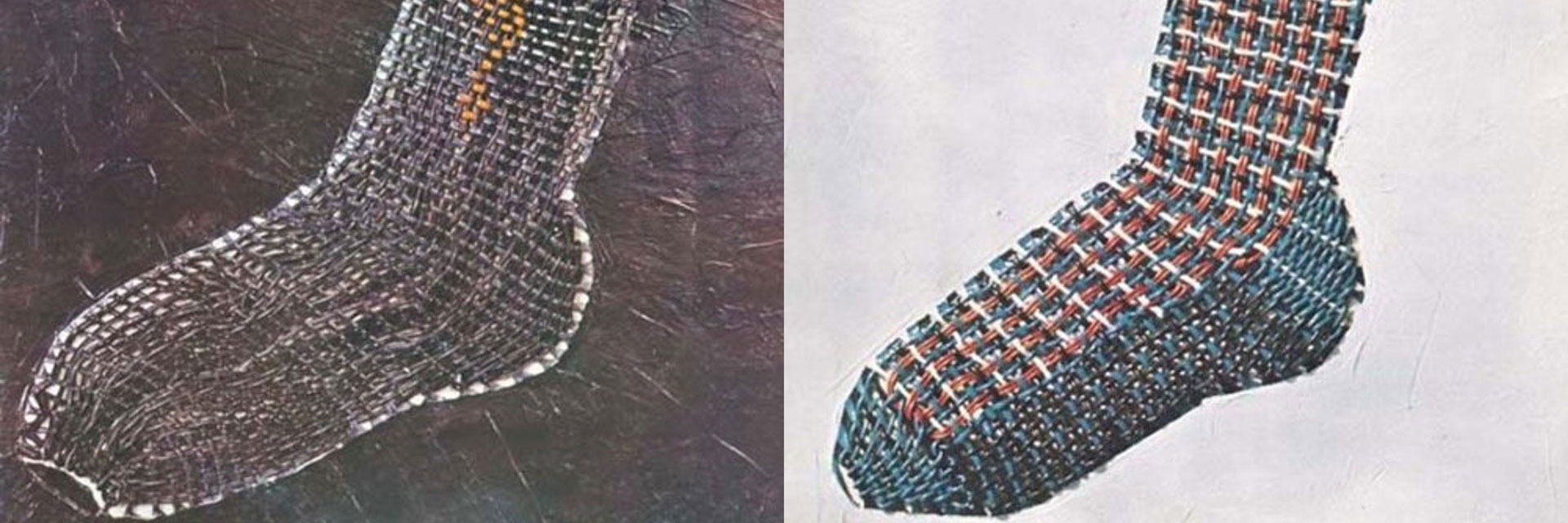
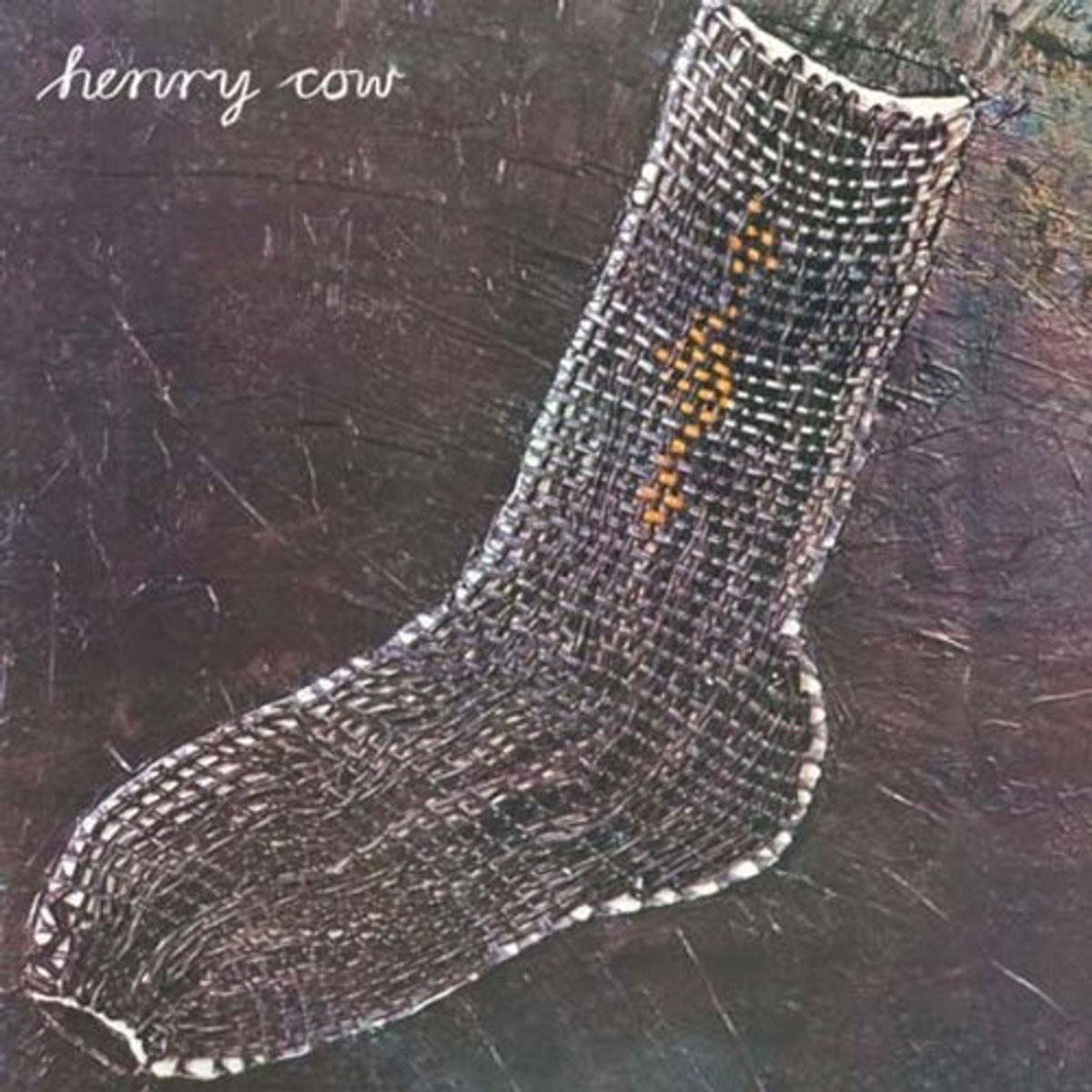
The result was a brightly colored sock. The joke, of course, lies in the album title Legend, which can be read as “leg end” – the end of a leg. Smith was also determined that the band’s name should not appear on the front cover, following the example set by such illustrious contemporaries as Pink Floyd and Led Zeppelin. He conceived of the sock as a kind of Pop Art object, rather like Andy Warhol’s famous banana for the Velvet Underground. Accordingly, the motif reappeared on the second album, its colors altered to reflect the band’s musical evolution. (The sock made a further appearance on the later album In Praise Of Learning.)
Henry Cow’s second album was titled Unrest – an apt name for music that is once again restless, volatile, and eclectic in the extreme. The 23-year-old Lindsay Cooper had joined the group as a replacement for saxophonist Geoff Leigh. Her principal instruments, oboe and bassoon, were to lend the music a more overtly serious avant-garde dimension.
This time, the centerpiece is the twelve-minute, multi-section “Ruins,” another offshoot of the band’s expansive Teenbeat experiments. Here, one can detect the influence of Bartók and Messiaen, as well as a passage featuring nothing but violin, bassoon, and xylophone. Since the band still lacked enough fully composed material to fill an entire album, four additional pieces were developed spontaneously in the studio, using loops, overdubbing, and tape experimentation. Critics compared the results to an improvised Stockhausen. One reviewer went so far as to suggest that, by Henry Cow’s standards, the usual progressive rock bands were little more than “brain-dead reactionaries.”
The relationship between Virgin Records and Henry Cow, however, was never an entirely happy one. After the first two albums, the band was effectively forced into an uneasy marriage with another Virgin act, Slapp Happy. In 1977, Virgin terminated the group’s contract: the label wanted greater commercial returns, while Henry Cow wanted more studio time. The music industry was undergoing a period of profound upheaval, and progressive rock bands everywhere were coming under increasing pressure. In protest, Henry Cow launched the Rock in Opposition (RIO) initiative in 1978. Together with like-minded musicians from Italy, Sweden, Belgium, and France, they organized a small festival in London to challenge the commercial dictates of the record industry. In opposition to that prevailing mindset, the RIO movement championed music that, in its own words, “continually challenges the listener to listen – and to listen again.”
Henry Cow: Legend (Virgin, 1973)
Henry Cow: Unrest (Virgin, 1974)