Ravel, Prokofiev, Hindemith, Britten, Korngold, and Richard Strauss: The great composers who wrote piano concertos for Paul Wittgenstein, the one-armed pianist
There are surprisingly many works for piano left hand alone, but very few for the right. The reason is as tragic as it is straightforward: when someone loses the use of a hand – through a wartime or accidental injury, stroke, dystonia, or any other cause – it is almost invariably the stronger, more active, more assertive, more forward-driving hand that is affected. For most people, that means the right hand, although nearly 20 percent of pianists are said to be left-handed. A number of pianists who lost the use of their right hand have achieved international recognition, among them Géza Zichy, Otakar Hollmann, Leon Fleisher, Siegfried Rapp, Izumi Tateno, and Nicholas McCarthy.
The most celebrated pianist to perform exclusively with his left hand was Paul Wittgenstein (1887–1961), brother of the philosopher Ludwig Wittgenstein. The young pianist made his Vienna debut in 1913; two years later, following a war injury sustained in Poland, his right arm had to be amputated. Rather than abandon his career, however, Wittgenstein commissioned the leading composers of his day to write piano works for the left hand alone. The Wittgensteins were among Austria’s wealthiest families, so he had the means to make such commissions happen. Among the first composers to supply him with works were Sergei Bortkiewicz, Hans Gál, Leopold Godowsky, Paul Hindemith, and Richard Strauss. Wittgenstein, however, proved a decidedly exacting client. He never performed some of the compositions he had commissioned and paid for; others he even sent back.
Wittgenstein’s favorite composer was Franz Schmidt (1874–1939), whom he regarded as the greatest Austrian composer of his time. A professor of cello and piano in Vienna, Schmidt was, as a composer, essentially a man of the nineteenth century. Nevertheless, he was commissioned to write no fewer than six works for Wittgenstein’s left hand, including the concertante Beethoven Variations (based on the scherzo theme from the Spring Sonata) and the Piano Concerto in E-flat major. The latter begins, contrary to convention, with an “idea knot” from which the principal themes gradually emerge. The three-movement work runs nearly 45 minutes and culminates in a monumental solo cadenza in the final movement. When Wittgenstein later commissioned Benjamin Britten, he suggested Schmidt’s concerto as a model. Markus Becker is the conscientious soloist in a fine recording with the NDR Radiophilharmonie: Beethoven Variations/Piano Concerto (cpo, recorded 2006).
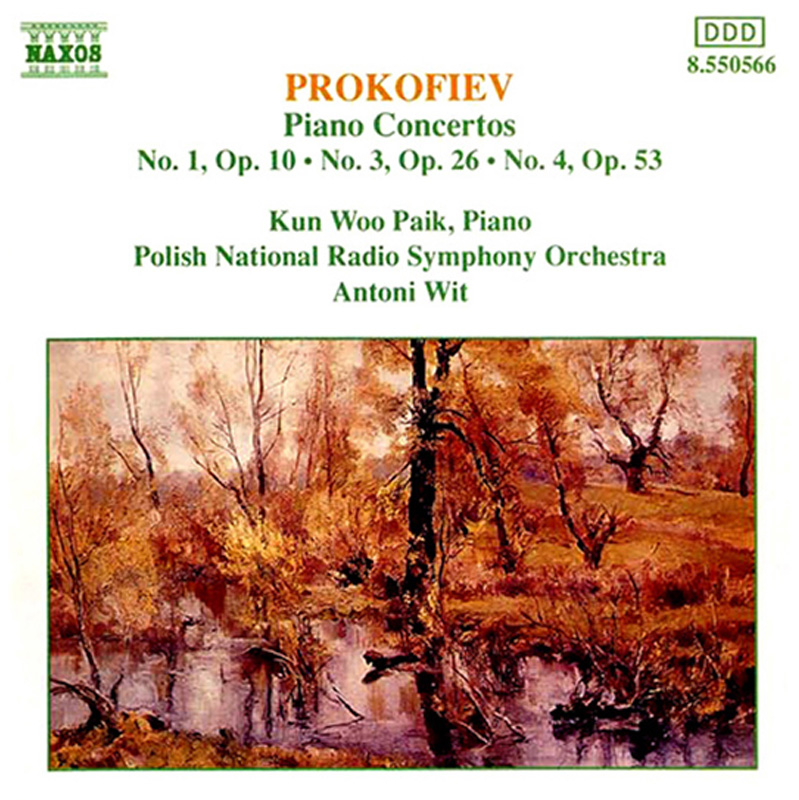
Wittgenstein was considerably less enthusiastic about the B-flat minor concerto delivered by Sergei Prokofiev (1891–1953), the Piano Concerto No. 4, Op. 53. “I don’t understand a single note of it, and I won’t play it,” declared Wittgenstein, whose musical tastes were decidedly conservative. Even so, he insisted for years on retaining exclusive performance rights. It was not until 1956, three years after Prokofiev’s death, that Siegfried Rapp – who had also lost his right arm in the war – gave the work its world premiere in East Germany. The opening movement (Vivace) bristles with motoric energy, which receives a brief reprise in the finale. The Andante has a Romantic cast, while the Allegro is dramatic and laconic. Pianist Kun Woo Paik is a specialist in Russian repertoire. His recording with the Polish Radio Symphony Orchestra offers no fewer than three of Prokofiev’s piano concertos: Piano Concertos (Naxos, recorded 1991).
Maurice Ravel’s (1875–1937) Concerto for the Left Hand in D minor provoked an outright quarrel. Wittgenstein felt that the technical demands placed on his left hand – particularly in the second cadenza – were excessive and that the orchestral writing was too sparse: “That doesn’t work.” But when he took it upon himself to make alterations to the score, Ravel was equally incensed. The work received its premiere in 1932 with the Vienna Symphony Orchestra, but it was not until Jacques Février performed it in 1937, after Wittgenstein’s exclusive performance rights had expired, that Ravel was finally satisfied.
The concerto is predominantly oppressive and somber in mood, almost as though it were an expression of the tragedy of living with one arm. By contrast, its fast central section erupts in wild, jazz-inflected rhythms. Wittgenstein’s commission also inspired Ravel to write another piano concerto at the same time, this one in G major and for both hands. In composing both works, Ravel drew inspiration from his colleague Gershwin’s Concerto in F, whom he had visited in the United States shortly beforehand. Philippe Entremont’s recording of all three concertos became a celebrated release: Gershwin/Ravel (Columbia, recorded 1971/1975).