
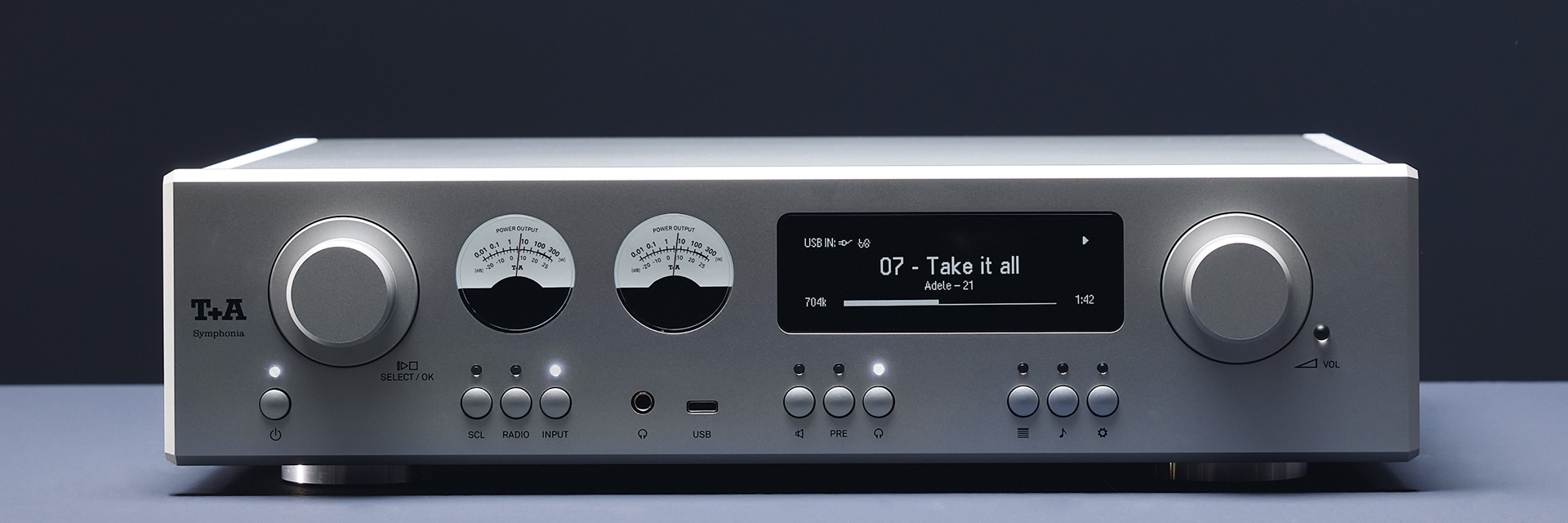
With its hand-assembled VU meters, it looks a bit like a steampunk creation, yet every detail is thoroughly modern: the Symphonia network receiver proves that, beyond its impressive HV flagship components, the company from Herford has also mastered the art of compact high-end audio.
Let’s play dumb for a moment: What exactly is a Symphonia? Well, that depends entirely on the century. During the Middle Ages, a sinfonia referred to a kind of semi-automatic lute. Beginning in the 17th century, the term evolved from describing a physical object into a conceptual one, referring to various types of musical movements in cantatas, operas, and suites.
As the pre-Classical era progressed, things became – roughly speaking – no less confusing. Today, however, everything is perfectly clear again: a Symphonia is a music playback device from Herford.
A once purely theoretical term has become a tangible object. That perfectly reflects the company behind it, T+A, whose name is hardly insignificant: “Theory and Application.” The Symphonia brings both together. Although the category of streaming integrated amplifiers, or network receivers, has become crowded with competitors, true audiophile performance across the board remains more of a theoretical aspiration than a practical reality. Packing an enormous array of features into a compact enclosure while simultaneously preventing interference, combining traditional electrical engineering with modern software development, integrating Bluetooth connectivity, and doing it all without alienating serious audiophiles is a formidable engineering challenge with no guarantee of success.
The practical application is a component that does it all – and does it exceptionally well. Visually, it resembles T+A’s 200 Series and likely shares some of its circuit board layouts. The Symphonia is designed to replace an entire rack full of components, making its price of around €8,500 seem far more reasonable. You can retire your old receiver because the T+A receives both DAB+ and FM radio. You no longer need a separate phono preamp, as the Symphonia supports both MM and MC cartridges. Naturally, it streams music from virtually any source, in a wide variety of formats and at every conceivable resolution, including hi-res audio. Your standalone DAC becomes unnecessary, as do your preamp and power amplifier. A pair of speakers is going to come in handy though, otherwise you’re not going to hear a thing.
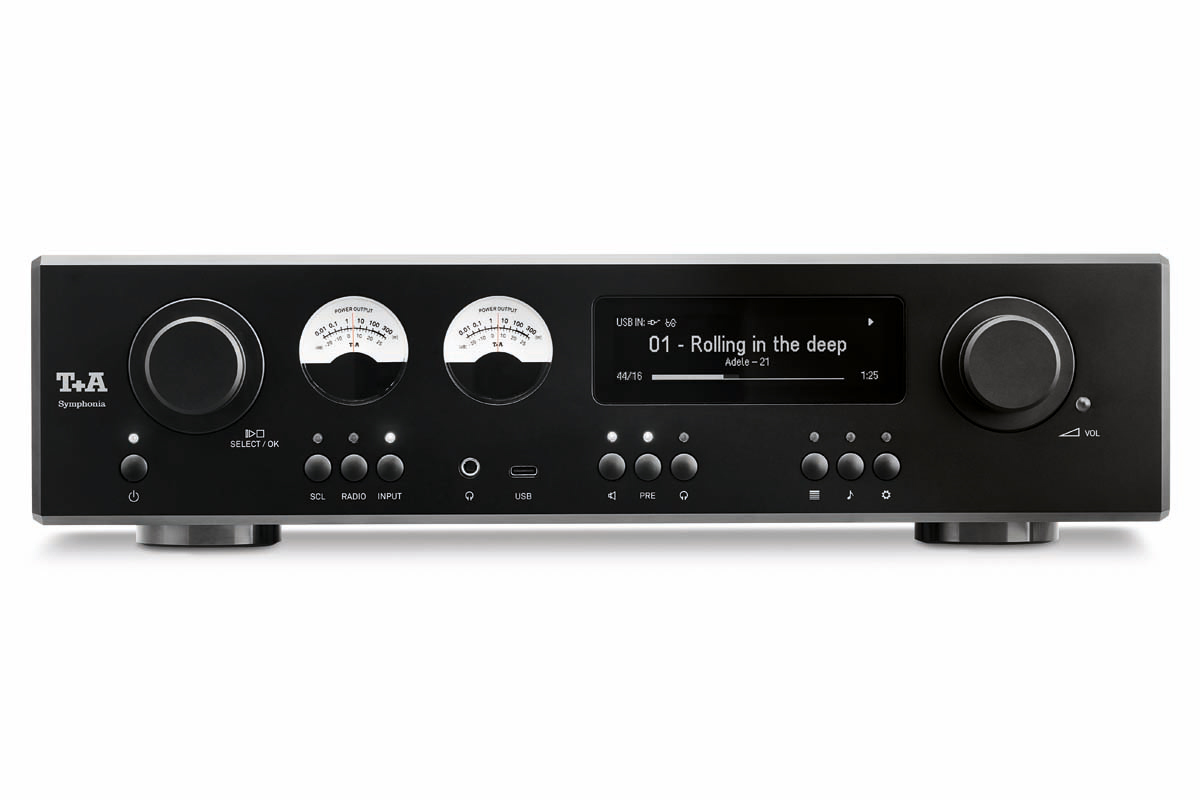
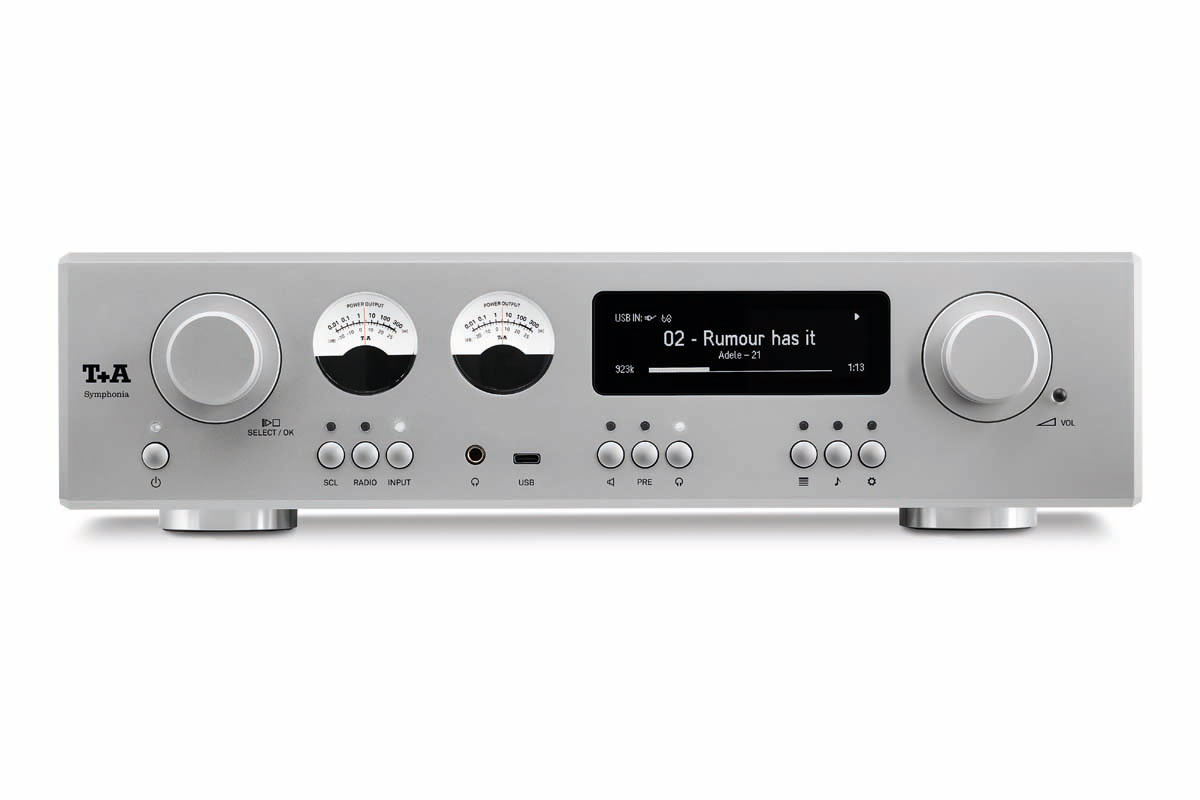
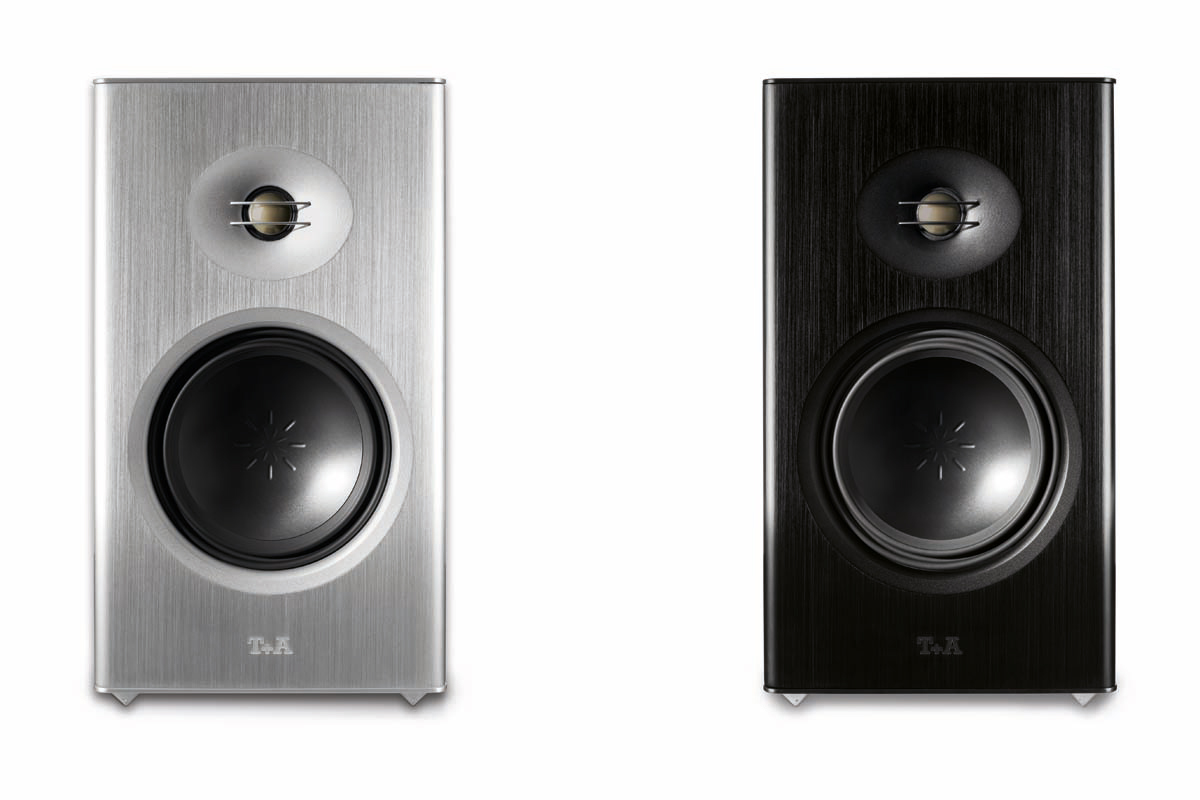
Being aware of this, T+A also supplied its Talis R 330 bookshelf speakers for our review, along with matching aluminum stands that are nothing short of gorgeous. The Symphonia, in particular, impresses with its retro styling, featuring dual VU meters and a clean, logically organized front panel. It sports push buttons and rotary knobs. What you won’t find is a touchscreen. The built-in OLED display is elegant but doesn’t show album art or other graphics. The Symphonia isn’t a smartphone disguised as an audio component; it’s a piece of equipment that may contain plenty of lines of code but remains firmly rooted in the tradition of electrical engineering. As a result, it feels like the future while reassuring you that the good old ways are still alive.
First impressions: Holy cow! The chassis, with its beveled edges, side-mounted cooling fins, and panel gaps worthy of German luxury automobiles, exudes exceptional quality. The front-panel controls deliver a wonderfully tactile experience, with precisely weighted button action and an exceptionally logical layout. In fact, the Symphonia can be operated comfortably and completely from the front panel alone. Even the remote control – a glaring weak point in far too many premium components – matches the unit’s overall quality and requires virtually no learning curve. Those who prefer not to use it can simply control the unit through the app.
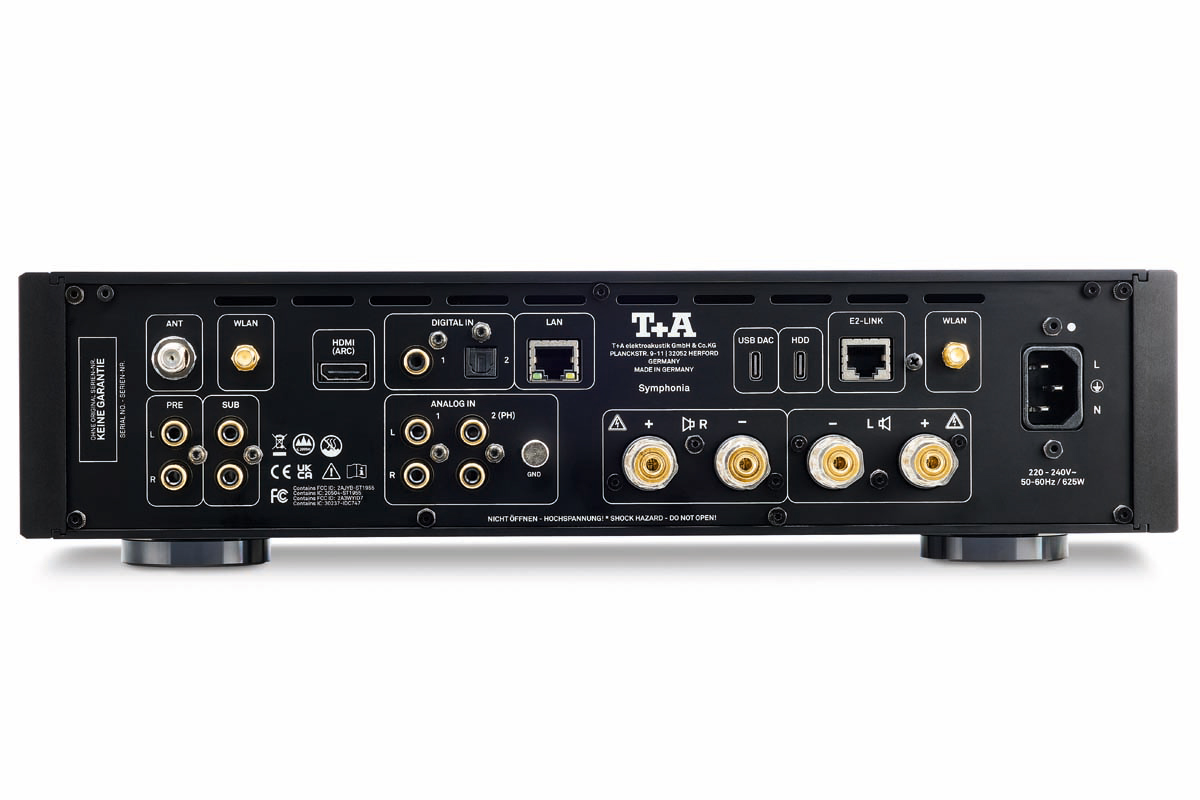
The rear panel is considerably busier, as you’d expect from a component that can connect to just about anything. Between Wi-Fi and Ethernet, digital and analog inputs, preamp and subwoofer outputs, HDMI, USB DAC connectivity, and the gold-plated speaker terminals, it’s remarkably easy to find your way around. Setup is straightforward enough that you hardly need to consult the owner’s manual: simply connect the Symphonia to the outside world and power it on. Depending on the selected input, it’s ready to play in about ten seconds.
Inside the chassis, the receiver is organized on two levels. The upper tier houses the modern technology – its streaming architecture, networking hardware, HDMI circuitry, and aptX HD support – while the lower level accommodates more traditional components such as the power supply, Class D output stages, and power distribution. Fitting all of this into such a compact enclosure couldn’t have been easy. Jörg Kupper, Head of Development at T+A, puts it succinctly: “Compact is the new frontier.”
As a basis for developing a receiver, the enclosures of the 200 Series were really “far too small,” as he explains. The engineers in Herford took on the challenge regardless, galvanically isolating the analog and digital signal paths as well as providing separate power supplies for each section. T+A relies on its proprietary ASA G3 streaming platform, which processes PCM and DSD signals independently. DSD files (up to DSD512, depending on the source) are not converted into PCM but instead remain in their native format, where they are handled by T+A’s in-house “True 1-Bit DSD” converter. PCM signals, meanwhile, are processed by a variation of the company’s double-differential converter architecture employing two 32-bit sigma-delta DACs per channel.
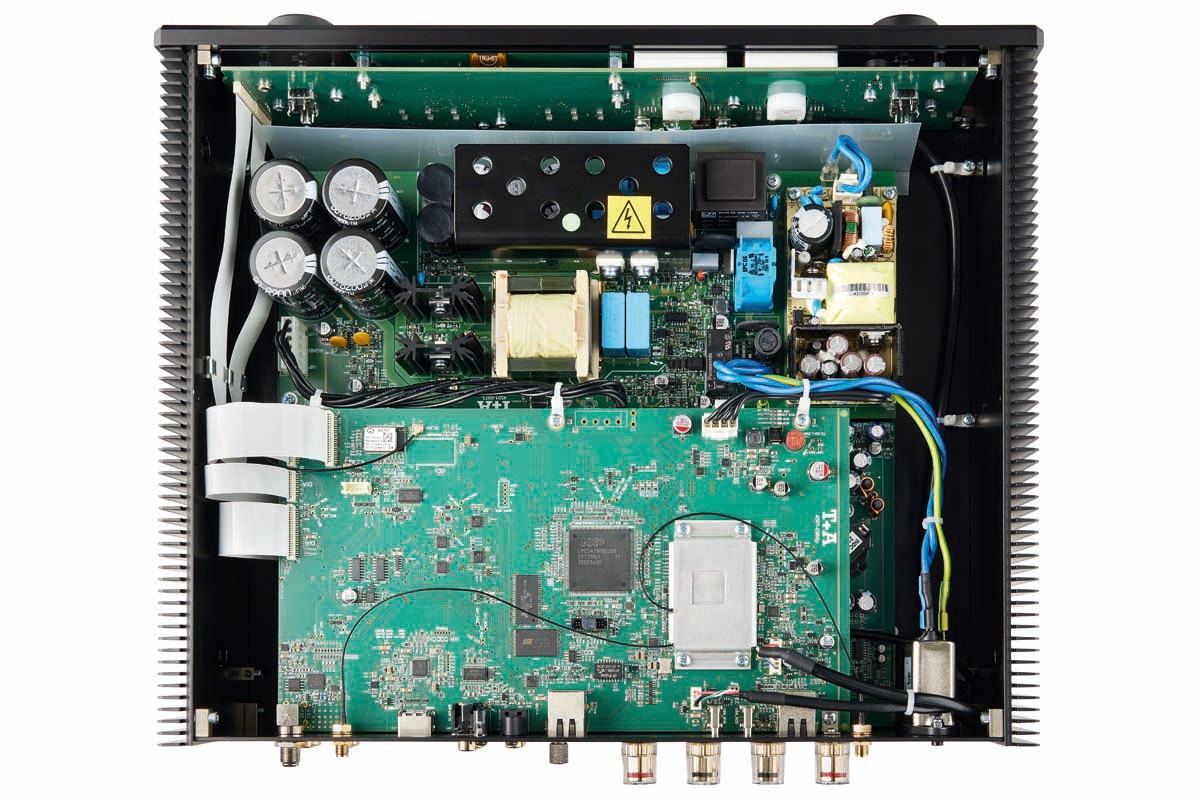
The Class D power amplifier comes from the Danish manufacturer Purifi, whose proprietary Eigentakt topology promises both high efficiency and exceptionally low distortion, along with a ruler-flat frequency response extending to 60 kHz and performance that remains virtually unaffected by speaker load. T+A has designed its own auxiliary circuitry around this amplifier module. Configured as a dual-mono design, the Symphonia delivers up to 250 watts per channel without breaking a sweat. Even during extended listening sessions at decidedly high volume levels, the unit barely became warm.
Power comes from a proprietary switching power supply that avoids the abrupt switching behavior typical of conventional SMPS designs by employing a high-frequency sine wave instead. Four buffer capacitors downstream recharge 100,000 times per second, resulting in an exceptionally clean and lightning-fast power supply capable of handling even the most demanding dynamic peaks.
The result is a presentation that is analytical and refined while still possessing considerable reserves of raw power. A perfect example is Bad Bunny’s catalog (streamed via Qobuz). His music, rooted in reggaeton and trap, resembles the kind of bass-heavy soundtrack you hear blasting from neighboring cars at a red light on a summer day. Through the Symphonia, you not only get genuinely authoritative deep bass – as on “Moscow Mule” – but, because these mixes are typically drenched in reverb, you can effortlessly follow the decay trails as new sonic events continue to unfold on top of them.
Complex passages featuring embedded soundscapes – engine noises in “Monaco,” or ocean surf and birdsong in “Ojitos Lindos” – are unraveled with remarkable ease. Behind the obvious effects, the Symphonia reveals layers of detail that might otherwise remain hidden. Drum sounds acquire sharply defined contours, while hi-hat transients are reproduced not only with impeccable speed but also with enough microdynamic finesse to expose their vanishingly brief decays.
In terms of voicing, the Symphonia leans toward the brighter side of the spectrum. That said, it never neglects the other virtues of musical reproduction. Compared with the DAC section of the C.E.C. CD 5, it sounds more lively and warmer. “Learning to Fly,” from Pink Floyd’s A Momentary Lapse of Reason, has greater punch, while the opening sound collage, “Signs of Life,” is reproduced with a stronger sense of coherence and continuity. Those who enjoy fine-tuning the sound themselves have more than just traditional bass and treble controls at their disposal – the Symphonia also offers four different digital filter settings.
If there’s one “drawback” to the Symphonia, it’s simply this: it gives you very little reason to tinker with your system. You can confidently rely on it to perform superbly with virtually any kind of music. An external phono preamp? Hardly necessary. Listen to Abdullah Ibrahim and Carlos Ward during the more energetic passages of “Anthem for the New Nation.” Ibrahim’s grand piano has enough attack to rival a percussion instrument, while Ward’s alto saxophone retains its tonal richness even at the limits of overblowing. The acoustic space of the small New York club is reproduced on an almost life-size scale – all from this compact aluminum enclosure.
Ultimately, you don’t really need anything else. The Symphonia stands on its own, delivering music with both finesse and authority. Above all, it is one thing: a marvelous piece of engineering.
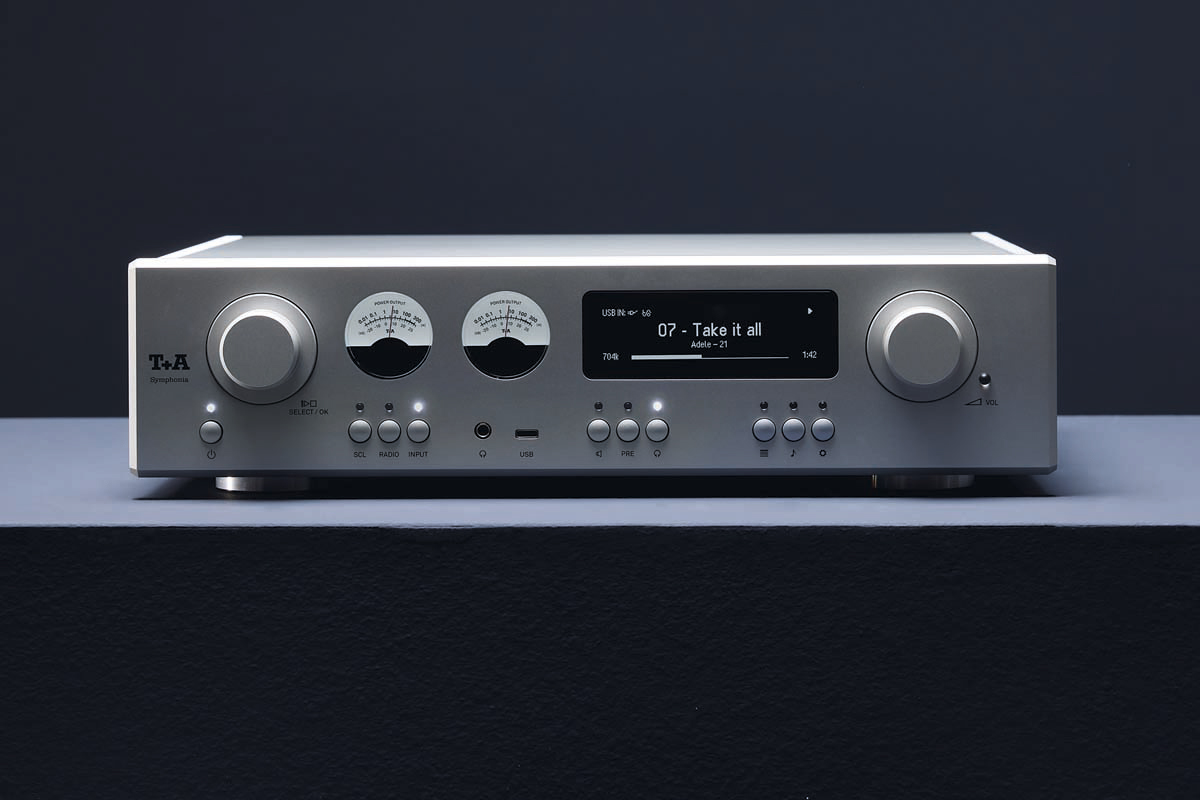
Streaming Integrated Amplifier T+A Symphonia
Concept: Network receiver with premium individual component sections | Analog inputs: 2 × RCA, one switchable for MM/MC phono | Digital inputs: 2 × S/PDIF (coaxial and Toslink), USB-C, HDMI ARC, Ethernet, Wi-Fi | Outputs: Pre Out (RCA), 2 × Sub Out (RCA), speaker terminals (single-wire), headphone output (balanced 4.4 mm Pentaconn jack) | Power output (4 Ω / 8 Ω): 2 × 250 W / 2 × 125 W | D/A conversion: Double Differential Converter with two 32-bit sigma-delta DACs per channel (PCM); 705.6/768 kSps conversion rate; T+A True 1-Bit DSD DAC, up to DSD512 (22.4/24.5 MHz), native bitstream | Supported audio formats: MP3, AAC, OGG Vorbis, FLAC, WAV, AIFF, ALAC, DFF, DSF | Integrated streaming services: Tidal, Qobuz, Deezer, Amazon Music HD, HighResAudio, Tidal Connect, Spotify Connect, Qobuz Connect, Apple AirPlay, Roon Ready, Internet radio | Special features: Headphone output, DAB and FM tuner | Finish: Silver or black aluminum | Dimensions (W/H/D): 15.0 × 3.9 × 13.4 in. (38 × 10 × 34 cm) | Weight: 13.7 lb (6.2 kg) | Warranty: 2 years (3 years after registration) | Price: Around €8,500
T+A elektroakustik
Planckstraße 9–11
32052 Herford
Germany
Phone +49 5221 76760
info@ta-hifi.de