
Songs aren’t the only thing that’s being covered; the practice extends to album covers as well. Covers of covers: Are they witty references, respectful nods, parody – or is there some deeper meaning behind them?
Few things symbolize pop culture like record covers. Some have risen to become genuine 20th-century icons – referenced, imitated, and parodied on a massive scale. Take the three great Zs: zebra crossing, Zeppelin, and zoo.
The zebra crossing on London’s Abbey Road, where the Beatles crossed in near lockstep in 1969, has inspired hundreds of subsequent cover designs. Millions of Beatles fans and London tourists have posed for souvenir photos on Abbey Road – and in 2010, the zebra crossing was even granted heritage status.
The image of the burning Zeppelin – it was the airship Hindenburg (LZ 129) in 1937 – became the defining emblem of another band after it appeared on their debut album. The Zeppelin has been copied and recycled countless times on record covers, posters, and merchandise. Originally, Led Zeppelin wanted to call themselves “Lead Balloon.”
At the San Diego Zoo, meanwhile, the Beach Boys were photographed feeding goats in 1966. One later member of the band called it the worst record cover in history. Yet it adorns one of the finest pop albums ever made. The image consequently became world-famous – and has been re-created and reinterpreted dozens of times.
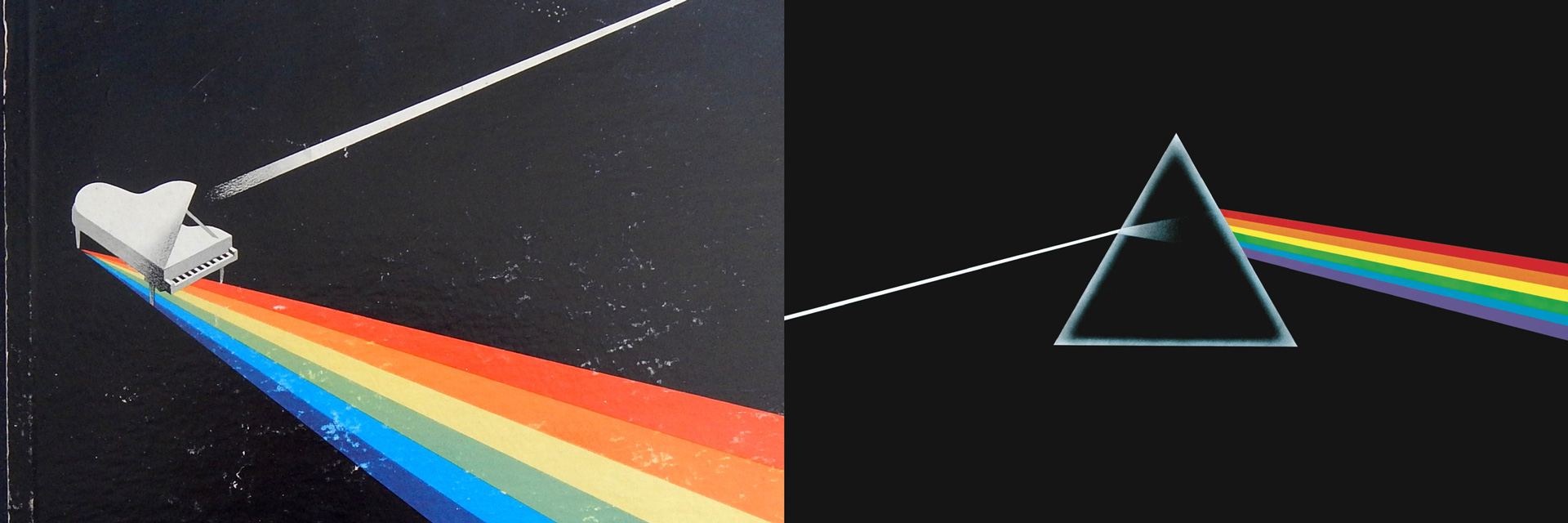
When the most iconic record covers are discussed, one is, of course, impossible to leave out: the one with the prism. The pyramid and the beam of light split into the colors of the rainbow have represented Pink Floyd for decades. Almost every Pink Floyd homage alludes to this image – whether by the Flaming Lips or the Squirrels, by all-star tribute acts or symphony orchestras.
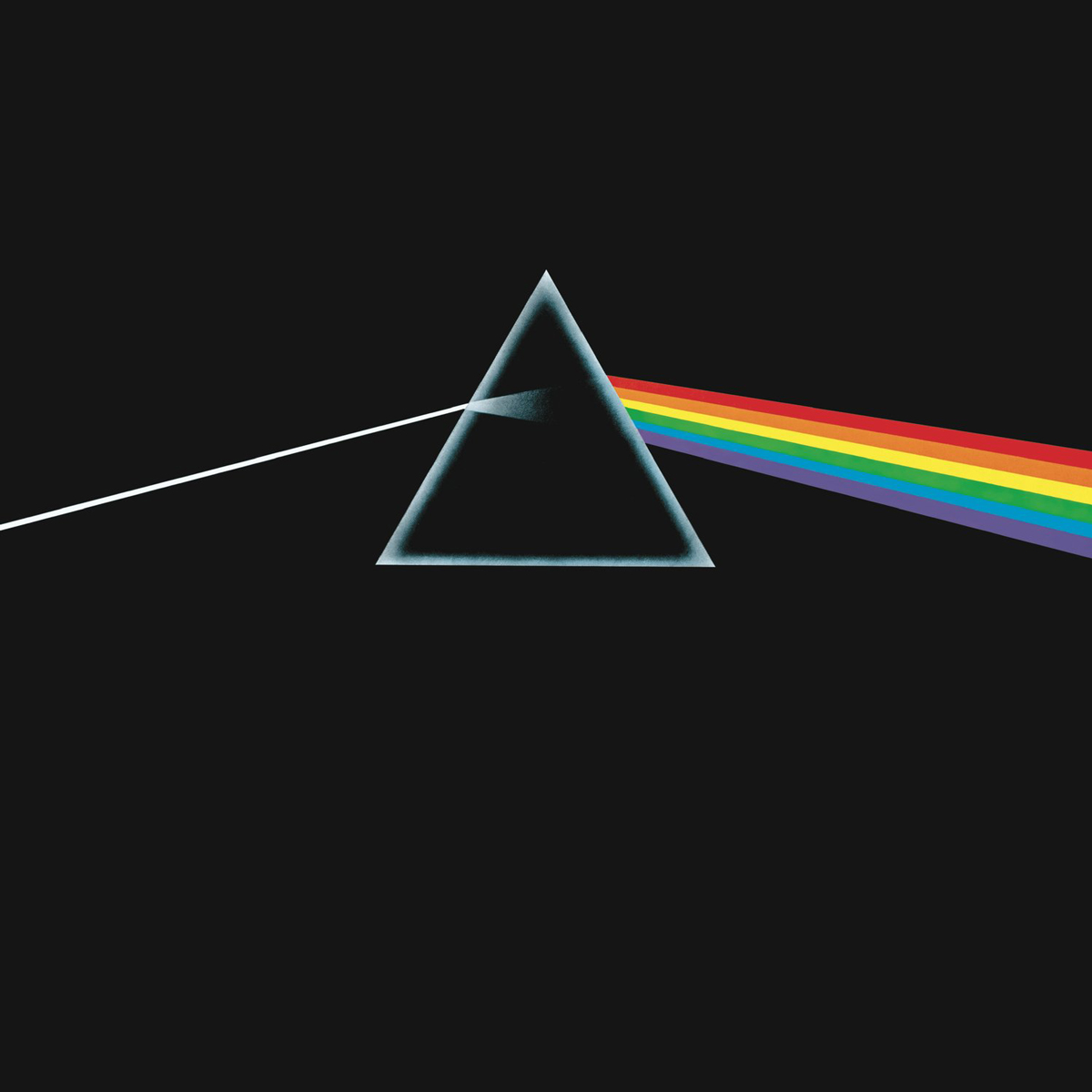
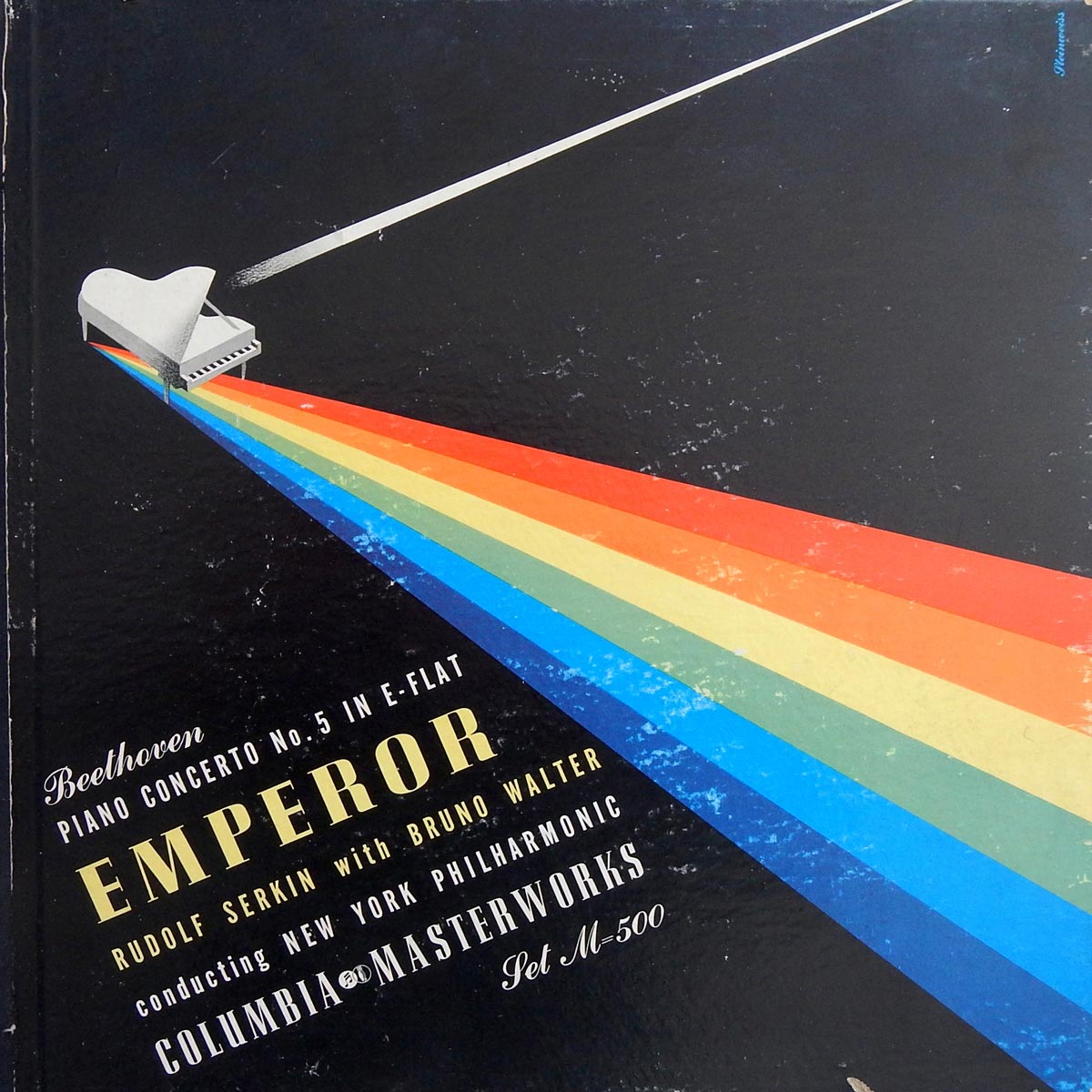
Interestingly, though, the Pink Floyd cover itself was inspired by an earlier cover classic – in which a white grand piano seems to float like a spacecraft in the darkness. The graphic designer Alex Steinweiss (1917–2011), who created it in 1942, is generally regarded as the inventor of the record cover as we know it. This was back when record “albums” really were albums: bundles of shellac discs. Beethoven’s Fifth Piano Concerto alone – with Rudolf Serkin at the piano and Bruno Walter conducting the New York Philharmonic – required no fewer than ten record sides. Each of the three movements was spread across several sides.
Incidentally, the reason Beethoven’s London publisher gave the concerto the name “Emperor” has never been fully established. The idea certainly did not come from Beethoven. He didn’t have many kind words to say about Napoleon ever since his coronation. Besides, as Beethoven was writing the concerto, Vienna was being occupied by Napoleon’s troops; the composer had to leave the city to escape the incessant noise. Perhaps his publisher simply wanted to suggest that this Fifth was the “emperor” among Beethoven’s piano concertos. In German, at any rate, the term Kaiserkonzert never caught on.
The Dark Side of the Moon, of course one of the best-selling albums in the history of recorded music, is generally considered a concept album. The conceptual thread, however – much like that of its successor, Wish You Were Here – is somewhat vague. It is somehow about the problems of modern life, and perhaps also about the band’s lingering guilt over the departure of their former member Syd Barrett.
The songs deal with the stress of flying (“On the Run”), the pressure of deadlines (“Time”), greed for money (“Money”), armed conflict (“Us and Them”), and mental instability (“Brain Damage”). The wordless “The Great Gig in the Sky” is supposedly about death – not exactly a modern theme.
In fact, the entire album is said to have been developed from this conceptual premise – as a kind of “sonic philosophy of the modern world.” The sound design was correspondingly ambitious: a heartbeat, snippets of conversation, laughter, ticking and shrieking clocks, airport announcements, the clinking of coins and the ringing of cash registers – all of it creates an almost claustrophobically vivid sense of reality. (The heartbeat came from the bass drum; the snippets of conversation came from the recording-studio staff.)
Technically, all of this was realized with extraordinary sophistication, using a 16-track machine, EMS synthesizers, reverberation effects, tape played backward, phasing and flanging, numerous crossfades, and even quadraphonic sound. The two instrumentals, “Any Colour You Like” and “On the Run” – with their deliberately technological use of synthesizers – are musical high points. The album’s hit “Money” stands out for its 7/4 sound loop and some of the record’s finest solos.
Another highlight is Clare Torry’s brilliant vocal improvisation on “The Great Gig,” for which she was fobbed off with £30. (Some 30 years later, she successfully fought for a share of the song’s royalties. Well done.)
Interestingly, many listeners also associate Dark Side of the Moon with outer space and science fiction. That is understandable: the moon in the title, the futuristic-looking prism, the universe-black background. Pink Floyd also cultivated that decidedly “spacey” image.
The later “quotations” of the prism cover frequently incorporate elements of outer space as well: stars and galaxies, a lunar surface, an astronaut. But the truth is that The Dark Side of the Moon is merely a metaphor in Pink Floyd’s title. The “moon” refers to the “lunatics” – the moon-struck, the crazy, the mentally disturbed. The album’s original subtitle was “A Piece for Assorted Lunatics.”
As an aside, of course, the moon doesn’t have a dark side. Its nighttime side is constantly changing, just as it does on Earth. What remains the same, however, is the far side of the moon – the side that never faces Earth. It has significantly more impact craters than the side protected by the Earth.
New York Philharmonic Orchestra: Emperor (Columbia, 1942)
Pink Floyd: The Dark Side of the Moon (Harvest, 1973)