
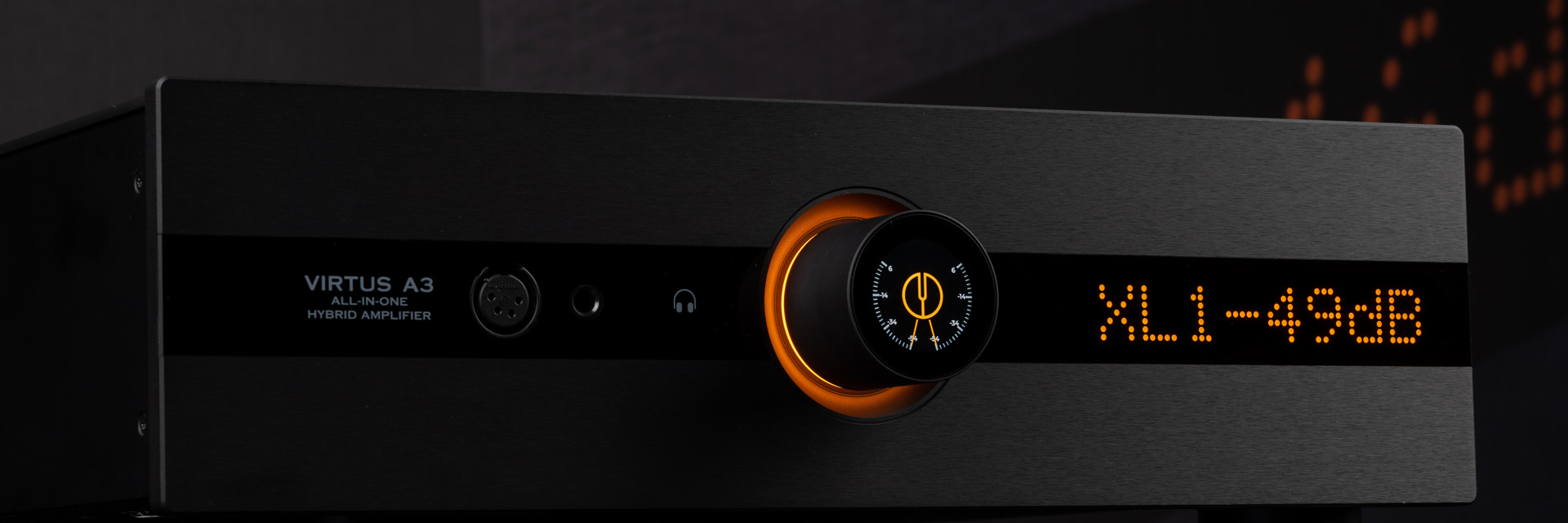
An amplifier should be powerful enough to drive any speaker you throw at it. And of course, it should meet audiophile standards. It should also sport a full feature set and fit neatly into a home environment. And through it all, it should remain reasonably affordable. If you can agree with modest list of requirements, you should definitely take a closer look at the Canor Virtus A3.
Founded in Prešov, Slovakia, Canor has developed since its beginnings in 1995 from a small manufacturing facility into a high-tech operation equipped with an ultra-modern machine park. In addition to its constantly expanding in-house portfolio, several well-known manufacturers also make use of its expertise and manufacturing capacity – the OEM business accounts for a substantial percentage of the company’s activities. Its high level of vertical integration makes Canor largely independent of suppliers. It goes without saying that the OEM business and its own product line benefit from each other. During a visit to the company, our editor-in-chief was given the opportunity to see this for himself; more on this can be found here.
At the latest since 2020, when IDC Klaassen Distribution added the Slovak products to its lineup, the devices have also become popular in Germany. The portfolio encompasses several product lines, all the way up to the exclusive Reference series. The integrated amplifier sent to us for testing, the Virtus A3, belongs to the mid-range Performance series. Until now, I had only known the components from trade-show demonstrations, which are usually of limited value. So I was all the more curious when Sales Director Uwe Kuphal delivered the amplifier to me. Thanks to its compact dimensions and weight (18 kg), “unboxing” it and placing it on my rack took only a few minutes.
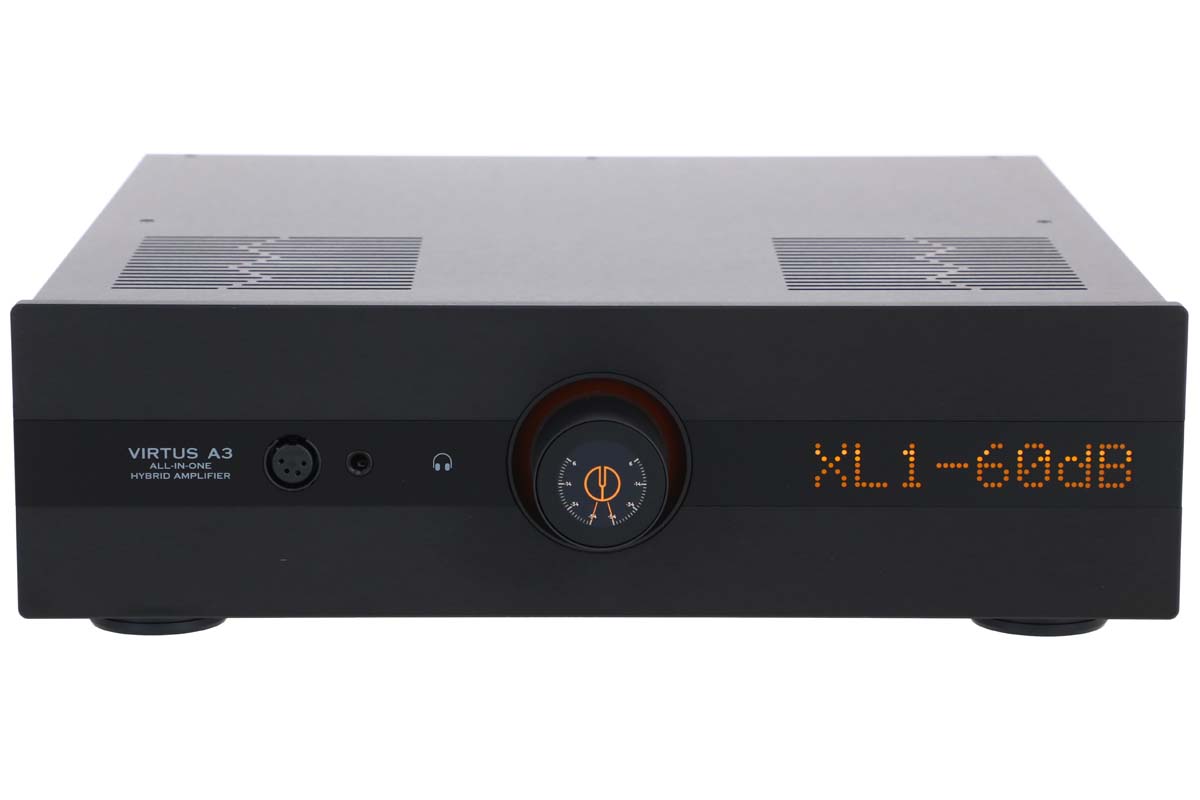
The A3 adopts the familiar Canor design language; in person, it looks even more premium than it does in photographs. The simple rectangular enclosure is broken up only by the centrally positioned, fairly prominent multifunction control. Neatly recessed Torx screws hold the black-anodized aluminum chassis together. A horizontal, glossy black strip is inset into the front panel. The headphone jack is located on the left, while a large dot-matrix display on the right shows the selected input and volume. The absolute highlight of the controls is the multifunction rotary knob.
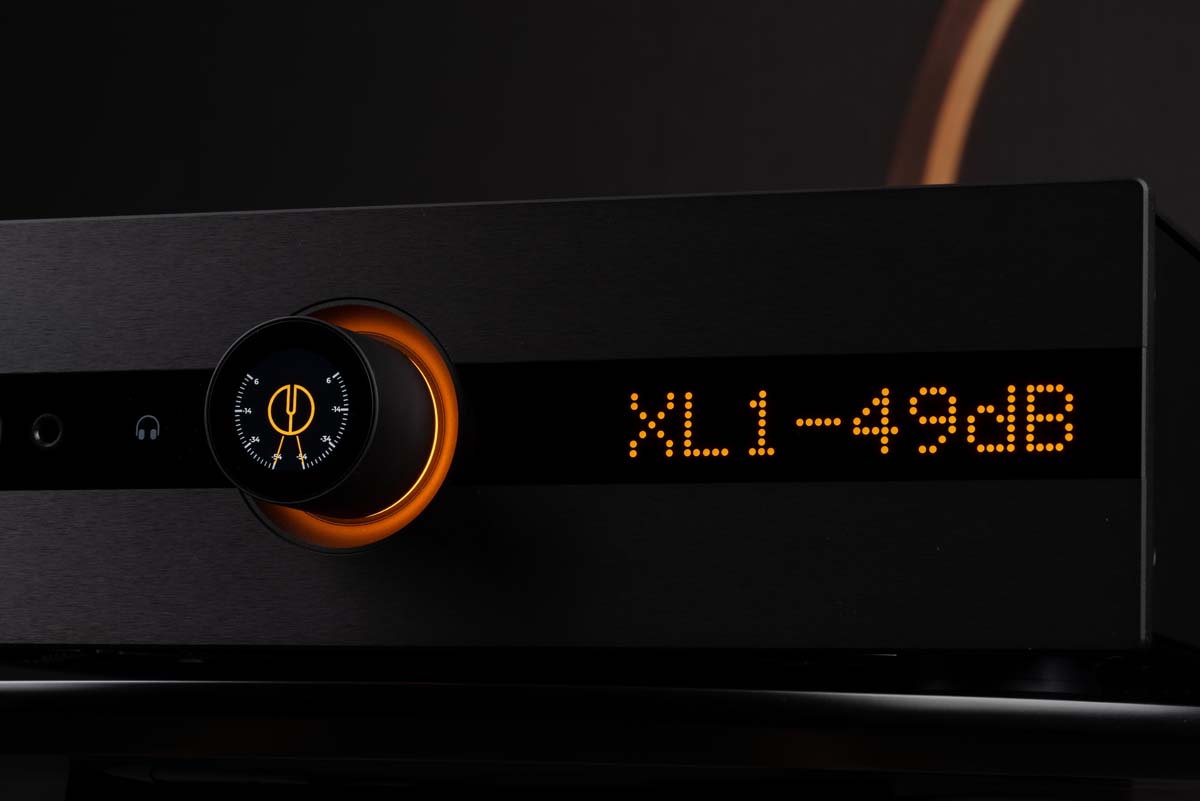
Almost all functions and parameters can be controlled through it. Guided in a dual-row bearing, the aluminum knob turns without any play, making it a tactile pleasure to use as well. Its front face is a touchscreen. My initial skepticism about this highly concentrated wealth of functions quickly disappeared. A brief look at the pleasantly concise and clearly laid-out owner’s manual was enough for me to operate this tool intuitively after a short time. Most switching operations can also be performed with the included remote control; it is simple in design, but its well-sized buttons make it easy to use.
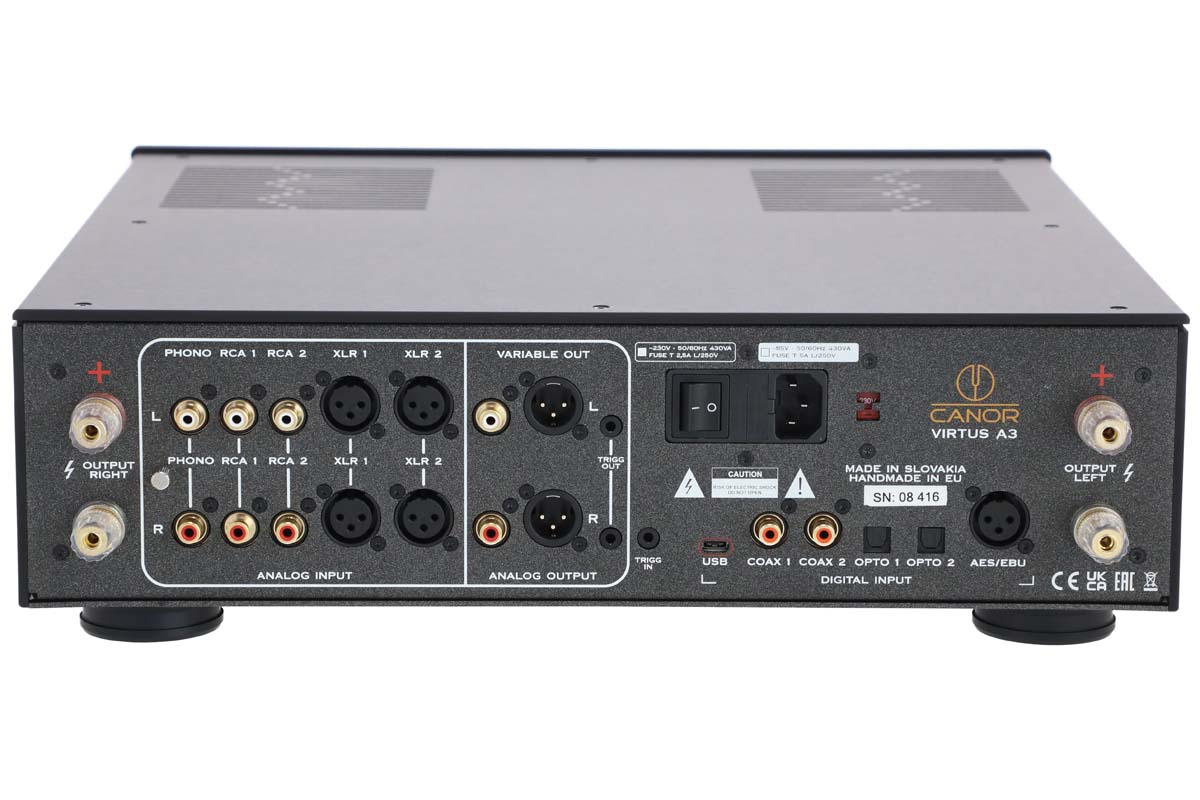
The rear panel of the amplifier is packed and well organized. The speaker terminals are located on the far left and right, exactly where they belong. The connection panels, arranged by function, leave nothing to be desired: an RCA phono input with grounding terminal, two pairs each of RCA and XLR line inputs, and one RCA and one XLR preamp output. Some inputs can be configured as a home-theater bypass with a fixed level. The A3 receives ones and zeros through a USB-C port, an AES/EBU input, and two optical and two coaxial inputs. The power inlet with fuse and hard power switch, along with trigger jacks, completes the connection panel.
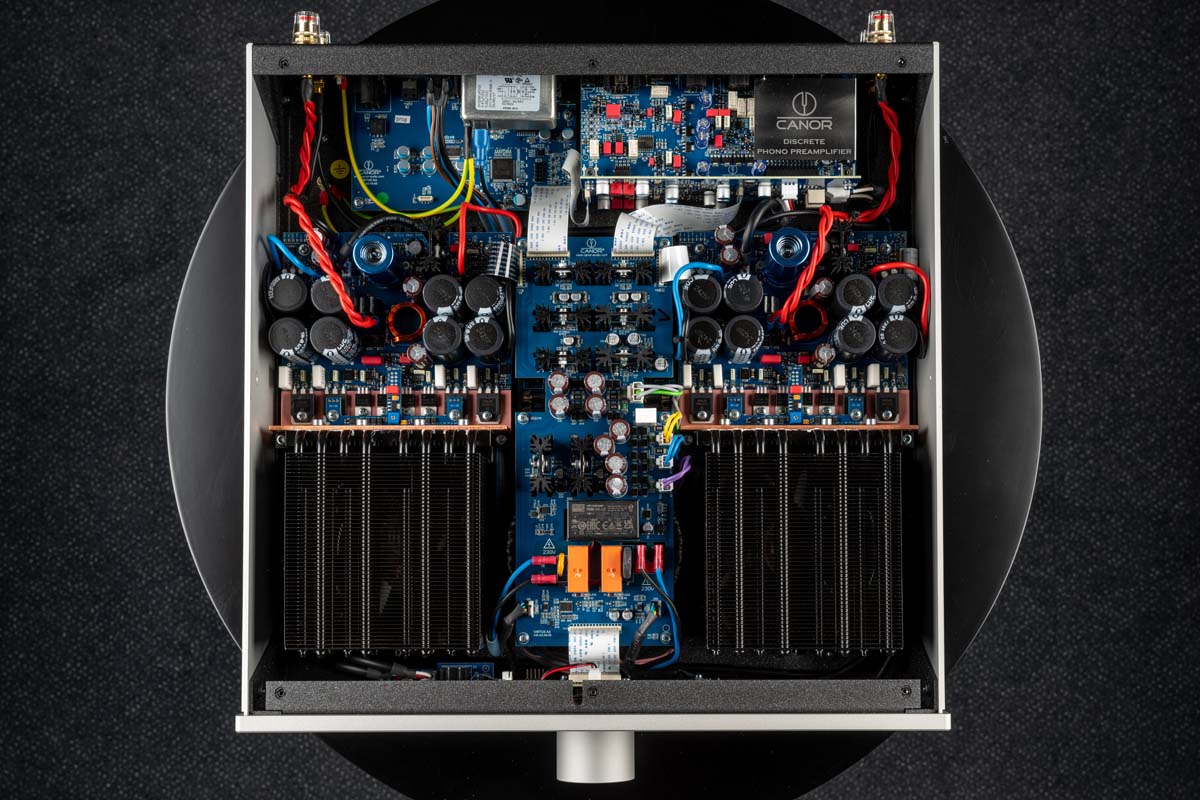
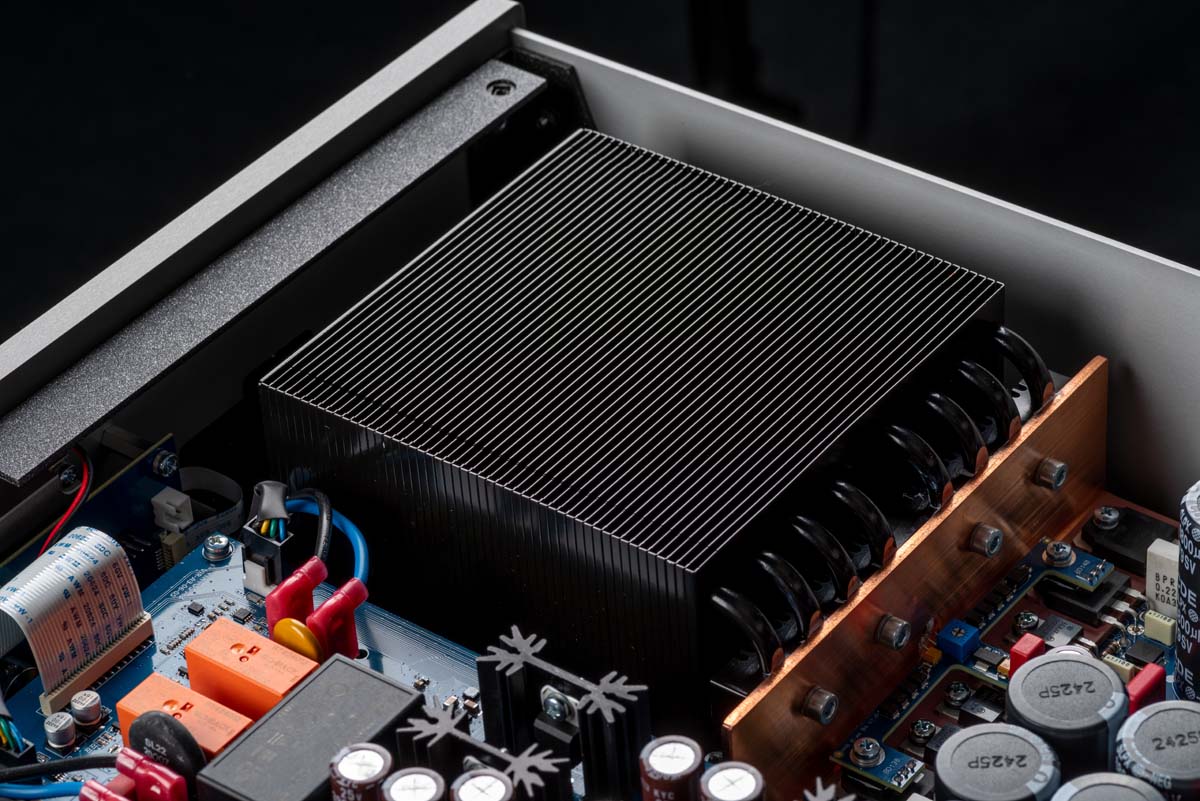
In contrast to its understated exterior, the A3 is filled to the brim with complex circuitry. This is partly due to its generous feature set, including a DAC, phono stage, and headphone amplifier, but also to the technical implementation of the amplifier section. According to the manufacturer, the hybrid amp uses a Current Dumping circuit developed by Peter Walker (Quad) in the 1970s and improved by Canor, combining the advantages of Class A operation with the power efficiency of a Class A/B amplifier. Two specially selected and carefully manufactured E88CC tubes provide the sonic character, while an array of solid-state devices supplies the muscle. To prevent the densely packed electronics from getting too hot, Canor’s engineers have taken an unusual approach: heat pipes, assisted by two precisely regulated fans, dissipate the heat. The display can show the fan speed and the temperature of both power-amplifier stages. The fans run virtually silently. Had I not read that they were there, I would never have known. The Virtus uses a fully dual-mono design throughout, including the DAC and phono stage. Even the Class A headphone amplifier follows this principle.
The extensive configurability demonstrates the manufacturer’s ambition to provide a phono stage worthy of the amplifier’s quality. MM cartridges can be amplified by 40 or 46 decibels, and MC cartridges by 60 or 66 decibels. For MM cartridges, the input capacitance can be selected from 50 to 400 picofarads. Input impedance values of 10, 50, 100, 1000, and 47 kilohms are available. These parameters allow most cartridges to be matched optimally.
The DAC consists of two ESS9038 chips; here too, Canor has selected a top-tier solution. It converts the data stream from virtually any source device into analog signals and offers a useful level adjustment feature by +3 or +6 decibels. This allows all analog sources to be brought approximately to the same volume level. It is unfortunate that this function is not available for the digital inputs. Unused inputs can be removed from the source-selection menu. Nine different filter settings are available for digital sources. I would have found it helpful if they had been explained in the owner’s manual, even though you can and should, of course, determine your favorite by ear. The Virtus A3 features an extensive safety system; malfunctions and overloads are displayed in differentiated ways. An unusual feature is the regular cleaning of the relay contacts. According to the manufacturer, all relays are triggered by various high-frequency signal sequences, which happens automatically every twentieth time the unit is switched off. The display can be dimmed or switched off completely. I find the soft orange hue of the display very appealing; it doesn’t permanently burn itself into your retina, yet remains easy to read.
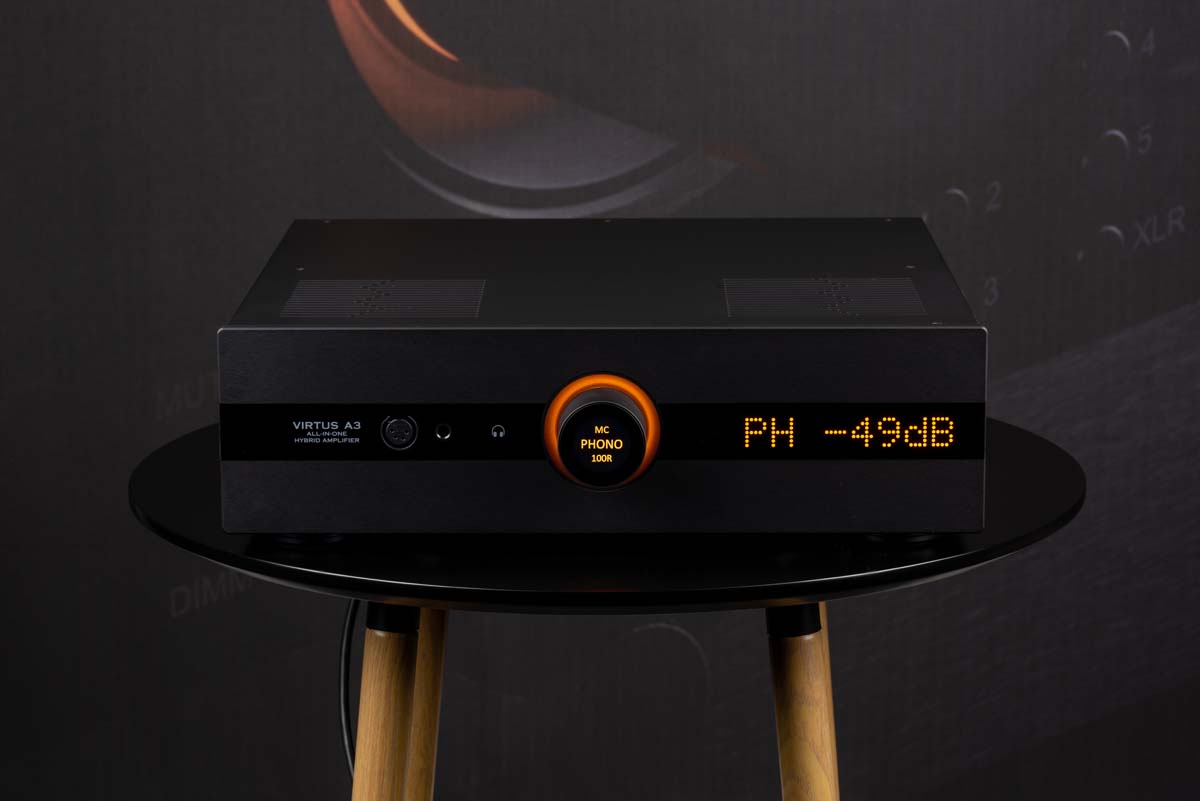
After the power switch is pressed, a red LED indicates standby mode. A brief touch of the touchscreen wakes the amp, and when I switched it on for the first time, I eagerly admired the light show (a ring of light moves clockwise around an image of a tube, indicating the tube warm-up phase). The Virtus A3 greeted me somewhat rudely with a hum in the right channel – the suspicion fell on one of the tubes. After consulting with Uwe Kuphal, I swapped their positions. I expected the hum to move to the left channel, but fortunately, after this change the amplifier was completely silent. This wasn’t the first time that a test unit stressed by the trade-show and review circuit had grown a bit grumpy. Now everything sounded quite good, but not yet particularly exciting. That was to change radically after a few days of acclimatization: I was amazed by the confidence with which the A3 constructed a perfectly organized soundstage. Against an absolutely quiet background, sonic events were clearly separated from one another and presented in believable dimensions. The result was an easy-to-follow, highly three-dimensional soundstage. This was particularly impressive with Hector Berlioz’s Symphonie fantastique in a recording by the Berlin Philharmonic. I was also able to follow the artificially generated spaces of pop productions without difficulty. A nostalgic trip back to the late 1960s and early 1970s became an evening-long pleasure with the Virtus. The amp drove Jimi Hendrix’s Electric Ladyland into the listening room with power and definition, exactly as it should. But it also handled the delicate tones of the folk-rock band America extremely well. That the A3 isn’t an outright beautifier despite its pleasing character became clear with Crosby, Stills & Nash: you can’t get around the fact that this is a hopelessly poorly produced record (at least my re-release of it). Everything I had heard up to that point reached my ears via the Ortofon MC X40 in the TW 12.9 and the internal phono preamp. I can only attest to the latter’s outstanding sound quality – to achieve a serious improvement, you would certainly have to spend quite a bit more money.
The same applies to the DAC, for which my Michi Q5 served as the source. I found the sonic differences between the various filter settings relatively small. Ultimately, I settled on the “Hybrid Filter.” I very much liked the A3’s ability to reproduce the instruments’ fundamental tonal character cleanly without obscuring it with exaggerated finger noises or disproportionate treble chatter. This balanced presentation feels and sounds pleasantly natural. Details are by no means omitted; they are simply embedded proportionally correctly within the overall context.
That, along with the spatial presentation already described, is in my opinion the reason for the Virtus A3’s pleasing sound. Although the amplifier, thanks to its fairly powerful output stages, is capable of filling a party with sound when paired with suitable speakers, I think it will appeal particularly to lovers of subtle sonic nuances and delicate tones. Its comprehensive feature set makes it the foundation of a high-end setup reduced to just a few components. Sonically, it has little competition in its price range. This is especially true because its phono stage, DAC, and headphone amplifier all perform at the same high level.
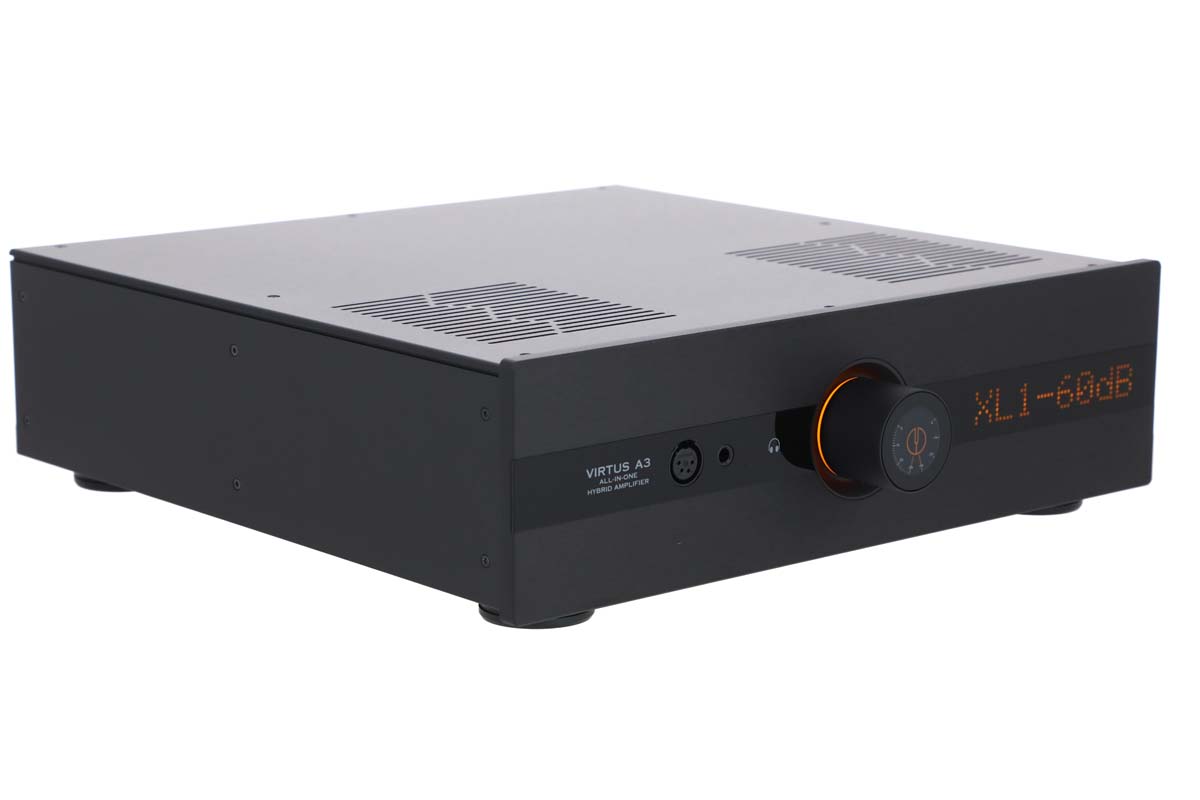
Integrated amplifier Canor Virtus A3
Concept: Hybrid integrated amplifier with built-in DAC and phono preamp | Analog inputs: 2 x RCA, 2 x XLR, 1 x phono (RCA) | Digital inputs: 2 x coaxial, 2 x optical, 1 x USB, 1 x AES/EBU | Analog outputs: 1 x RCA, 1 x XLR, headphone (6.3 mm) | Power (8 / 4 Ω): 2 x 100 W / 2 x 150 W | Frequency response (±0.5 dB @ 5 W): 10 Hz to 35 kHz | THD (1 W @ 1 kHz): < 0.008% | Signal-to-noise ratio (20 Hz to 20 kHz): 90 dB | Phono preamp (MM/MC): 40 to 46 dB / 60 to 66 dB | D/A converter: 2 x ESS9038 (dual-mono configuration) | Tubes: 2 x E88CC | Other: Remote control, trigger connections (12 V), home-theater bypass | Finish: Black or silver | Dimensions (W/H/D): 44/12/46 cm | Weight: 18 kg | Warranty: 2 years | Price: approx. €6,499
IDC Klaassen
Am Brambusch 22
44536 Lünen
Phone +49 231 22178822
idc@idc-klaassen.com