
Led Zeppelin were a legendary live band because they delivered something new and unexpected at every performance.
“As soon as a song was recorded and became part of our live set, it started to change,” Jimmy Page says. The songs grew longer and longer, while the improvisations became increasingly inventive. As a result, numerous illicit Led Zeppelin concert recordings, or bootlegs, circulated. If the band wanted to top those, it had to offer something truly special as a live document. That was the genesis of the idea for a concert film. In the summer of 1973 – when Led Zeppelin were regarded as “the biggest band in the world” – the idea of making a film suddenly became a reality within the space of a week. As the band’s U.S. tour drew to a close, they spontaneously contacted a director who was a friend of theirs. He quickly flew from England to New York with his film crew to capture the tour’s final three shows.
Jimmy Page recalls: “In America, we were always like we were unleashed. U.S. tours were the crème de la crème.” With the film crew now making its preparations, everything was building toward a climax. “It had become such a huge thing that an enormous sense of freedom developed,” says Robert Plant, the singer. “We were conquerors, ready to try anything.” The film became far more than a concert document. It opens with the band’s arrival, shows backstage scenes, and includes several staged sequences in which the musicians act out their fantasies: Jimmy Page as a mountaineer, John Paul Jones as a nocturnal horseman. And then there was a hotel theft complete with the New York police making an appearance … all while the cameras kept rolling.
The film was not completed until 1976. After Robert Plant’s serious car accident, the band was unable to perform concerts for months, but that gave them time to finish the film … along with the magnificent soundtrack album, which was released simultaneously but did not feature exactly the same musical selection as the film. “Celebration Day” appears only on the album; other songs appear only in the film. In some cases, the film and album also use different takes of the songs. “For me, the Madison Square Garden shows were a pivotal moment,” says Robert Plant. “Until then, I couldn’t have imagined the kind of energy that could flow between us and the audience.”
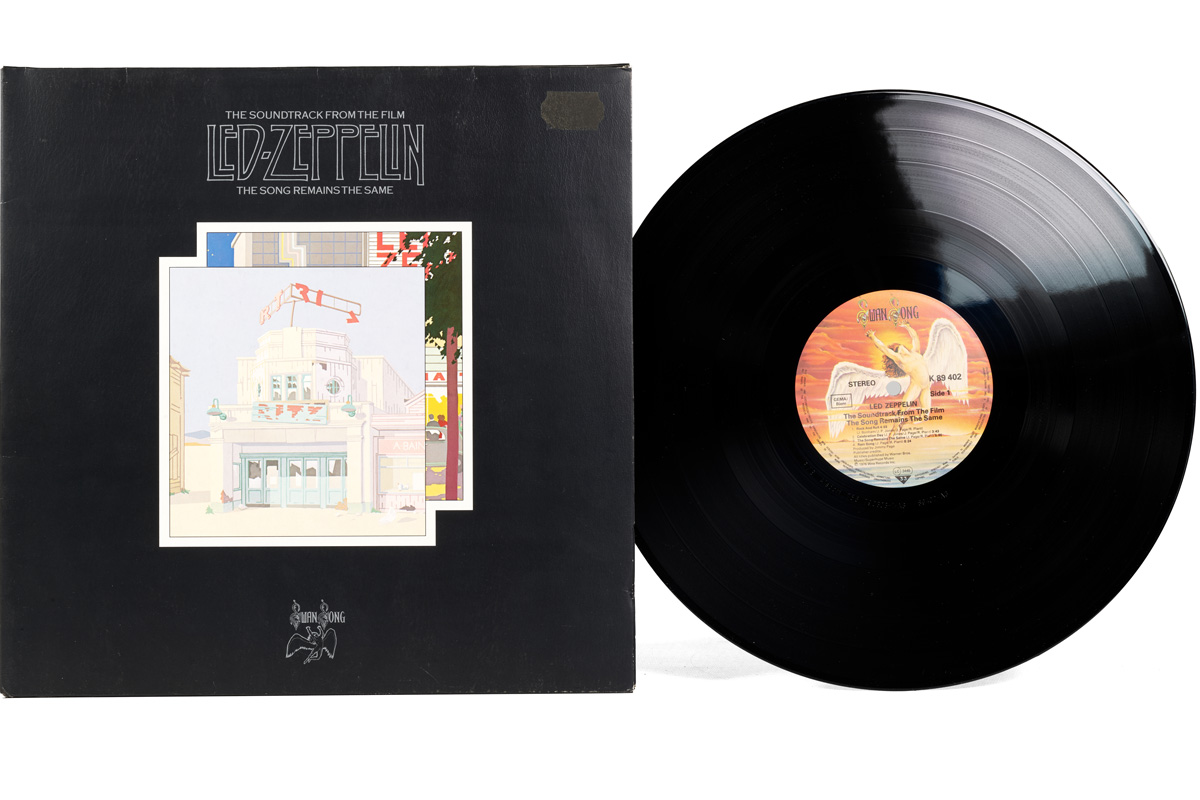
Led Zeppelin – The Song Remains The Same
Recording: August 1973
Release: October 1976
Label: Swan Song
Produced by: Jimmy Page
Tracklisting
Side A
- Rock And Roll 4:03
- Celebration Day 3:43
- The Song Remains The Same 6:00
- The Rain Song 6:24
Side B
- Dazed And Confused 26:53
Side C
- No Quarter 12:30
- Stairway To Heaven 10:58
Side D
- Moby Dick 12:47
- Whole Lotta Love 14:24
Musicians
Robert Plant – vocals
Jimmy Page – guitars, etc.
John Paul Jones – bass, keyboards
John Bonham – drums
Commentary and Trivia
- The performances at Madison Square Garden are recorded with a mobile recording studio. It is the legendary studio truck belonging to recording engineer Wally Heider (1922–1989), which he originally outfitted for big-band recordings.
- The soundtrack album features live versions of songs from all five of the band’s previous studio albums. Three tracks alone come from the most recent album, Houses Of The Holy.
- Some of the live versions – especially the earlier songs – bear little resemblance to the studio recordings. “Whole Lotta Love” (complete with a theremin passage) and “Moby Dick” (with its drum solo) run almost three times as long in concert. “Dazed And Confused” – “the 30-minute madness” (Rolling Stone) – takes the prize.
- Robert Plant on Led Zeppelin’s intoxicating flow in 1973: “An absolute mixture of adrenaline, drugs, euphoria … and there were no brakes. We had no idea what was actually happening. We just kept going, charging ahead, at every show.”
- The gatefold cover of the double album depicts an old movie theater in London. The band rehearsed there before their 1973 U.S. tour.
- The film project proceeds in fairly chaotic fashion. Even the director in charge is replaced during production. Some concert scenes are later recreated in London – partly with a wig, because John Paul Jones has changed his hairstyle.
- The film acquires some additional drama when the band is robbed at its New York hotel (nearly $200,000). The manager gets into a confrontation with a reporter and is arrested. “I’m still asked whether the theft was staged to add some drama to the film” (Jimmy Page).
- Late 1976 is hardly an ideal time for the release. Punk is raging in England, while Led Zeppelin are being dismissed as “dinosaurs” and tax exiles. The somewhat labored feature film flops. The powerful live album, however, reaches No. 1 on the UK charts. Four-times platinum in the U.S., gold in Germany and France.
- The sonically improved 2007 CD reissue contains all 15 songs from the live program and receives enthusiastic reviews. The DVD edition of the film is unchanged in terms of its editing, but the refreshed soundtrack is better synchronized with the images.