

He recorded his first song when he was 18—supposedly it was meant to be just a birthday gift for his mother.
But perhaps it was no coincidence that the young man chose the studio of a record company specializing in African American blues singers for the recording. When a producer there noticed how well he handled blues and rhythm, the young man was promptly offered a recording contract. His version of Arthur Crudup’s “That’s All Right” became a radio hit in Memphis and led many listeners (including Black audiences) to assume he himself was Black. Not for nothing was Arthur Crudup one of his role models. Not for nothing had he attended plenty of events in Memphis labeled “Colored Night.” “Nobody can sing this kind of music like Black people,” he once said. No white performer before him had brought such a dynamic and provocative style to the microphone. “Elvis opened the door for Black music,” Little Richard once remarked.
Elvis Aaron Presley, the King of Rock and Roll, became one of the most successful musicians in pop history. His provocative singing, sex appeal, showmanship, and good looks made him a teenage idol. On American television, he soon flaunted his cocky pompadour, his crooked, teasing grin, and his suggestive hip movements (“Elvis the Pelvis”). The wholesome world of the American mainstream found him scandalous. When Bill Haley unleashed rock ’n’ roll on the world in 1954, Elvis Presley was right there from the start. In 1956, the major label RCA signed him. Songs like “Don’t Be Cruel,” “Hound Dog,” “Blue Suede Shoes,” and “Tutti Frutti” made him world-famous.
In 1959, while he was serving in the military in Germany and unable to record new material, his fourth compilation album was released. Since RCA had sold 50 million Elvis records by then, the album was titled 50,000,000 Elvis Fans Can’t Be Wrong.
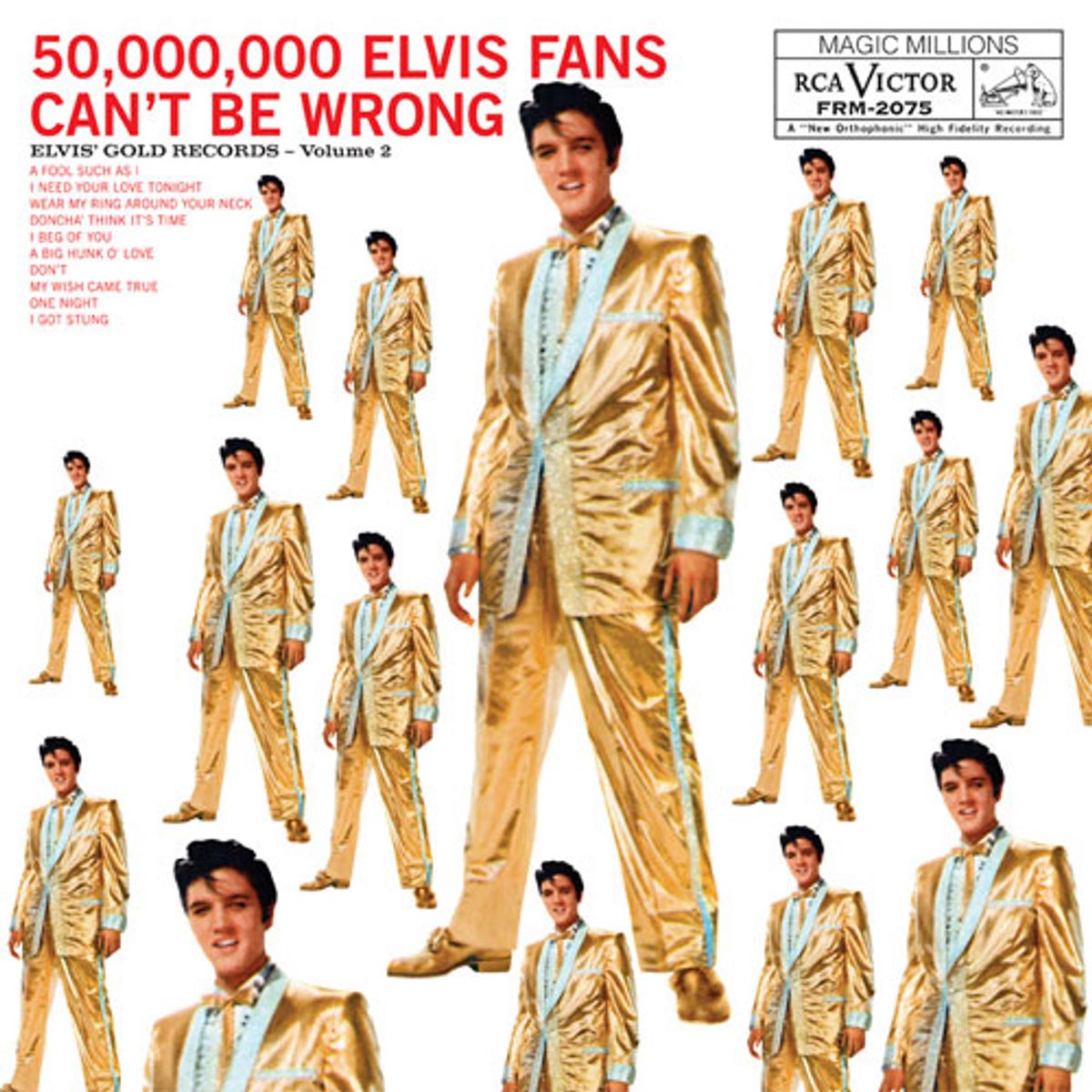
The idea that 50 million people couldn’t be wrong was already a common phrase in the U.S. at the time, at least since the 1927 song Fifty Million Frenchmen Can’t Be Wrong, a love letter to Paris and its liberal ways. The Elvis album brings together ten “Gold Records” from 1958 and 1959. The ballads with a gospel and doo-wop touch—like “Don’t,” “My Wish Came True,” and “One Night”—barely reach the two-and-a-half-minute mark. The upbeat rhythm numbers like “I Got Stung” and “I Beg of You” come in at under two minutes. Most of the tracks are typical rockabilly—rock ’n’ roll with country-leaning melodies. At times, the blues comes through more strongly, usually complemented by a B section. The song closest to Black R&B is “A Big Hunk O’ Love,” where two guitar breaks extend the vocal verse to 14 bars. Guitar and piano each get a 12-bar solo. Hank Ballard, Chet Atkins, and Floyd Cramer are among the musicians featured.
The album cover, showing multiple images of Elvis in a gold suit, became iconic. Other stars later “quoted” it on their own album covers, including Rod Stewart (Body Wishes) and Bon Jovi (100,000,000 Bon Jovi Fans Can’t Be Wrong). German jazz saxophonist Sandra Weckert showed humor and self-irony with her album title 50 Sandra Weckert Fans Can’t Be Wrong (2002). At the time—still not yet 30—Weckert already had a much larger following in the jazz world. Her debut album Way Out East had swept through the German jazz scene like a breath of fresh air—bold, virtuosic, and satirical. One might ask: provocative like Elvis? Her second album, produced by a “fan” at a public broadcaster, was described by jazz critic Wolf Kampmann as “a spirited tour de force” through jazz styles, but also “a lively radio play.”
The instrumental pieces on 50 Sandra Weckert Fans Can’t Be Wrong are brilliant miniatures, blending stylistic elements of cool jazz, free jazz, and funk jazz. In between are comedic parodies of German radio programs and their struggles with jazz music (“Bar Jazz with Bibo Mentär” and “What Music Does the Radio Play?”).

Both the music and the parodies echo the satirical, contrarian spirit of Charles Mingus and Archie Shepp. At times it’s freaky, dadaist, over-the-top—certainly far removed from the usual deadly seriousness of German jazz. Sandra Weckert herself said: “I like being a freak.” The magazine Jazz thing praised the fantastic melodic lines, the anarchic counterpoint, the perfectly imperfect notes, the ironic wink, and the cabaret-ready send-ups. The album also features several Berlin jazz standouts, including Daniel Erdmann, Kalle Kalima, Jan Roder, and Oliver Steidle.
Finally, a word about the blue smock worn by Weckert’s fans. Sandra Weckert herself wore such a housecoat (along with a headscarf and rubber boots) on the cover of her debut album Way Out East—and it became her trademark. She even sent these smocks out to journalists as promotional gimmicks, explaining: “Jazz is more than just head music. For me, it’s a total experience: marketing, selling, packaging, the band on stage, communicating with the audience. Music is like going out to eat.”